

Hospitality Software Quote Comparison: Calculate the Complete Cost
· Yiannis Yiasemis

The lower monthly subscription can produce the higher first-year bill. A £30 monthly difference is only £360 across twelve months, which setup, equipment or training can readily outweigh. Your hospitality software quote comparison should put matching working requirements and the complete cost on the same page before you decide which proposal offers the better value.
Jasmine Apps offers individual products and packages that can combine several hospitality workflows. The useful buying question is which documented scope fits your venue, what it costs to establish and run, and what you can demonstrate before committing. You can make a strong cost case without claiming one provider is cheapest for every business or treating another supplier's entry price as a complete equivalent system.
Key Takeaways
- Define a matching working scope before comparing prices.
- Separate one-off, recurring and usage-based costs.
- Compare first-year and renewal horizons.
- Check package limits and add-ons in writing.
- Keep time value distinct from an actual expense reduction.
Begin hospitality software quote comparison with a written scope
Describe the work your venue needs the proposal to support. Include locations, users, rooms, tills, relevant transaction volumes and the ordinary workflows you intend to run. A restaurant booking system for one venue is not automatically comparable with an offer that includes several venues, staff records and a document-signing archive, even if both use the same simple monthly headline.
Write representative scenarios with a completion condition. You might require a guest booking, an amended order, an approved timesheet and a signed event document that the next colleague can locate. The supplier should identify what is included, what needs configuration or an add-on and what remains outside the proposal, giving your manager a working scope rather than a collection of similar feature names.
Separate required capabilities from useful future options. Your first comparison should show the minimum complete system for the actual buying decision, with optional extensions priced clearly. Otherwise one quotation can appear more expensive because it includes services you have not yet decided to use, while another seems cheaper only because an essential handover was left out of the discussion.
Use your existing all-in-one hospitality software article for the wider workflow argument. This quote method supplies the purchasing discipline behind it: ask each provider to respond to the same scenarios and limits. You can then distinguish a legitimate difference in service from a price difference that exists only because the scopes do not match.
Keep unresolved items visible rather than filling them with optimistic assumptions. If a supplier has not confirmed hardware compatibility or an export requirement, mark it for demonstration or written response. Your comparison should help you choose confidently after those questions are answered, not create a precise-looking total that quietly assumes every missing item is free, automatic or unnecessary.
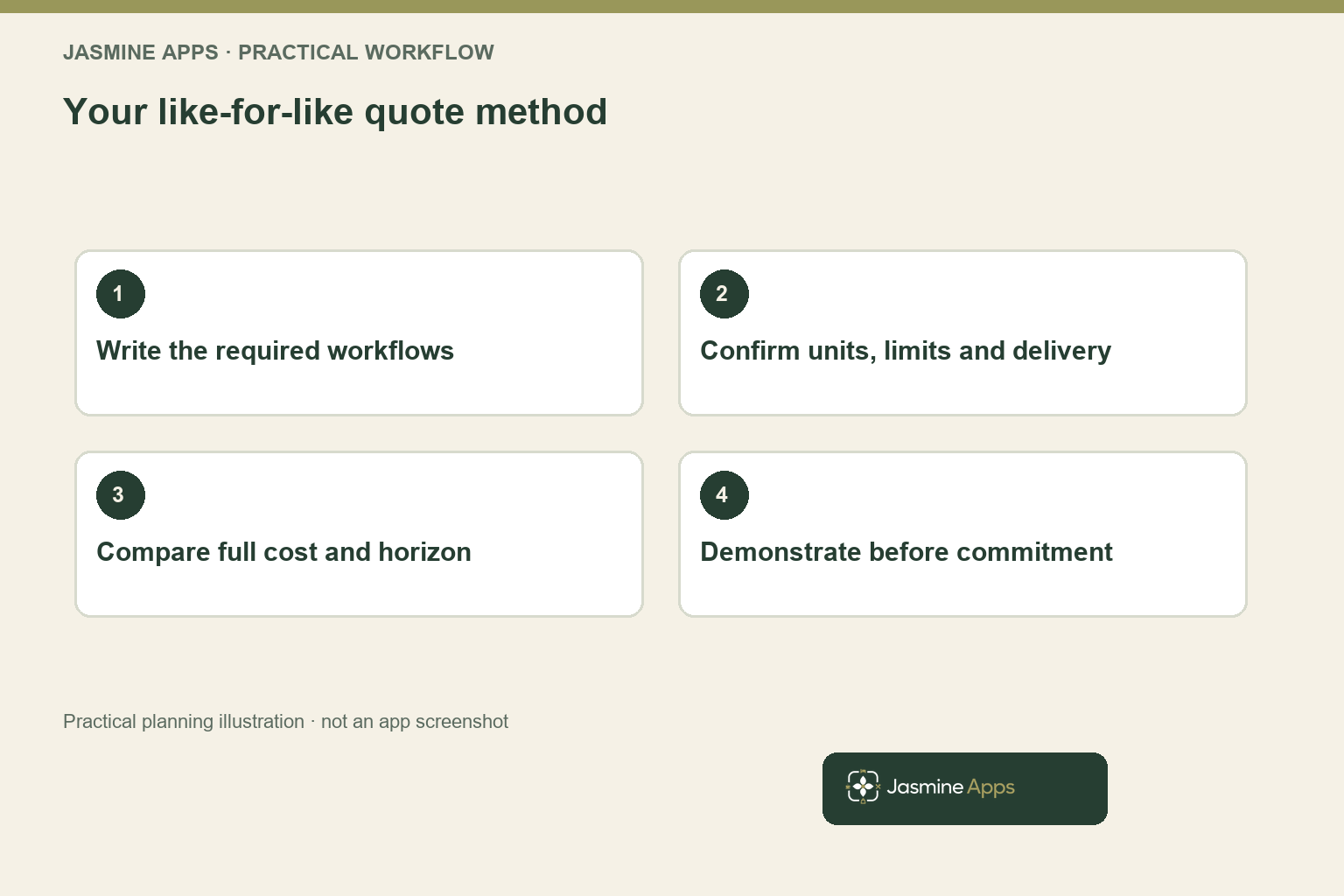
Use hospitality software quote comparison to separate cost types
Create distinct lines for subscription, implementation, hardware, training, support, payment arrangements, usage and exit. Identify which are one-off, recurring or conditional on volume. Your manager should be able to see what the venue pays to start, what it pays during ordinary use and what changes if the operating pattern grows beyond the quoted assumptions.
Check the unit on every rate. Per venue, employee, room, device, member and document are different charging bases, and a monthly minimum can change the calculation for a small business. A headline amount cannot be multiplied sensibly until you know the billable unit, minimum, applicable tier and how the contract treats changes during the period.
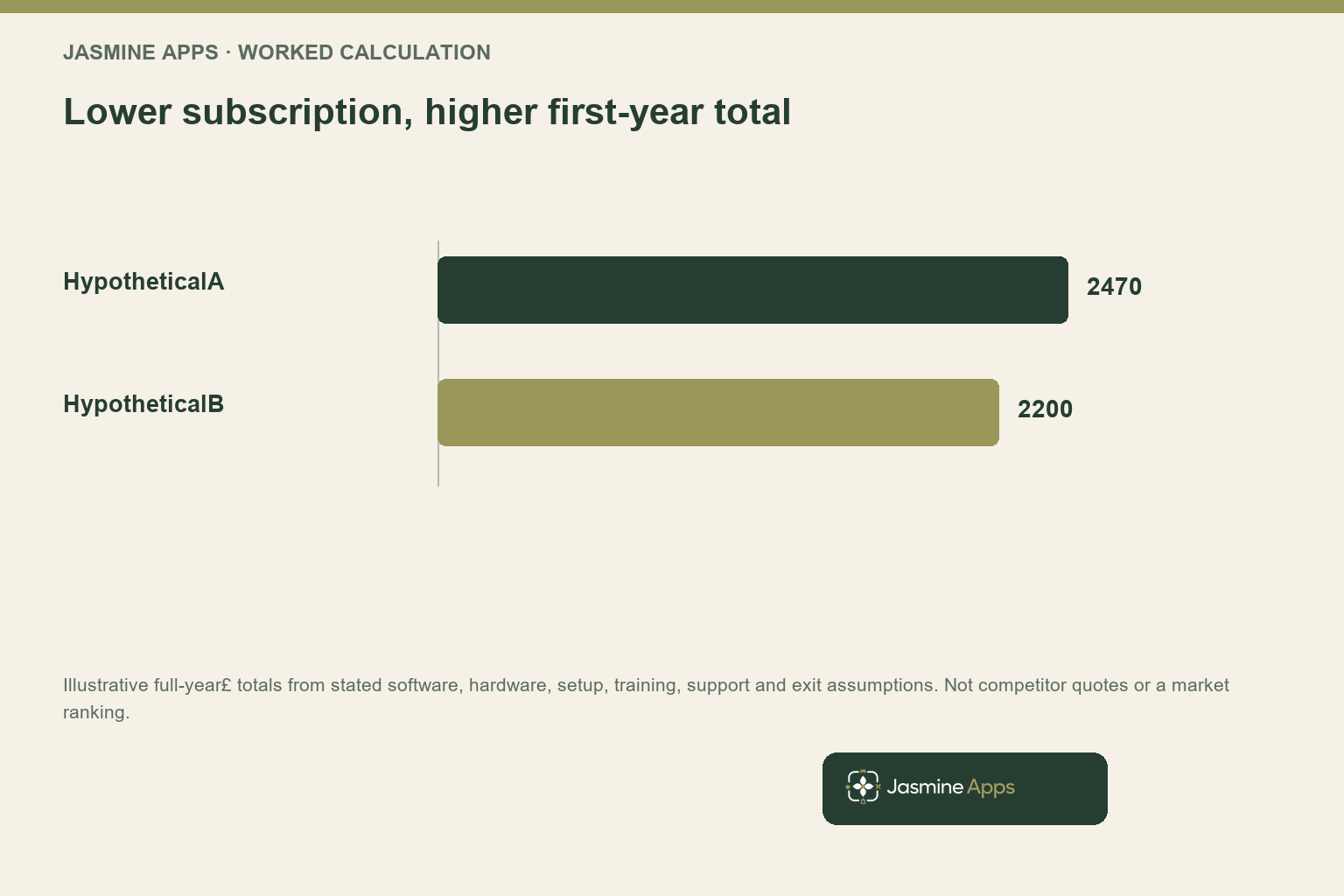
For a hypothetical proposal A, assume £120 monthly software, £400 hardware, £250 setup, £180 training, £120 annual support and £80 planned exit provision. The twelve-month total is £2,470. None of these figures describes a real competitor; they show how a lower subscription can sit alongside other costs that materially affect the complete comparison.
For hypothetical proposal B, assume £150 monthly software, £100 hardware, £100 setup, £120 training, no separate support charge and the same £80 exit provision. The first-year comparison is £2,200, or £270 less than A despite the higher monthly rate. Confirm that the support and equipment scope genuinely match before treating that arithmetic as a value conclusion.
Use a consistent tax basis and state whether relevant VAT is recoverable for your business, with your accountant's advice where needed. Separate refundable deposits from expenses and financing payments from the asset cost where appropriate. Your comparison becomes more useful when each line has a defined treatment, avoiding the common mistake of adding incompatible numbers simply because they all appear somewhere on a quotation.
Test hospitality software quote comparison across renewal and growth
Your first-year winner may differ from the lower-cost renewal option. In the hypothetical example, proposal A's recurring software and support total £1,560 annually, while B's software totals £1,800 under the stated assumptions. A is £240 lower on that recurring comparison, so the relevant buying horizon and complete renewal terms matter to the decision.
Check commitment, renewal, notice, price-review and cancellation terms in the actual contract. Do not assume a published annual rate can be cancelled monthly or that a trial establishes the same terms as the final order. Your manager needs to know the period they are committing to and the practical cost of changing the scope if the venue's requirements evolve.
Model a realistic growth case rather than an unlimited maximum. Your staff count may rise seasonally, membership may move to another tier or a second venue may require a separate charge. Ask how those changes are measured and billed, whether reductions take effect immediately and what happens to configuration or data if you move back to a smaller plan later.
Keep the complete operational effect visible. Another till may need equipment and training as well as a subscription change, while another room screen may depend on hardware compatibility and installation. A shared product name does not mean every extension has the same setup cost or that a bundle automatically includes an unlimited number of each connected component.
Use the second-venue readiness framework for the delivery dependencies when expansion is relevant. Your quote comparison should show the current scope, the plausible next stage and the assumptions behind each. You can then choose a commercially suitable route without buying speculative capacity or overlooking a predictable threshold that changes the cost shortly after launch.
Compare Jasmine Apps individual prices with the right package limits
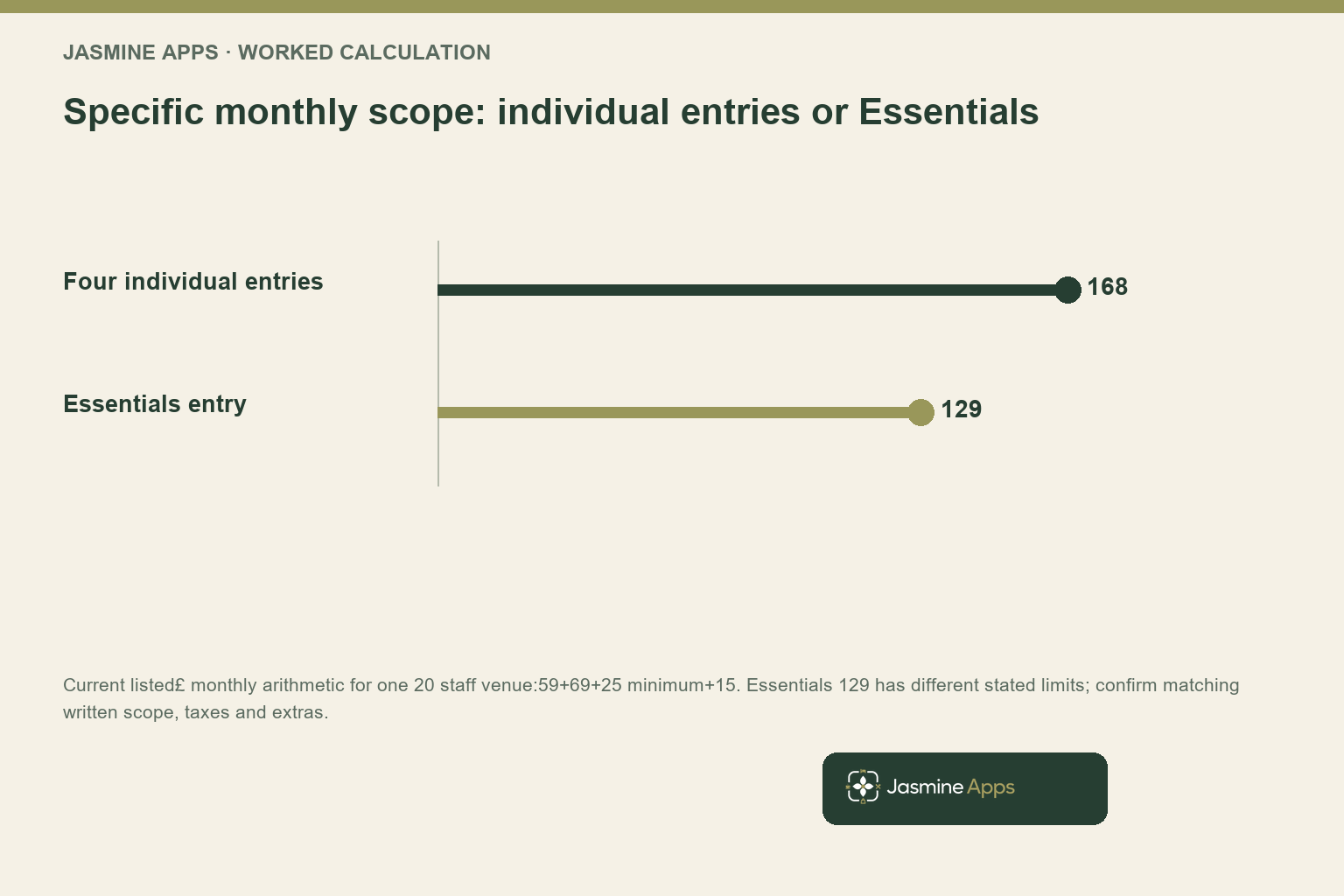
For a single venue using the currently listed monthly entries, Till Jasmine is £59, Table Jasmine £69 and Sign Jasmine £15. Clock Jasmine is £1 per employee with a £25 monthly minimum. A hypothetical twenty-person venue using those four entries would therefore compare £168 monthly before other applicable scope, setup and tax, because the Clock minimum applies.
Essentials is currently listed at £129 per venue monthly, including one till, Table Jasmine up to five hundred bookings, Clock Jasmine up to fifty staff and Sign Jasmine. Against the specific individual example, the arithmetic difference is £39 monthly, or £468 across twelve monthly payments. That difference is useful only if the package's written limits and delivered scope fit the same requirement.
Confirm the period and treatment of the booking limit rather than inventing one. The current description says up to five hundred bookings but does not establish every condition needed for your operating forecast. Ask how counts, overages, extra tills and seasonal staff are handled, and include the required Table extensions separately where they are not part of the agreed package.
Complete is currently listed at £249 per venue monthly, adding the described Maintenance, Loyalty and Marketing scope, unlimited Table bookings and Clock up to seventy-five staff. Confirm the Loyalty member treatment, email delivery, current product availability and any TV or kiosk requirement separately. The entry description should become a matching written proposal, not an assumption that every possible Jasmine service is included.
Annual package entries are £1,290 for Essentials and £2,490 for Complete. Compare those with the actual annual terms and required services, including minimum treatment, rather than mixing annual discounts with monthly cancellation assumptions. A clear product demonstration scorecard can verify the working scope before you decide whether individual products or a package offer the better fit.
Ask about the costs of implementation, integration and exit
Your implementation scope should say who prepares data, configures the products, tests the setup and trains the relevant colleagues. A supplier may include some work while expecting your team to complete the rest. Both arrangements can be reasonable, but your comparison should account for the internal capacity and any external fees needed to reach the same working outcome.
Check each important integration as a specific data handover. Ask which records move, in which direction, how often, with what permissions and what happens when the transfer fails. A shared login or common customer name does not establish every live integration you need. Demonstrate the actual scenario before valuing the connection as a dependable reduction in administration.
The government cloud lock-in guidance supports considering portability and the cost of switching. Apply that principle to your venue by asking how records, attachments and configuration can be obtained in a usable form, what assistance costs and how long access remains available. An export label alone does not establish that another system can interpret the relationships correctly.
For personal data processed on your behalf, the ICO controller-processor contract guidance is a relevant reference for appropriate contractual responsibilities. Use current guidance and professional review for your circumstances, keeping commercial exit costs and data-protection obligations distinct. Do not assume a broad ownership slogan answers the practical questions about retention, return and deletion.
Include the agreed exit and transition arrangements in the written scope before purchase. Your data exit-plan article provides the operational checklist. A suitable provider can still be the right choice when switching has a cost, provided your manager understands that dependence and the proposal gives the venue a realistic route to maintain its records and service.
Make the final value decision from evidence and a transparent horizon
Once the required scope is confirmed, compare the complete cost over the horizon relevant to your decision. Show first-year, recurring and realistic growth cases separately, with the assumptions and unresolved items visible. Your manager should trace each number to a quote, contract or internal estimate, with the calculation explained.
Assess benefits with the same discipline. A quicker rota process may release manager capacity, while a lower subscription reduces a cash expense. An improved booking route may support more fulfilled demand, but additional sales require evidence and contribution after relevant costs. Keep those different outcomes separate so a useful operational improvement is not weakened by an exaggerated financial claim.
Prioritise requirements that cannot be traded away for price. Your venue needs appropriate security, legal suitability, reliable service and access to the records required for its operation. A weighted commercial score can help compare suitable proposals, but a strong average should not hide a critical workflow failure or an unanswered question that makes the installation unsuitable for the role it must perform.
Do not claim Jasmine Apps or another provider is cheapest for every business from published entry rates. Those prices do not establish the total cost of delivering your exact reservations, staff, signing, maintenance, loyalty, marketing and TV requirement through another supplier. Matching written scopes and the relevant full costs are needed before making a specific like-for-like comparison that a decision-maker can rely on.
Your final recommendation should explain the chosen scope, the cost horizon, the tested workflows and the main dependency. That is a stronger sales case than a universal superlative because it shows how the proposed system fits the venue in front of you. You can then commit with a clearer view of what you are buying, why it is worthwhile and which terms govern the next stage.
Pro Tips
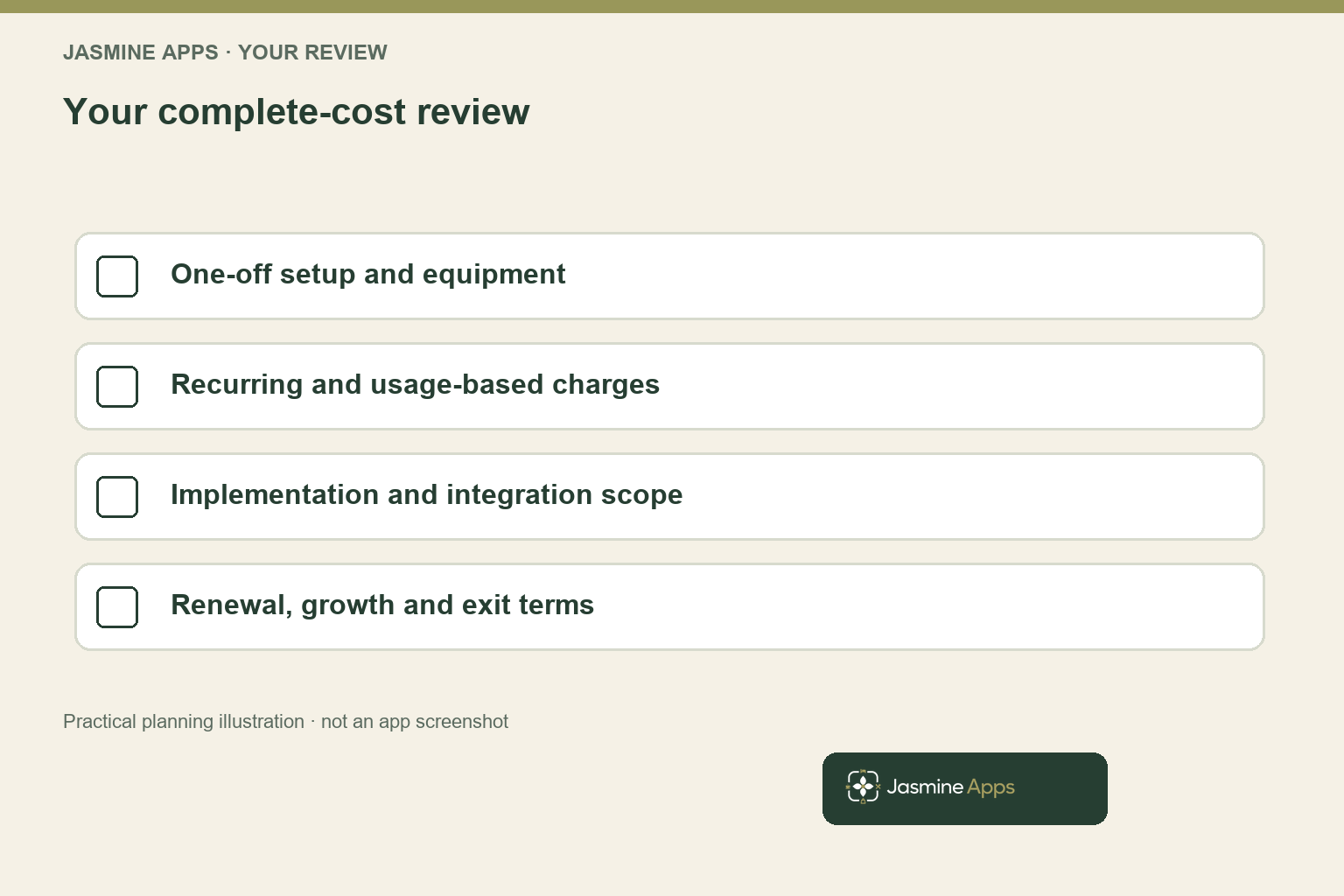
Compare the renewal year. Show recurring costs separately from implementation. The lowest first-year total and the lowest ongoing total can belong to different proposals.
Price your internal work. Estimate the staff capacity needed for data preparation, configuration and training. Keep its planning value separate from cash fees while acknowledging the resource requirement.
Require the same scenario. Give each supplier one written completion test for the important handover. Similar feature names are not enough to establish equivalent delivered scope.
Common Mistakes
Comparing entry prices as complete systems. You can omit essential limits, add-ons and equipment. Obtain matching written scopes before ranking cost.
Mixing annual and monthly assumptions. You create a saving that may require a different commitment. Compare the relevant contract horizon and cancellation terms consistently.
Calling all time saved cash saved. You overstate the financial return when paid expense remains unchanged. Distinguish capacity released from an expense actually reduced.
Frequently Asked Questions
How do you compare hospitality software quotes fairly?
You define a matching working scope, ask each supplier to respond to the same scenarios and separate one-off, recurring and usage-based costs. Keep billable units, minimums, tax treatment and contract horizon consistent. Demonstrate critical workflows and identify unresolved assumptions before ranking totals. Your recommendation should explain the complete first-year and renewal position, with the benefits supported by evidence rather than treating a low subscription as proof of the lowest complete operating cost.
What costs should you check beyond a restaurant software subscription?
You should check equipment, setup, data preparation, configuration, training, support, payment arrangements, usage limits, integrations and exit assistance where relevant. Identify which costs are included, optional, recurring or dependent on volume. Your own team's implementation capacity also matters, although its planning value is not automatically an extra cash fee. Ask for the required scope in writing so a missing line does not quietly become an assumption that the work or service is free.
Are Jasmine Apps packages cheaper than buying products separately?
You can calculate a difference for a specific matching requirement using the current listed prices, but you must confirm the package limits and full terms. Essentials includes one till, a stated Table booking limit, Clock up to fifty staff and Sign; Complete has a different described scope. Your required extensions, equipment, product availability and tax may affect the result. Compare the written proposal for your venue rather than assume every bundle includes every service or is always the lowest-cost route.
Is the cheapest monthly software always the best value?
You should compare the complete cost and suitable working scope over the relevant period. A lower monthly price may be accompanied by higher implementation, equipment or support charges, while a higher entry rate may include services you would otherwise buy separately. Renewal and growth can change the comparison again. Your decision should also require critical workflows and appropriate safeguards to pass, because an unsuitable system is not made good value by a small headline saving.
Can you prove a provider is the cheapest from website prices?
You cannot establish a universal cheapest claim from entry rates alone. Published prices may describe different users, limits, equipment, support and commitments, while your exact multi-product requirement may need a tailored quotation. Obtain matching written scopes and complete costs for the relevant horizon before making a specific comparison. Your buying case can still be persuasive by showing the verified cost and demonstrated benefit for the venue, without extending that evidence into a market-wide claim it does not support.
Hospitality software quote comparison: your next step
Your hospitality software quote comparison should make the complete buying decision clearer. Request a scoped Jasmine Apps quotation with your venues, staff, rooms and three essential workflows. You can compare the relevant products and package limits against a written delivery plan, then choose the cost and commitment that fit your operation.