

All-in-One Hospitality Software: Lower Costs, Connected Workflows
· Yiannis Yiasemis
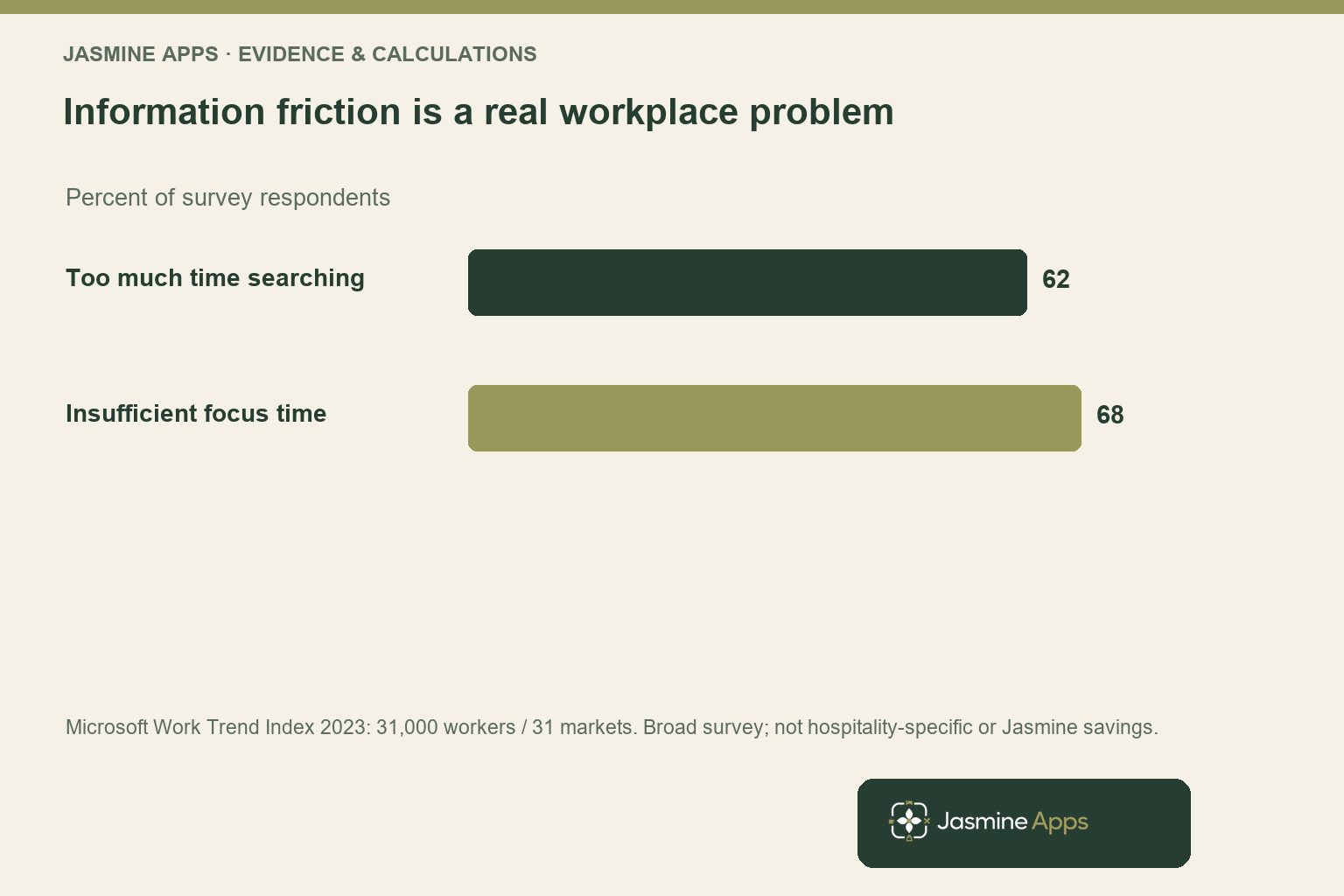
In Microsoft’s 2023 Work Trend Index, 62% of respondents reported spending too much time searching for information. Your venue may recognise the problem when a booking detail, staff record or approved offer sits somewhere nobody can quickly find. Your all-in-one hospitality software should make that work easier to complete, rather than simply put more icons behind one login.
The research covered 31,000 workers across 31 markets, highlighting a familiar workplace frustration: information is available, yet finding it takes too long. For your hotel or restaurant, the opportunity starts with the everyday handover. Jasmine Apps brings shared guests, staff and venues into its Essentials and Complete bundles, giving you a coordinated foundation for the tasks that keep your venue moving.
Key Takeaways
- Your buying decision should compare a complete operating scope, not a basic POS headline.
- Essentials is listed at £129 per venue/month; Complete at £249.
- At 75 staff, six relevant standalone apps total £316/month before Loyalty.
- Direct app connections and staff-led handovers should be demonstrated separately.
- Time released is useful capacity; a cash saving needs an actual expense reduction.
Why all-in-one hospitality software helps you reduce disconnected work
You rarely lose time because an app takes too long to open. The problem is finding the current record, checking whether it belongs to the right venue and copying its meaning into the next task. Uncertainty adds a handover that your team has to resolve during service.
Your booking team, bar, supervisors and reception work on related decisions. A guest’s visit becomes an order, a colleague’s attendance becomes a timesheet, and an approved service offer becomes information guests need. A connected suite can reduce fragmentation when the relevant record and action remain understandable across those tasks.
With Jasmine Apps, your team works from one login, with shared guest, staff and venue records. Your dashboard brings guest service, events and marketing, property and back-office modules into the same account context. You can organise access around each role, helping colleagues reach the tools they need for their part of the service.
The useful benefit is continuity with appropriate permissions. Your host needs booking details; your supervisor needs attendance records, with access appropriate to each role. Shared identity and venue access give you an operating foundation, with role decisions still controlled by your organisation.
The best place to look for your return is the work your team repeats every week. Follow a booking detail, attendance query or document check from its first request to its final resolution. In your demonstration, use that same task to see where a connected workflow can shorten the search and make the next action clearer.
Your first test might follow a member purchase or a kiosk attendance event into its next review. You can then see whether the connection removes a real step, whether an exception remains and whether staff understand the final record. That is a stronger buying test than counting how many products share a brand.
Compare all-in-one hospitality software prices by the scope you need
Your pricing comparison should begin with the jobs your venue needs to complete. A basic till subscription and a suite containing reservations, workforce tools and signing cover different scopes. You should compare the full proposed solution, including hardware, payment charges, setup and relevant limits.
As checked on 14 October 2026, Square for Restaurants lists a £0 monthly Free plan and a £69 monthly Plus plan per location, with processing fees additional. Those are restaurant POS starting points, not quotations for the same complete hotel-and-restaurant scope as a Jasmine bundle.
Epos Now’s UK offer advertises Countertop 2 from £299, tied to a twelve-month payments, care and support subscription starting at £54 monthly under the stated offer conditions. Your hardware-and-service offer is therefore different from a software-only bundle comparison.
Your best-value option is the one that covers the way your venue runs. Compare the combined cost of reservations, staff management, signing, maintenance, loyalty, marketing and guest TV, together with your till. Jasmine Apps brings these functions into one suite, with bundle pricing that helps you plan your monthly software spend.
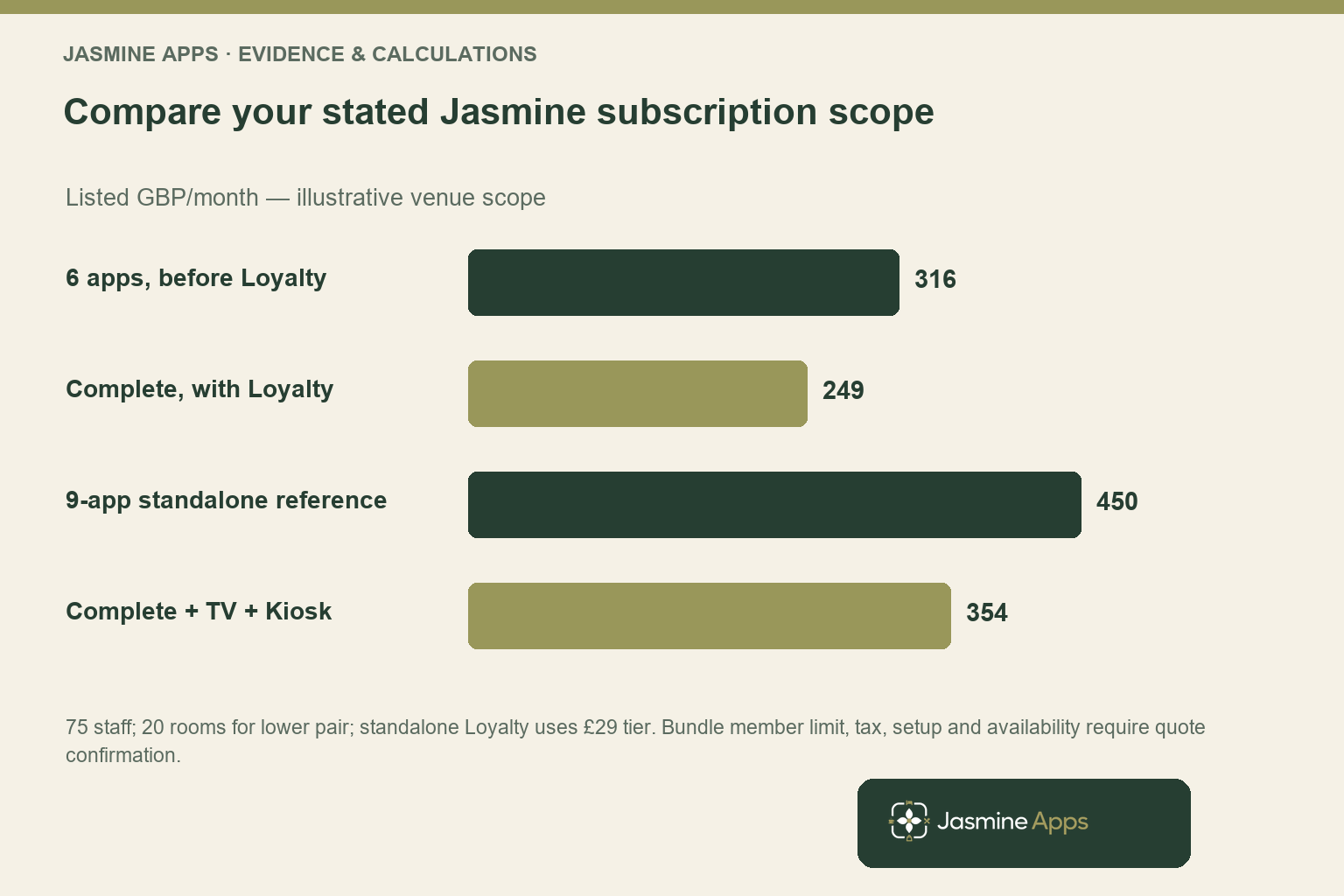
Here is where Jasmine Complete becomes particularly attractive. At seventy-five staff, separate subscriptions for Till Jasmine, Table, Clock, Sign, Maintenance and Marketing total £316 a month. Complete brings those six functions together for £249 a month and includes Loyalty too; your quotation will specify its member allowance.
On those listed subscription rates, the six-app comparison gives you a £67 monthly difference: £804 over twelve monthly payments, before adding a standalone Loyalty subscription. Confirm the same allowances and deployment costs in your quote, then compare the complete package with your other options. You get a clearer budget and a practical reason to bring more of your operation together.
Test all-in-one hospitality software interoperability through real tasks
You should ask what actually passes between apps: identity, a record, a completed action or a staff instruction. A common login is useful, but it is not the same as every field automatically synchronising. Your demonstration should distinguish each supported connection from the human decisions that remain.
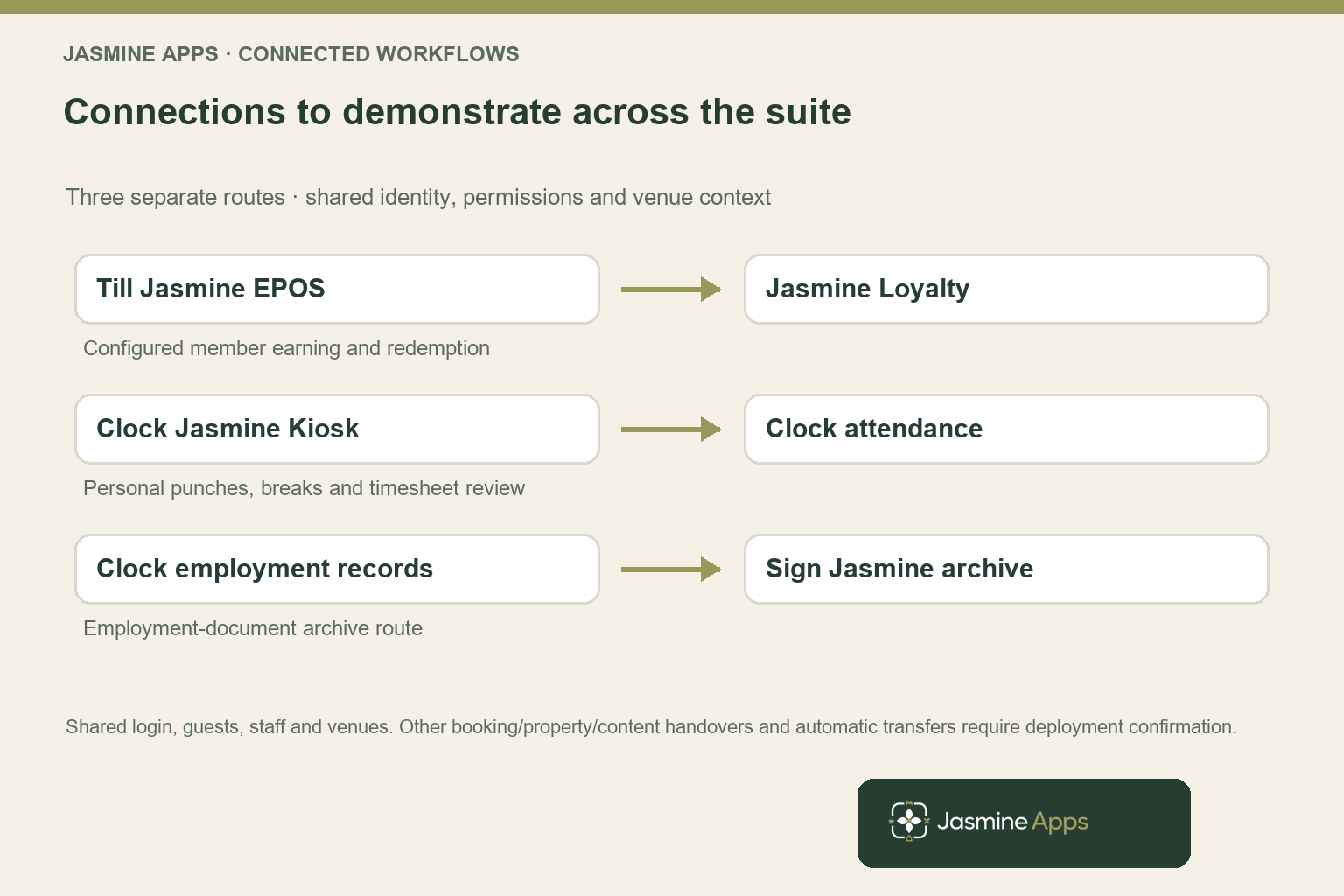
For a member purchase, the Till Jasmine and Jasmine Loyalty workflow connects the sale with the configured earning and redemption rules. Your participating venues and member-card setup matter. Ask to see a fictional member’s purchase, the relevant reward conditions and the resulting record without assuming every sale earns the same points.
For attendance, Clock Jasmine Kiosk is an extension of Clock, using personal PINs for clock-in, clock-out and breaks. Clock provides the attendance and timesheet context, including review of exceptions. You can test an arrival, a break and a correction as one workforce workflow rather than manually reconstructing the event elsewhere.
For employment documents, Sign’s live navigation includes a Clock Jasmine archive. Clock’s settings also provide employment-contract templates used during onboarding. That gives you a concrete cross-app route to inspect, while document approval, appropriate access and the relevant formalities remain part of your responsible process.
Table bookings, event documents, room faults, TV information and marketing content can also form one operating sequence. You should confirm any automatic record transfer in the proposed deployment rather than infer it from the sequence. Updating an approved service time in several channels may still require a named content owner.
Your test should include an exception as well as the ideal case. Ask what happens when a participating venue is missing, an attendance action needs correction or a document changes. A useful connection gives your team a dependable next step when normal service does not follow the simplest path.
What the Jasmine Apps bundles cost for your actual venue
Your Essentials package is listed at £129 per venue per month or £1,290 annually. Your package includes Till Jasmine with one till, Table up to five hundred bookings, Clock up to fifty staff and Sign. You should confirm the booking-limit period and required entitlement details in the quotation.
Your Complete package is listed at £249 monthly or £2,490 annually. It extends Essentials with unlimited bookings, Clock up to seventy-five staff, Maintenance, Loyalty and Marketing with a ten-thousand-email allowance. Confirm the Loyalty member limit, email delivery scope and current availability of the included modules.
Your standalone monthly rates are £59 for the till, £69 for Table, £1 per Clock employee with a £25 minimum, £15 for Sign, £79 for Maintenance and £19 for Marketing. That creates the £316 six-app reference at seventy-five employees. Adding the entry Loyalty tier, £29 up to five hundred members, creates a £345 reference rather than a universally identical bundle.
For an illustrative twenty-room venue using those seven modules, TV and Kiosk, your Complete-based subscription total is £354 monthly: £249 plus £100 TV plus £5 Kiosk. The corresponding standalone reference with the entry Loyalty tier is £450. The £96 difference depends on confirmed matching scope, especially membership limits.
TV is listed at £5 per room monthly with a £40 minimum, and Kiosk at £5 per venue monthly as a Clock extension. Other booking extensions, equipment, setup and taxes require separate confirmation. Essentials’ booking cap also differs from standalone Table’s unlimited listing.
Use the quote to select what your operation needs. You do not need every extension to benefit from shared records, and a smaller venue may reasonably begin with Essentials or individual apps.
How much time can your connected suite save?
Your time-saving estimate should follow a completed task, including review and exceptions. Start by observing your current process, then measure the demonstrated replacement under comparable conditions. Count a saving only when the work is genuinely removed rather than passed to a colleague or postponed until service.
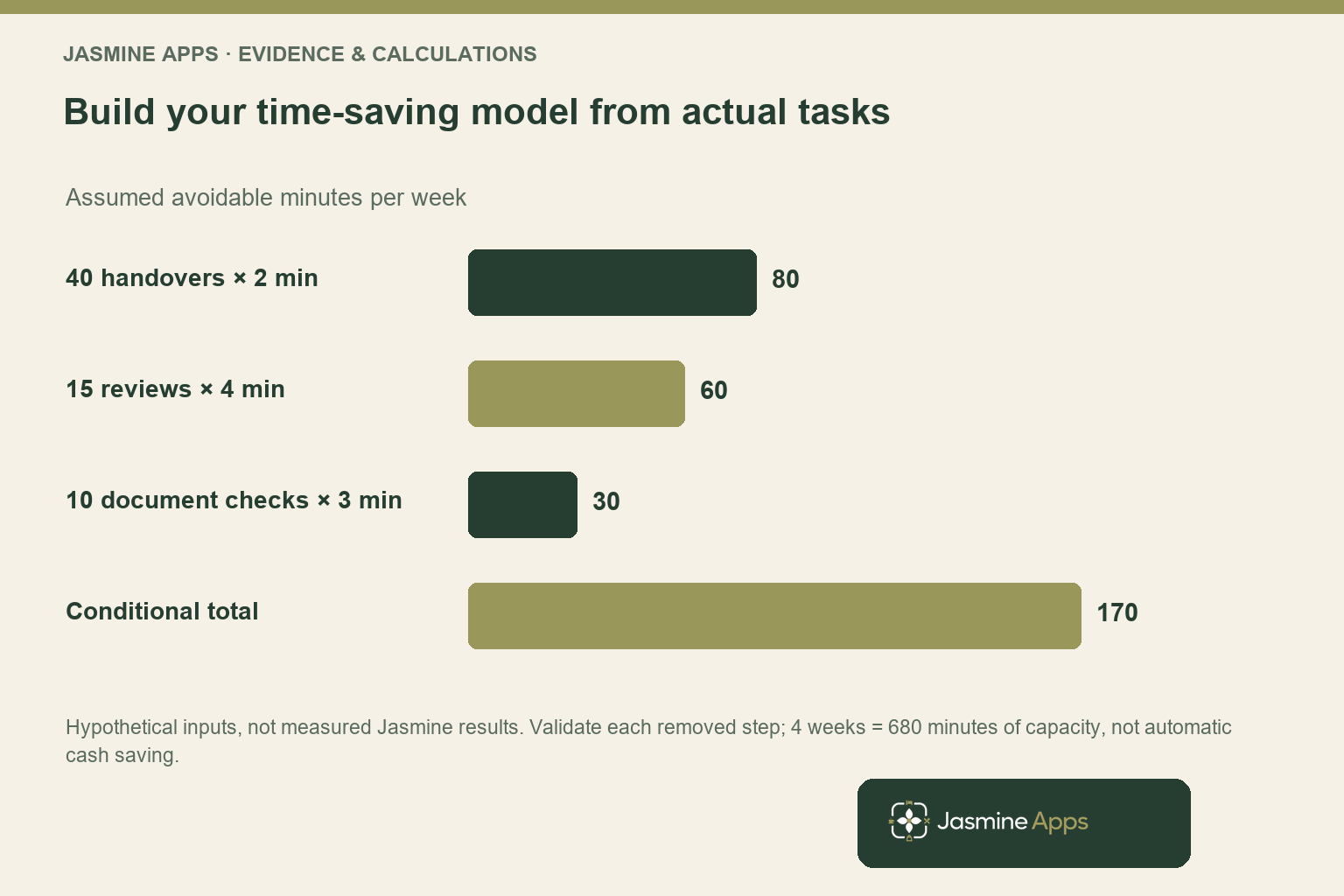
Consider a hypothetical weekly model. Suppose forty repeated handovers lose two minutes each finding or re-entering information, fifteen exception reviews each lose four minutes to record hunting, and ten document checks each lose three minutes to version searching. Those assumed avoidable steps total 170 minutes per week.
If your pilot actually removes them, you release two hours and fifty minutes weekly, or eleven hours and twenty minutes over a four-week review period. At an assumed £18 hourly capacity value, that four-week amount is £204. These are transparent planning inputs, not measured Jasmine customer results or a promise that software removes every step.
You should keep that capacity value separate from the subscription difference. A lower subscription invoice is a direct cost comparison; time released during the same paid shift is not automatically cash saved. Your team may use it for better guest service, supervision or more complete commercial follow-up.
Revenue also needs a separate measurement. A clearer booking handover may support a completed visit, and an understandable reward may support a return purchase, but neither proves a particular sales uplift. Record completed transactions and contribution, with demand that would have existed anyway kept visible.
Your hospitality software ROI guide explains that distinction. For this suite decision, choose one connected task first, validate the time and quality result, then expand the model only to additional work your team has actually changed.
Roll out the suite around a complete service workflow
You should build the rollout around a task your staff can finish rather than activate every app simultaneously. Choose a clear owner, a suitable venue and a fictional or controlled test record. Your team then has a practical sequence to learn and a specific result to review.
For example, start with a member purchase and reward review, or a kiosk attendance event and approved timesheet exception. Confirm the participating venue, permissions and relevant rules before the trial. You can add the next workflow after staff understand the first one and its exception route.
If you operate a hotel, include room charging in your demonstration. The EPOS dashboard offers live charge-to-room, with PMS folio posting and a guest-sign screen identified as later additions. Ask to follow the charge through your proposed setup so you know how reception, the till and your existing property-management process will work together.
Build your rollout around the modules available for your venue. Jasmine currently lists the till, Table, Clock, Loyalty, Sign, TV, Marketing and Kiosk in alpha testing, with Maintenance coming soon. Your demonstration is the right time to agree availability, support and a deployment schedule that fits your service calendar.
Bring your venue count, staff numbers and rooms to that conversation. An itemised proposal can set out your package, devices, setup, fees and tax basis in one place. You can then compare complete proposals and choose the combination that fits your budget and operating priorities.
Read the hospitality software-adoption guide before expanding beyond the pilot. Your connected platform earns its place when your staff can find the right record, complete the next action and resolve the exception consistently. The subscription saving becomes more valuable when that operational benefit is demonstrated.
Pro Tips
Test a complete transaction. Bring one realistic workflow with a normal case and an exception. Ask which record moves automatically, which requires approval and who owns the next step. You can distinguish a direct connection from a staff handover before either appears in the purchase case.
Use the same scope on every quote. Specify venue count, till licences, monthly bookings, staff, members, rooms, devices and required channels. Ask suppliers to identify exclusions and variable charges. Your comparison then measures the system your operation needs instead of unrelated starting prices.
Keep three benefit measures. Track subscription expenditure, released capacity and additional contribution separately. You can see which benefit is already evidenced and avoid counting the same improvement twice. Your pilot should preserve data quality and useful checks while removing avoidable work.
Common Mistakes
Calling one login universal synchronisation. Your staff may still need to approve, update or communicate a decision. A shared account does not prove every external integration or automatic transfer. Demonstrate the exact route before describing it as seamless.
Comparing only the headline subscription. A low entry price can leave you paying separately for the tools your venue needs. Include your bookings, staff, members, rooms, hardware and payment charges in each quote so you can see the complete cost.
Measuring only the easiest part of the task. A quick clock-in tells you little if your supervisor still spends the afternoon resolving missing breaks. Time the whole process, including corrections, so your pilot captures the work your team really completes.
Frequently Asked Questions
What is all-in-one hospitality software?
You use an all-in-one hospitality platform to bring related venue functions into a coordinated operating environment. Your scope may include POS, reservations, attendance, signing, loyalty, maintenance, marketing and guest TV. You should assess the shared identity and records alongside the actual cross-app actions. A suite does not automatically replace every external system, so your demonstration and quotation need to define the complete workflow and the boundaries relevant to your venue.
How much do Jasmine Apps bundles cost?
Your Essentials subscription price is £129 per venue per month or £1,290 annually, while Complete is £249 monthly or £2,490 annually. The packages have different booking, staff and module scopes. TV, Kiosk and other extensions need their own confirmation in your proposed deployment. Ask for the membership allowance, device requirements, tax basis, setup and current module availability before treating a simple subscription total as your complete purchase price.
Can you use all the Jasmine apps together?
You can assess the suite through its shared login and guest, staff and venue design, then demonstrate the specific routes you need. Examples include till loyalty, Kiosk attendance within Clock and the Clock archive in Sign. Your Table, room, TV and marketing sequence may also involve staff-led decisions. Confirm each automatic transfer and required permission instead of assuming every app synchronises every field or external system in the same way.
How much time can an integrated hospitality system save?
You should measure your own complete tasks before promising a result. The illustrative model here totals 170 avoidable minutes weekly, but those assumptions are not measured Jasmine performance. Record the repeated handovers, searches and checks that your pilot actually removes, including exceptions and quality review. Your released time can support service and supervision; it becomes a cash saving only when you can identify a corresponding reduction in paid expenditure.
How does a Jasmine Apps bundle compare with separate subscriptions?
At seventy-five staff, your separate subscriptions for the till, Table, Clock, Sign, Maintenance and Marketing total £316 a month at the listed rates. Jasmine Complete is £249 a month and includes Loyalty as well, creating a £67 monthly difference against those six subscriptions. Your quote should confirm matching allowances, module availability and deployment costs. That gives you a clear starting point for comparing the complete package with separate tools or another supplier’s proposal.
All-in-one hospitality software: your next decision
Your all-in-one hospitality software should help your team spend less time finding information and more time looking after guests. Jasmine Apps combines a shared operating foundation with bundle pricing you can calculate for your venue. Start with the tasks that slow your team down, choose the modules that address them, and build a package around the way you work.
Request a Jasmine Apps suite demonstration with your venue count, staff, rooms and three repeated handovers. Ask to see a member purchase, an attendance exception and a document archive route, then request an itemised bundle comparison. You can leave with a confirmed scope, a measurable pilot and a practical decision about the apps your operation should use together.