

Hospitality Software Data Exit Plan: Keep Your Records Usable When You Switch
· Yiannis Yiasemis

A downloaded spreadsheet can still leave your venue unable to use its history. The file may contain bookings without their notes, transactions without a stable reference or document names without the signed attachments. Your hospitality software data exit plan should test what the next team can reconstruct, rather than stop when someone confirms that an export button exists.
Jasmine Apps brings several operational records into a shared product environment. Before buying or switching, agree which records your venue needs, how they can be obtained and what happens to access at the end of the arrangement. A practical exit plan can strengthen confidence in the provider you choose, because you understand the dependency instead of discovering it during an urgent changeover.
Key Takeaways
- Inventory records and relationships by operational purpose.
- Test whether exports are usable by the receiving team.
- Keep retention, return and deletion obligations distinct.
- Plan access and reconciliation before cutover.
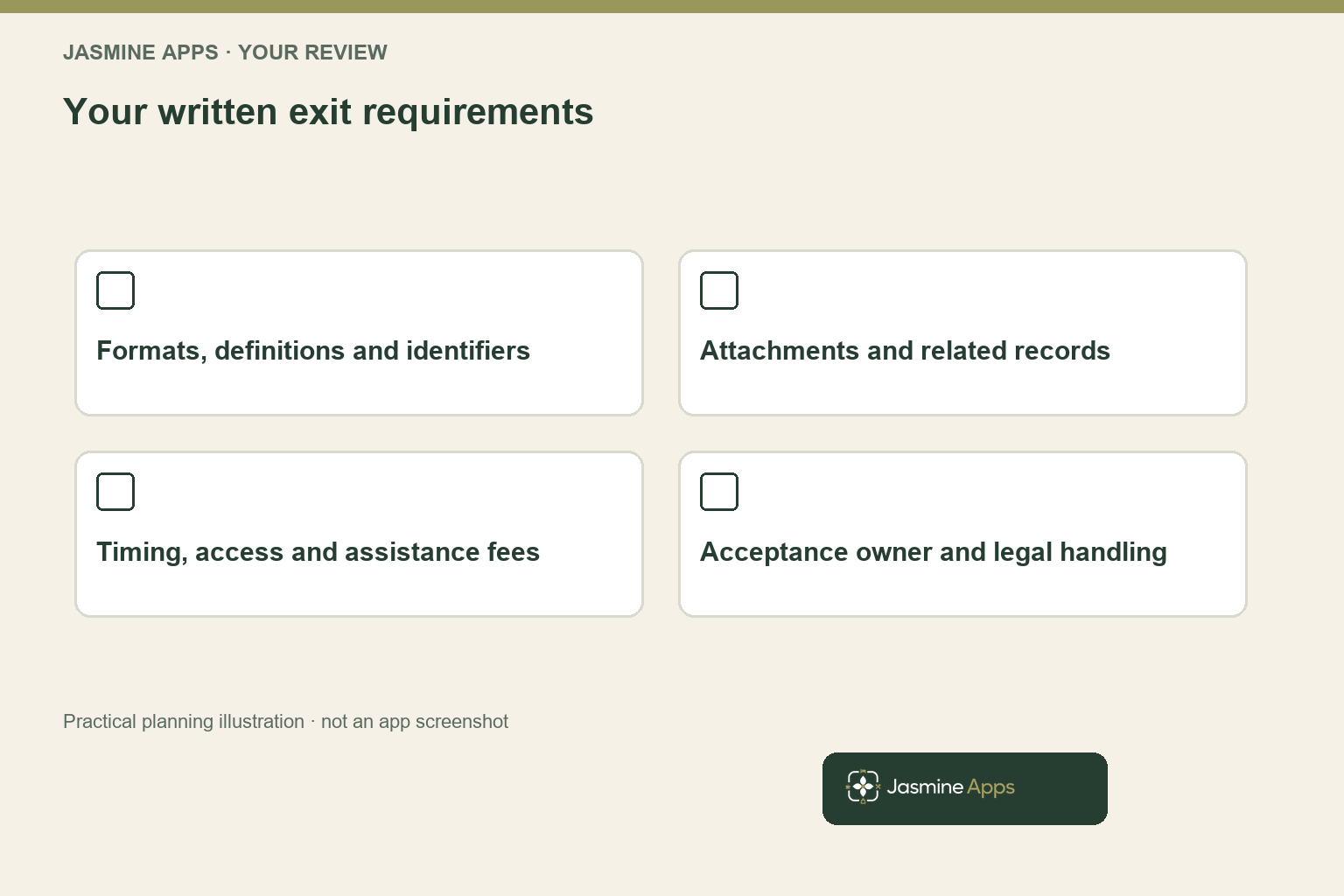
- Confirm format, timing, assistance and fees in writing.
Start your hospitality software data exit plan with record purposes
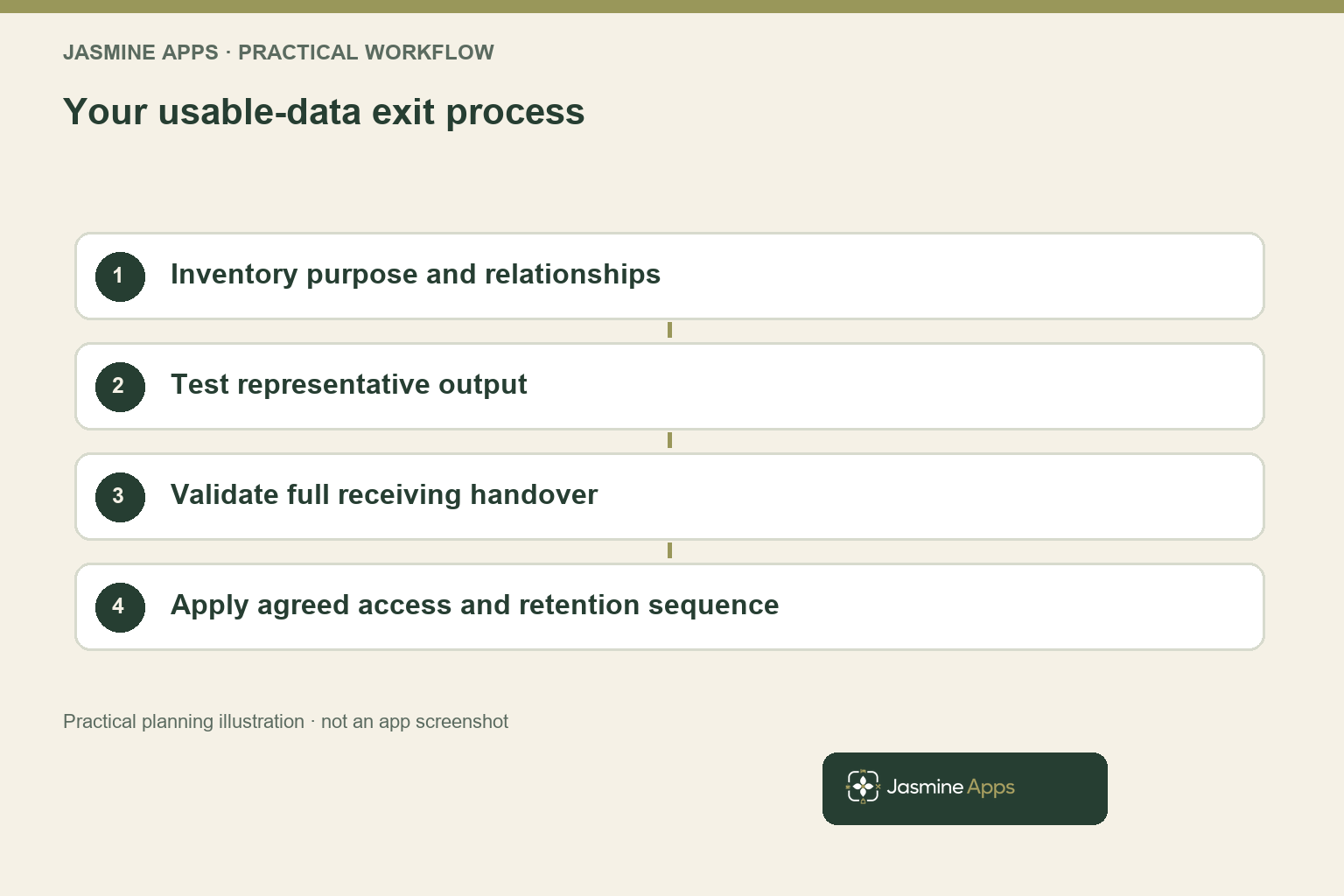
List the records the venue needs to continue operating, meet relevant obligations and handle later questions. Your inventory may include future reservations, completed sales, staff time records, signed documents, loyalty balances and maintenance history. Keep those purposes separate so the team can prioritise what must move into a live system and what can remain in an appropriate accessible archive.
Identify the relationships that give the records meaning. A reservation may relate to a guest and a deposit; a sale may refer to a member; a signed document may need its associated completion evidence. If those relationships disappear during export, individual rows can remain technically readable while the practical question your manager needs to answer becomes difficult or impossible to resolve reliably.
Give each record group an owner who understands the receiving use. Your accounts colleague may need different detail from reception, and a new supplier may require a particular mapping before importing anything. Ask those people what a usable result means, rather than allowing the export project to be defined only by whichever fields are easiest to download from the old system.
The government cloud lock-in guidance supports considering portability and switching implications when choosing a service. Apply that principle to your own requirements without assuming that every dependency is unacceptable. A useful system may still be worth adopting when some transition work is required, provided the venue understands the scope, cost and practical route before committing.
Connect the inventory with your EPOS migration checklist where relevant. That checklist tests a working menu and service changeover; the exit plan preserves the records behind it. Your first deliverable should describe the information needed for each purpose and the person responsible for accepting it, not simply name every file the supplier can produce.
Test your hospitality software data exit plan at field and relationship level
Ask for a representative export specification and an approved sample using fictional or appropriately protected data. Review identifiers, dates, time zones, amounts, tax treatment, statuses and text encoding. A column called total may mean something different in the receiving system, so document the definition before anyone imports a large file and assumes the values are commercially comparable.
Check stable references across files. If a booking export and deposit export use different identifiers with no mapping, the receiving team may not be able to reconcile them. Your test should follow one fictional record through the related outputs and show how the next system or archive preserves the relationship, rather than confirming each spreadsheet opens independently.
Include attachments and evidence where the purpose requires them. A document list is not a substitute for the signed PDF and relevant audit record, and a maintenance note may not replace the contractor report needed for later review. Confirm file formats, naming and the index that links the attachment to the correct event through the appropriate secure process.
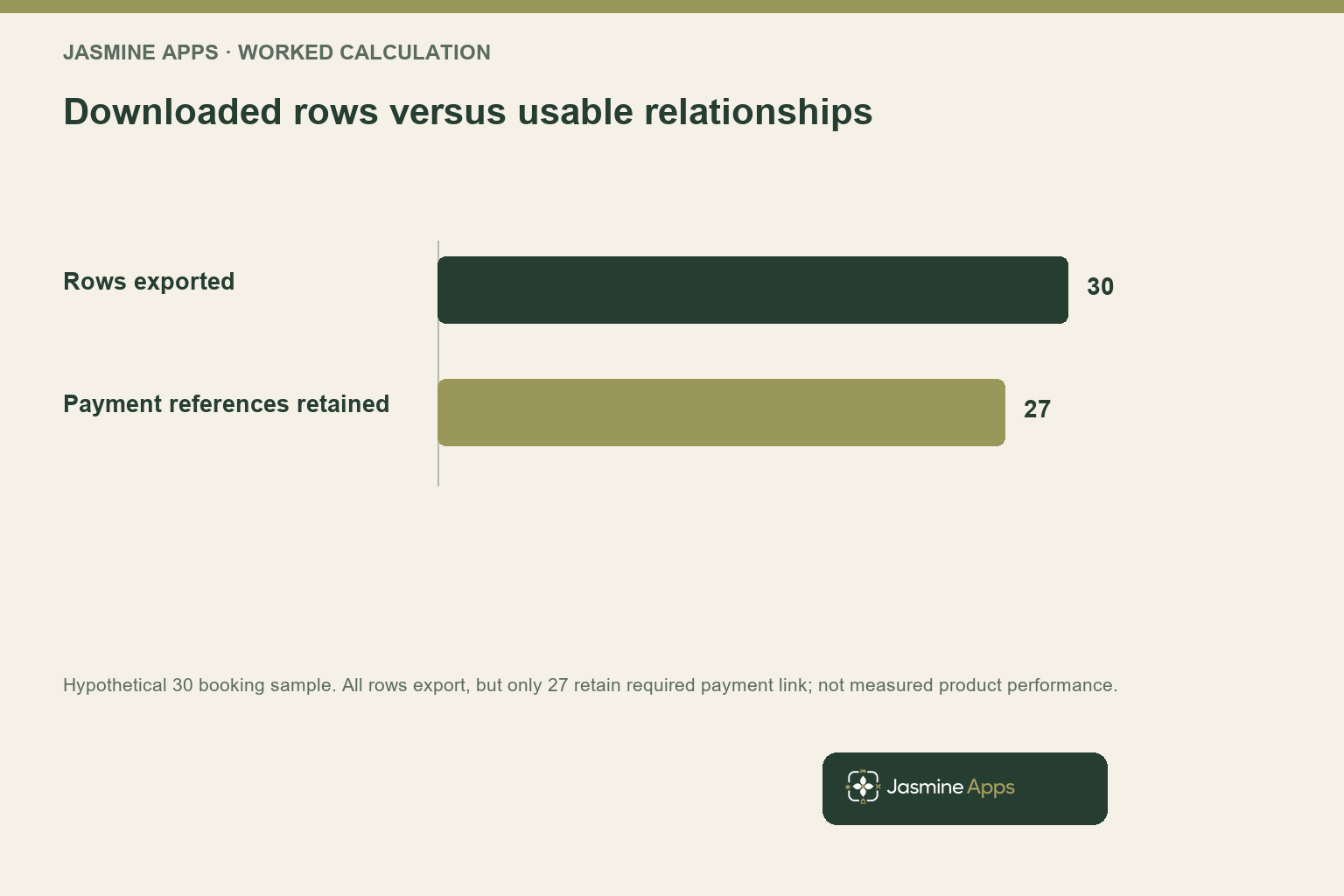
For a hypothetical sample, suppose thirty fictional bookings export successfully but only twenty-seven retain the related payment reference required by your receiving workflow. The headline row export is one hundred per cent, while the relevant relationship completeness is ninety per cent. Your acceptance test should identify the three gaps and resolve the mapping before calling the transition ready.
Use the existing signed PDF and audit-record article for the document distinction. Your wider plan should give every record group a similarly practical check. A usable export is one the receiving owner can interpret and reconcile for the intended purpose, with the limitations known and an agreed route for any information that cannot move directly.
Put responsibilities and retention into your hospitality software data exit plan
Distinguish commercial access rights from data-protection roles and legal retention needs. A slogan that your data belongs to you does not answer who can export it, in which format or how long the venue can access an archive after cancellation. Your agreement and operating process should address those practical questions alongside the appropriate legal responsibilities for the different records.
The ICO controller-processor contract guidance is a relevant reference where a provider processes personal data on your behalf. Confirm the appropriate contract provisions, including end-of-contract handling, with current guidance and professional advice for your circumstances. Keep the supplier's own processing roles and lawful obligations distinct where they differ from the service performed for your venue.
Define the records your organisation must retain and the appropriate period through its approved legal and data policies. Do not copy one universal retention duration across payroll, financial, guest, signing and maintenance information. The purpose, applicable obligations and circumstances can differ, so the responsible owner should determine what remains necessary and who may access it after the operational system changes.
Agree the sequence for return, validation and any deletion instruction. Your venue needs to know what can be verified before access ends, what the provider retains lawfully and how the relevant completion is communicated. Avoid requesting indiscriminate deletion while the team is still checking whether essential records were received, and do not assume a downloaded file removes every other obligation or copy automatically.
Keep personal information secure throughout the transition. Use approved transfer, storage and access arrangements, with only the data necessary for the relevant purpose. A migration should not become an excuse to place an unrestricted copy of staff or guest records in a general shared folder. Your exit plan should preserve usability and appropriate protection together, with named people responsible for the handover.
Plan cutover access so service does not depend on an untested archive
Set a timeline for sample export, mapping, extraction, validation, cutover and read-only access. Identify the provider's required notice and the people available to resolve discrepancies. Your venue should know which tasks must finish before cancellation or access expiry, rather than discovering that the export owner is unavailable on the day the old account closes.
Decide how changes after the first extraction will be handled. Future reservations, amended staff records or new completed sales may arrive while the receiving system is being prepared. Your process needs a controlled final update or reconciliation route, with a clear boundary for which system is authoritative at each stage. Do not assume two editable copies remain synchronised merely because both contain similar data.
Test the archive with the colleague who will answer later questions. Ask them to locate a fictional completed sale, identify its relevant date and amount, then find the related document or reference where required. A folder that opens for the project lead may still be impractical for the manager who needs a specific answer six months after the original software has been retired.
For Till Jasmine, the public description explains that completed sales are recorded at payment and that receipts preserve the relevant sale-time details. Use that information to frame your questions about the actual export and archive scope; do not assume that changing a current product reconstructs historical receipts or that every reporting format contains the complete transaction detail needed by another system.
Use your system-switching guide for the wider service continuity plan. Your data cutover should support that operational change with validated records and a workable fallback. The manager needs to know what is complete, what remains accessible and who resolves an exception, keeping the transition from becoming an urgent search through unfamiliar files during a live shift.
Budget the transition and compare real dependency costs
Ask the provider to identify export formats, timing, assistance and any fees in writing. Standard downloads, custom extraction, attachment bundling and migration support can involve different work. A provider can reasonably charge for a defined additional service, but your manager should understand the required cost before the venue becomes dependent on an output that was never part of the ordinary scope.
Include the receiving side. Your new supplier or internal team may need mapping, import work, reconciliation and training to use the archive. Those tasks do not disappear because the outgoing system can produce a CSV. Compare the complete transition process, with the internal time requirement shown separately from external cash fees and a clear owner for each acceptance step.
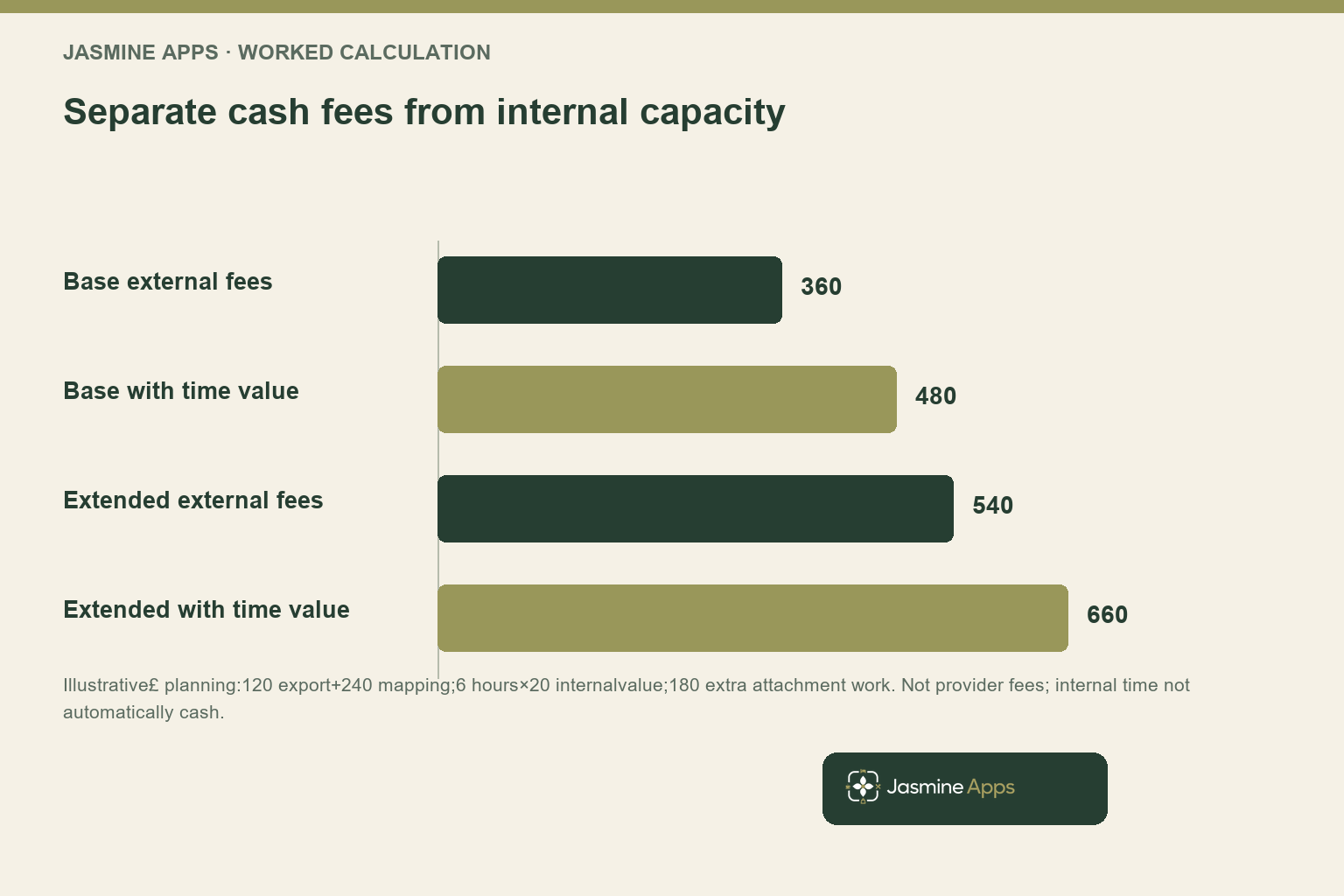
For a hypothetical project, assume £120 export assistance, £240 mapping and import support, and six internal hours valued at £20 each for planning. External fees total £360; the internal capacity value is £120; the combined planning view is £480. Do not report the whole £480 as cash paid if the internal hours do not change an actual expense.
Model a more complex case only where the requirement makes it plausible. Adding £180 attachment-index work would make the external fees £540 and the combined planning view £660 under the same internal-time assumption. These are illustrative figures, not Jasmine charges, competitor prices or an estimate that applies to every venue's data; the actual quotation and sample determine the relevant scope.
Connect the result with your software quote comparison. A low recurring price may still be a suitable choice with transition costs, while an apparently portable product may require substantial receiving work. Your decision becomes stronger when the dependency is explicit and the exit route is tested, rather than treated as either free by definition or a reason to reject every useful integration.
Keep the plan current while you are still happy with the system
Review the exit plan when you add a product, integration, venue or record type. A plan written for sales and bookings may not cover a later document archive or loyalty balance. Your change process should ask whether the new relationship can be exported and reconciled, keeping the inventory current throughout the supplier relationship.
Periodically test an appropriate small export and the receiving interpretation, following your data-protection process. Confirm that identifiers and formats still match the documented method and that the authorised owner can use the result. The exercise should be proportionate; you do not need repeated unrestricted copies of sensitive records simply to prove that someone remembers how to click download.
Distinguish an export archive from a recoverable backup or a complete disaster-recovery arrangement. A spreadsheet may preserve selected business information without restoring the application, configuration and relationships required to resume service. Your continuity planning should confirm the recovery responsibilities and supported options separately, rather than assume the exit pack solves every outage or security incident.
In a Jasmine Apps buying demonstration, follow one fictional cross-product relationship and ask for the actual record handover required by your venue. Confirm the scope and limitations in the proposal, including current product availability. A shared guest, staff or venue environment can improve operational continuity, while the exact export route still needs to be assessed for the use you intend to make of it.
Your exit plan should leave the venue confident enough to choose on value and fit. Keep the required records, acceptance tests, contract provisions and transition owner together, then revisit them when the operation changes. You can benefit from a connected system with a clearer understanding of how your information remains usable, giving the manager a practical route to switch later if the business needs a different arrangement.
Pro Tips
Test a relationship. Follow one fictional booking and its payment reference across outputs. A successful file download does not establish that the receiving team can reconnect the records.
Ask the future user. Have the colleague who will answer later questions find a sample record and attachment. Archive usability should be judged by the intended task, not the exporter alone.
Validate before access ends. Put the sample, full extraction and reconciliation ahead of cancellation deadlines. Your team needs a realistic opportunity to resolve gaps while the original source remains available.
Common Mistakes
Equating export with portability. You can lose definitions, links and attachments. Test how the receiving process interprets the complete required record.
Applying one retention period everywhere. You overlook different purposes and obligations. Use approved record-specific policies and appropriate advice.
Calling a CSV a complete backup. You may preserve selected information without a recoverable application. Confirm recovery and exit responsibilities separately.
Frequently Asked Questions
What should a hospitality software data exit plan include?
You should include the record inventory, purposes, identifiers, required relationships and attachments, along with formats, timing, responsibilities and any fees. Define who accepts each output and how changes during transition are reconciled. Keep retention, return and deletion arrangements appropriate to the relevant records and legal roles. Your plan should demonstrate that the receiving team can use the information for its intended task, rather than stop at confirmation that a download exists.
Does a CSV export mean you can easily change software?
You need to check the fields, definitions, identifiers and relationships required by the receiving system. A readable spreadsheet may omit attachments, payment links or the status history needed to reconstruct a useful record. Test a representative sample and confirm mapping and import work before relying on it. Portability depends on the complete receiving process, so include its cost and acceptance criteria alongside the outgoing provider's export function when assessing the transition.
Who owns guest and staff data in hospitality software?
You should distinguish commercial contract rights from data-protection roles and the purposes for which each organisation processes information. A broad ownership statement does not explain export access, lawful retention or end-of-contract handling. Review the provider's terms, relevant processing agreement and current guidance with appropriate professional advice. Your venue also needs a practical inventory and authorised access process so personal information remains protected and usable for the legitimate purpose during and after a system change.
Should you delete the old software data immediately after switching?
You should follow an appropriate approved sequence and record-specific retention obligations rather than apply an immediate blanket deletion rule. Validate the required return and receiving interpretation before access ends, then handle any deletion instruction and lawful retained records under the relevant contract and data policies. Keep responsibility clear for each step. A successful migration does not automatically remove financial, employment or other obligations, and downloading a file does not prove every required record has been received correctly.
What should you ask Jasmine Apps about exporting records?
You should ask for the actual formats, fields, identifiers, attachments and related records required by your venue, with a fictional sample you can reconcile. Confirm timing, access after cancellation, assistance, fees and relevant retention arrangements in writing. Demonstrate one important cross-product relationship rather than infer every export from a shared login. Your acceptance should involve the person who will use the archive or receiving system, making the result practical for the question the business needs to answer.
Hospitality software data exit plan: your next step
Your hospitality software data exit plan should keep the venue's history useful beyond any one system. Request a Jasmine Apps demonstration and scoped proposal with your three essential record groups and one sample relationship. You can confirm the operational value and the practical handover before making a connected platform part of your business.