

Hospitality Seasonal Campaign Lead Time: Work Back From the Service
· Yiannis Yiasemis

The date you want to post is often the least useful place to start a seasonal campaign. Your kitchen may need final choices before the organiser can collect them, while a corporate buyer may need internal approval before signing. Your hospitality seasonal campaign lead time should work backwards from those decisions, not from a generic claim that every venue should begin promoting the same event in the same month.
Jasmine Marketing Hub's calendar and connected social-content workflow can help organise the message. Your plan becomes stronger when the content schedule follows an offer your venue can deliver, a plausible customer decision window and a clear booking route. You can then launch at a time supported by your own evidence and know when a message needs to change or stop.
Key Takeaways
- Work back from delivery and decision deadlines.
- Separate search interest from completed booking demand.
- Use different lead times for different buying occasions.
- Keep capacity, terms and campaign content aligned.
- Review completed contribution rather than impressions alone.
Set hospitality seasonal campaign lead time from the delivery deadline
Start with the service you intend to fulfil: a dinner, hotel package, private event or seasonal experience. Identify the dates and capacity actually available, then ask operations which decisions must be settled before delivery. Your campaign cannot promise unrestricted choice up to arrival if the kitchen, staffing or supplier arrangement requires a much earlier commitment.
Work backwards through the practical dependencies. Your kitchen may need a menu count, the organiser may need time to collect choices and the buyer may need a confirmed price before seeking approval. Each step creates a decision window. Map those windows explicitly so your proposed launch date leaves a plausible route to completion rather than merely enough days to publish several posts.
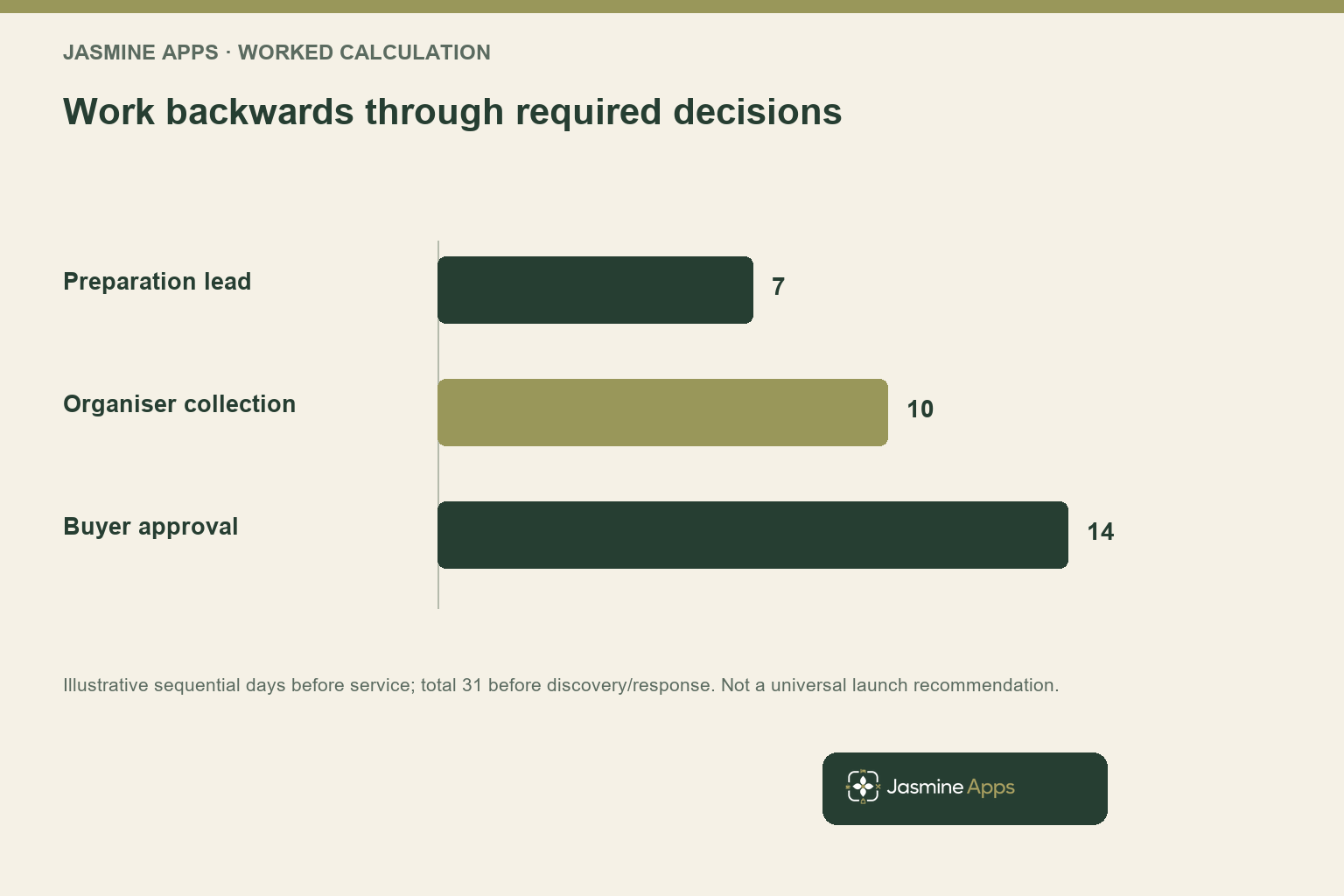
For an illustrative sequence, assume final preparation decisions are needed seven days before service, the organiser needs ten days to collect information and the buyer needs fourteen days for internal approval. If those stages must occur sequentially, you already need thirty-one days before adding discovery and response time. The assumptions are a planning example, not a recommended universal lead time.
Check whether stages can overlap in your actual process. A buyer may gather guest interest while reviewing the proposal, but you should not assume that every approval happens immediately or that every supplier accepts a late change. Your manager should identify which dependencies are fixed, which are flexible and who can authorise a change if the campaign generates a different request.
Use the existing Christmas campaign deadline article for the specific festive-service example. This broader method applies the same discipline to different seasons and occasions. Your result is a practical last useful enquiry date and a realistic launch window, giving the marketer a schedule that respects the service rather than a calendar full of unsupported promises.
Use customer evidence to choose hospitality seasonal campaign lead time
Review the records you can obtain about previous relevant enquiries and completed bookings. Identify when the first contact happened, when the customer committed and when the service took place. Keep those events distinct, because an enquiry received early and confirmed late describes a different buying journey from a guest who discovers and books the same evening.
Group the evidence by occasion and buyer type where appropriate. Corporate organisers may need a different approval route from couples booking dinner, and returning customers may decide differently from people who have never visited. Your campaign should reflect those useful differences without building intrusive personal profiles or assuming that one broad demographic predicts the exact time someone will purchase.
Google's Trends comparison guidance can help you compare relevant search terms and settings. Use search interest as context for discovery, not a direct forecast of your venue's reservations. Keep geography, term choice and date range consistent, and avoid presenting an interest pattern as a measured count of customers ready to buy your specific offer.
Compare that context with your actual operational evidence. A term may attract attention before people are ready to commit, while your best group enquiries may arrive through repeat contacts rather than search. Your launch decision should combine those sources and explain what each can establish, rather than letting a single attractive chart determine the entire marketing calendar.
Where your history is limited, state the assumption and plan a review. Begin with a manageable offer and track enquiry, commitment and completed service dates through the supported route. You can improve next season's lead-time decision from that record, making the programme more useful over time without inventing search volume or claiming a universal best launch date that the evidence cannot support.
Match hospitality seasonal campaign lead time to the buyer decision
Write the decision your message asks the reader to make at each stage. Early discovery may need a clear occasion, date range and reason to enquire; a buyer considering approval may need inclusions, availability and the complete relevant price. Your later reminder should answer what remains unresolved rather than repeat the same image and headline throughout the whole season.
Make the next step fit the offer. A straightforward dinner booking may suit a direct supported booking route, while a private event may require a discussion before the venue can confirm scope. Do not measure both journeys only by website clicks, because the useful outcome and the time needed to reach it differ. Your team should know which action counts as progress for each campaign.
Prepare the information that reduces avoidable back-and-forth. Include the relevant dates, eligible party or stay conditions, what is included and the route for questions. Your event enquiry-to-agreement article covers the wider pipeline; a good seasonal campaign should enter that pipeline with enough clarity for the responsible colleague to respond meaningfully.
Check the real response capacity before increasing promotion. A strong post can create an enquiry queue that goes cold if nobody owns the follow-up. Agree the monitored channel, responsible person and appropriate response arrangement, then include that operational resource in the campaign plan. The advertising schedule is only one part of the customer's experience of trying to book.
Test the journey with fictional information before launch. Ask someone to find the offer, understand the relevant details and identify the next step without a marketer explaining the page. You can then fix missing information or an unclear handover before paying to attract more readers, giving the campaign a better chance of producing useful enquiries within the remaining decision window.
Build a campaign calendar with capacity and change checkpoints
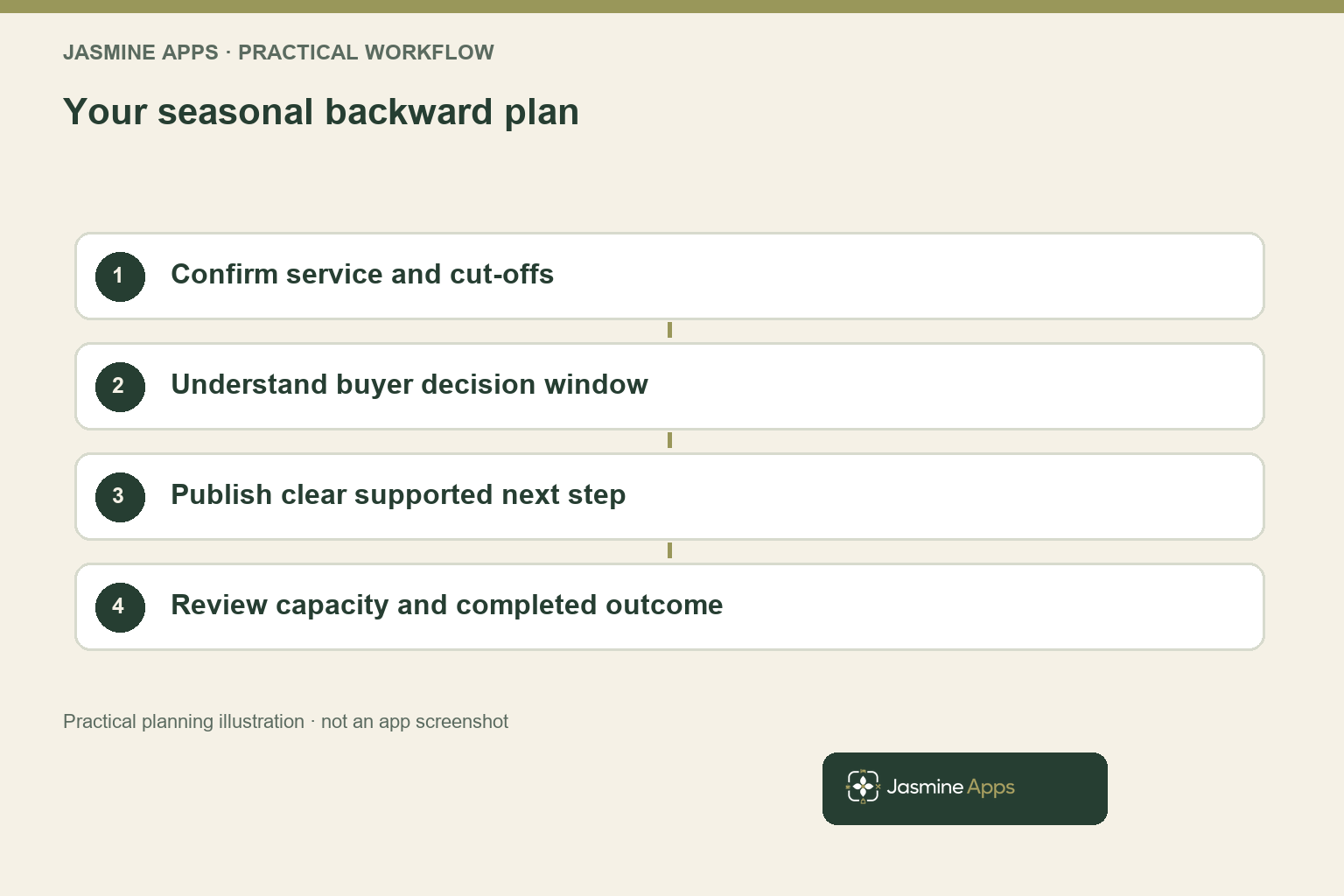
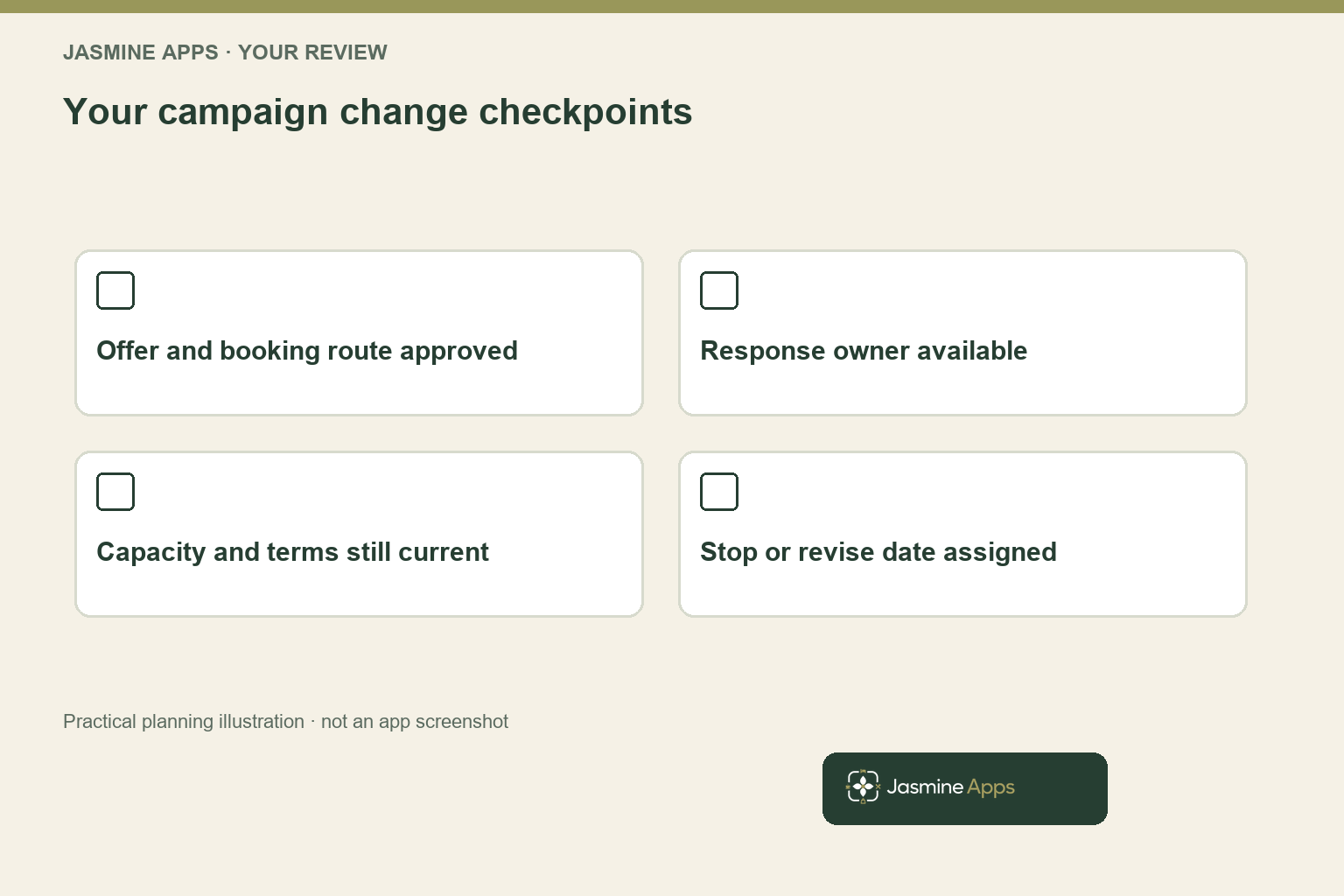
Use your calendar to show more than publication dates. Include offer approval, asset preparation, booking-route testing, launch, review and the last useful response or commitment point. Give each checkpoint an owner, so a delayed menu decision can change the content plan before an already scheduled post invites guests to buy something the venue has not finalised.
Jasmine Marketing Hub supports a content calendar and connected social-profile workflow. Demonstrate how your proposed campaign, copy and media are organised in the current setup, including the review and publication route you need. Confirm supported channels and permissions rather than assuming that every calendar entry automatically sends an email, publishes to every platform or joins a completed booking record.
Review capacity before each later message. A room, date or menu option may become unavailable while a campaign image remains attractive and shareable. Agree who tells marketing about the change and who updates or withdraws the relevant content through the supported process. Do not assume a booking automatically pauses every campaign unless that specific integration has been demonstrated.
Use your hotel package promotion article for the joined room-and-dinner promise where relevant. Your seasonal calendar should preserve one current approved offer across the customer-facing routes. A guest who reads a social post, visits the website and contacts reception should encounter compatible information rather than three versions of the same seasonal package.
Keep a simple record of what changed and when. Your later analysis needs to know whether a revised price, withdrawn date or new creative affected the comparison. That makes the calendar a useful operational record as well as a content planner, helping the team explain the campaign result and repeat the parts that supported a clear, deliverable buying decision.
Budget the campaign against completed contribution and uncertainty
Estimate the contribution available from the capacity the campaign can realistically sell. Use a consistent tax basis, subtract relevant variable costs and include advertising, offer and content expenses that change with the campaign. Your model should distinguish available capacity from demand you have evidence to expect, so the budget is not justified by assuming every promoted place will sell.
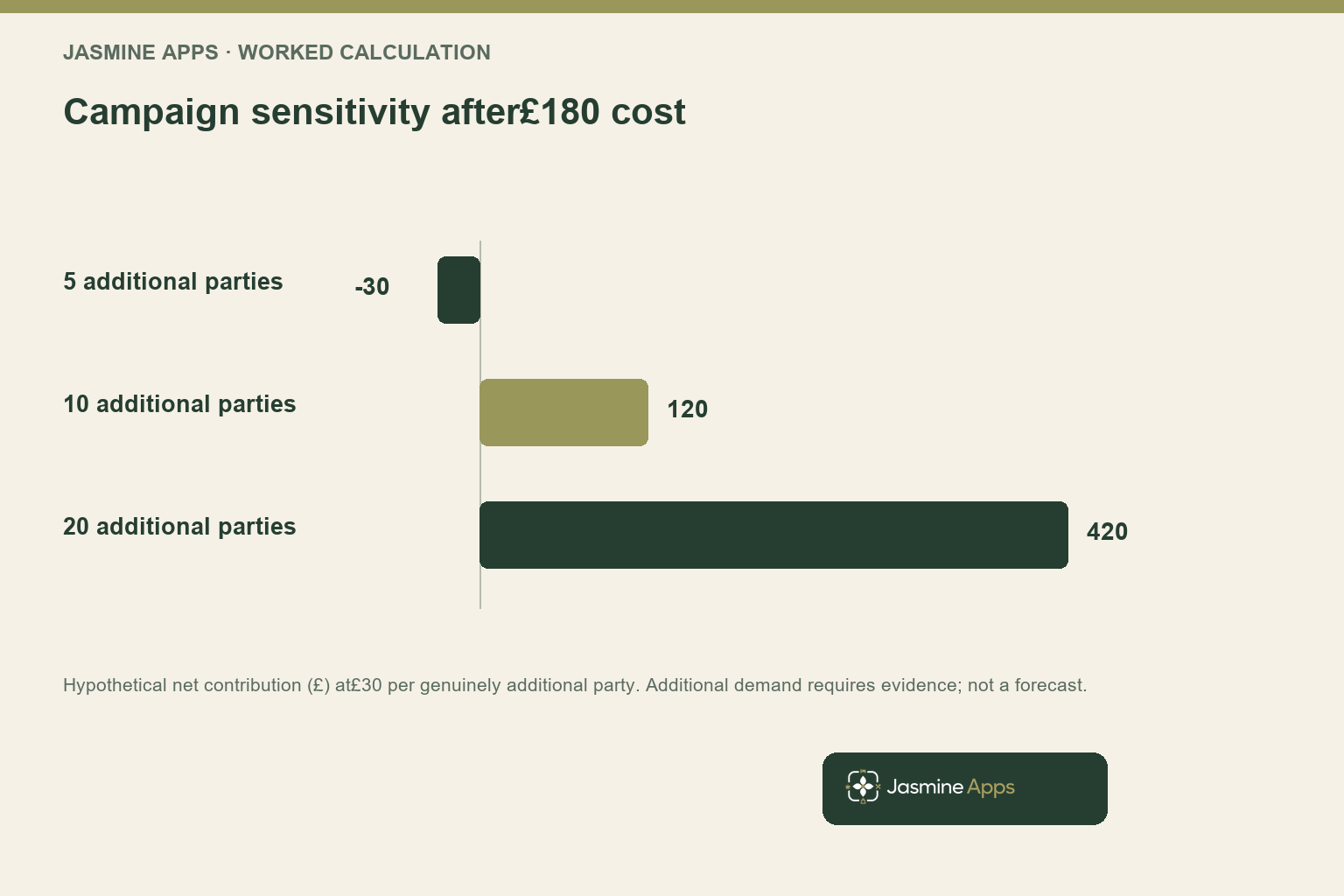
For a hypothetical seasonal service, assume twenty additional completed parties each contribute £30 before campaign cost. Associated contribution would be £600. If creative and advertising cost £180, the comparison is £420 before other relevant effects. The word additional needs evidence: a record that follows the message does not establish that the guest would not otherwise have purchased.
Test sensitivity to the volume assumption. At ten genuinely additional parties, the same £30 contribution gives £300, leaving £120 after the £180 cost. At five, the comparison becomes £150 less £180, or minus £30. These examples show why a decision-maker should see the minimum useful outcome and uncertainty rather than only the most optimistic seasonal forecast.
Marketing Hub is currently listed at £19 per venue monthly or £190 annually, with a description including ten thousand emails per month. Confirm email delivery, supported channels, reporting, implementation and tax in your quote, alongside the actual calendar workflow. Your campaign budget should include the services you intend to use rather than assume every listed capacity is already configured for your venue.
Use your booking-attribution framework to follow the result through completed service. Your calendar explains when you acted; the outcome record explains what followed and what the evidence supports. Together they give the manager a clearer basis for deciding whether to repeat, revise or stop the campaign before committing the next season's budget.
Use the season review to improve next year without copying blindly
Keep the enquiry and commitment timeline after the service has finished. Record when useful enquiries arrived, how long the decision took and which dates or options they sought. Your next lead-time plan can then use completed evidence, rather than relying on the busiest month in memory or the post with the most reactions.
Review the lost or unfulfilled opportunities as well. A late enquiry may reveal demand beyond the current cut-off, but the reason matters: insufficient preparation time, unavailable space or a buyer who needed a different offer. Your response next year might be an earlier message, a simpler late-booking option or a clearer deadline, not simply a longer advertising period.
Separate repeatable lessons from one-off conditions. Local events, weather, major price changes and unusual closures can affect the season, so do not copy a successful date without checking the next calendar and operating plan. Your evidence is strongest when it explains the decision mechanism and the service constraints that remain relevant, not only the fact that last year's launch happened on a particular Tuesday.
Keep appropriate contact permissions and current information within the follow-up process. Your team should respect the applicable marketing rules and opt-outs, with approved handling of any personal data. Use the existing email planning article for the relevant internal workflow discussion, and confirm the actual delivery route before building the next campaign around an assumed automation.
Finish with a revised backward plan and a small number of decisions for the next season. Identify the earliest useful preparation task, the likely buyer window and the final operational cut-off, with owners and review dates. Your venue can then start at a justified time, respond more confidently and stop or change messages when the service requires it, turning seasonal marketing into a repeatable commercial process.
Pro Tips
Plan the last useful enquiry. Work back through approval, guest choices and preparation. Your final advertising date should reflect the remaining path to a deliverable booking.
Compare enquiry and commitment dates. Keep both events rather than one generic booking date. The gap tells you which information or approval stage the campaign must support.
Put operations on the calendar. Include availability reviews and offer changes with an owner. The content schedule should react when the service promise changes.
Common Mistakes
Copying a universal launch month. You ignore the buyer and production dependencies. Build the lead time from your actual offer and evidence.
Treating search interest as confirmed demand. You can overbudget against people who are only exploring. Combine discovery evidence with your own completed booking record.
Leaving old offers running after capacity changes. You attract enquiries the team cannot fulfil. Assign a clear route to update or stop the relevant messages.
Frequently Asked Questions
When should you start promoting a seasonal restaurant offer?
You should work backwards from the service and the decisions required before delivery, then compare that plan with relevant enquiry and commitment history. Account for the buyer's approval, guest choices and preparation rather than applying one universal month. Search interest can inform discovery but does not establish your venue's bookings. Where evidence is limited, label the assumption and review the journey so the next season's lead-time decision rests on completed information.
How far ahead should a hotel promote Christmas events?
You should assess the particular event, customer decision process, available dates and operational deadlines rather than copy a single lead time for every hotel. Corporate organisers, family meals and short-stay packages may require different information and approval windows. Review previous useful enquiries and completed commitments, then build a backward plan with a last feasible response date. Your campaign should begin early enough to support that path and change when the remaining capacity or service requirements change.
Can Google Trends tell you how many seasonal bookings you will receive?
You can use relevant search-interest comparisons as context for discovery, with consistent terms, geography and dates. They do not directly forecast completed bookings for your venue or prove that a particular launch will create additional sales. Combine the context with your own enquiry, commitment and service records. Your budget should show its demand assumptions clearly and include a sensitivity calculation, rather than treating an attractive search pattern as guaranteed bookable demand.
What should a hospitality campaign calendar include besides posts?
You should include offer approval, asset preparation, booking-route tests, launch, response ownership, capacity reviews and the final useful enquiry or commitment point. Assign an owner to updates when dates, prices or availability change. Keep the current approved message consistent across the website and team handover. Your calendar then supports delivery as well as publication, helping the venue avoid promoting an outdated offer or attracting enquiries nobody is ready to answer.
Does Marketing Hub automatically stop campaigns when an event fills?
You should demonstrate that specific behaviour in your proposed setup rather than assume it from a shared product brand. The current calendar and connected social-content workflow can organise the campaign, while booking-triggered stops, email delivery and reporting require confirmation of the actual supported route. Give a named colleague responsibility for capacity updates and content changes where a manual handover remains. Your buying test should include a date becoming unavailable after the campaign has launched.
Hospitality seasonal campaign lead time: your next step
Your hospitality seasonal campaign lead time should give customers enough time to decide and your team enough time to deliver. Request a Marketing Hub demonstration with one seasonal offer, its preparation cut-off and your enquiry route. You can build a calendar around the decisions that lead to worthwhile completed bookings.