

Hospitality Marketing Booking Attribution: Which Visits Followed the Post?
· Yiannis Yiasemis

A booking made after a campaign is not necessarily a booking caused by it. Your guest may have planned to visit already, seen several messages or completed the reservation through another route. Your hospitality marketing booking attribution should first establish what you can trace, then ask what the campaign genuinely changed.
Jasmine Marketing Hub gives your team a calendar and connected social-content workflow to plan the message. A useful measurement process joins that activity with the booking and completed-service records your venue can obtain. You can then explain which visits followed the campaign, what contribution they produced and how strong the evidence for additional demand really is.
Key Takeaways
- Distinguish traceable bookings from additional demand.
- Use a consistent campaign naming and link structure.
- Follow reservations through cancellation and completion.
- Confirm the data route instead of assuming automatic joins.
- Report contribution and evidence strength together.
Define hospitality marketing booking attribution before the campaign
Start by deciding what your measurement can answer. You may want to know which link brought a guest to the booking page, which offer they selected or which completed visit included a campaign reference. Those are different stages, and none by itself proves that the guest would not have purchased without the message.
Give each campaign a simple name and a defined service window. Your marketer, reservations team and manager should use the same reference, with clear rules for when it is recorded. A consistent naming convention makes the later review easier and helps you avoid combining unrelated offers because their social posts used similar wording.
Google’s campaign URL guidance explains how UTM parameters identify traffic sources, media and campaigns. Use that supported approach where your website and analytics setup allow it. Confirm how the booking journey handles the reference, especially when the guest moves to another provider or finishes through a telephone enquiry.
Plan a usable supporting route for offline enquiries. Your team can ask a short, optional source question or record the relevant offer mentioned by the guest, following your approved information process. Keep the evidence type visible, because a self-reported source and a tagged online visit have different limitations and should not be blended without explanation.
Your hospitality social-media ROI guide covers the broader distinction between activity and commercial effect. This article builds the record trail you need for that review. You can trace the journey with appropriate data and describe exactly what the evidence supports, instead of assigning a causal result to every reservation that follows a post.
Follow hospitality marketing booking attribution through completion
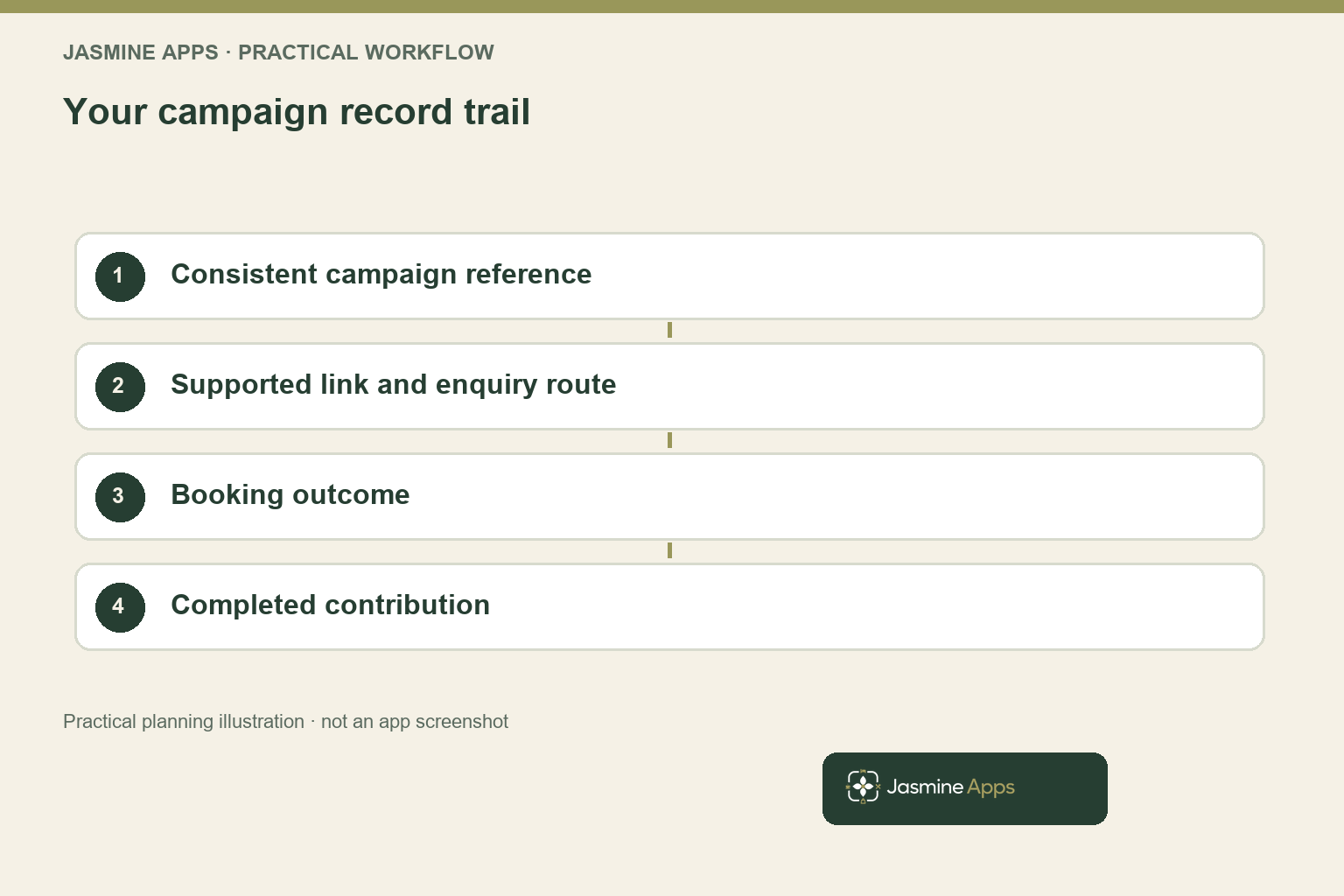
Your booking stage should preserve the useful campaign reference through the records your setup supports. Confirm that route in the demonstration rather than assuming Marketing Hub and your booking system automatically join every field. Where a staff handover remains, give it a clear owner and a practical way to maintain the reference.
Count booking creation, cancellation, no-show and completed service separately. A campaign can generate enquiries and reservations that never become fulfilled visits, so a booking total alone can overstate the commercial result. Your completed-service record gives you a better basis for estimating contribution and understanding which part of the journey needs attention.
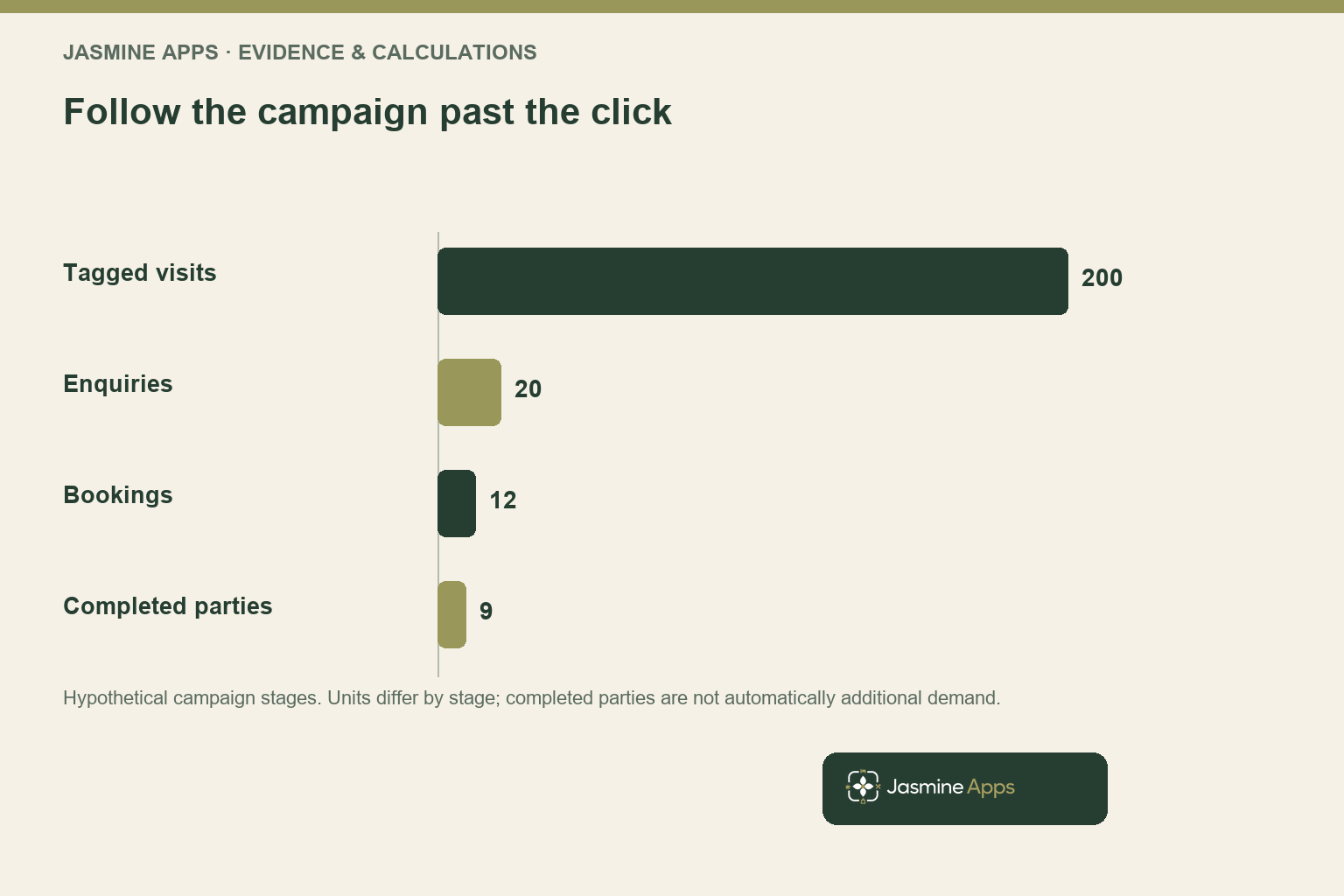
For a hypothetical campaign, assume 200 tagged visits lead to twenty enquiries, twelve bookings and nine completed parties. The stage counts reveal more than a single click total. You can ask whether the information fits the audience, the booking route is usable and the completed-party rate reflects normal service conditions or an issue worth reviewing.
If those nine parties generate £540 contribution before campaign costs, deduct the relevant advertising, offer and content expenses. Suppose they total £150, leaving £390 associated contribution after those costs. That is a useful traced result, but the additional portion still depends on what those guests would otherwise have done and the quality of your comparison.
Keep party, cover and transaction units consistent. A twelve-person event and a two-person dinner should not become equivalent revenue outcomes because both count as one booking. Your review should show the unit and service context, with a clear cost definition, so the manager can compare campaigns without mistaking different business shapes for different marketing effectiveness.
Use hospitality marketing booking attribution to test additional demand
To investigate additional demand, choose a comparison before launching where practical. You might use similar service periods or a suitable audience group that does not receive the same intervention, with appropriate permissions and fair operating decisions. Record other changes in price, availability and local demand so the campaign is not credited for every difference.
A small venue may not have enough observations for a strong causal conclusion from one short test. You can still report traceable completed visits and the operational lessons, with a clear explanation of the comparison. Repeat the process across relevant periods before treating an uncertain pattern as a reliable basis for a large budget increase.
The Google Ads conversion-lift guidance distinguishes exposed and control groups when measuring incremental conversions in supported studies. Use the principle to ask what your own test can establish, while confirming any platform eligibility separately. Your manually planned venue review is not automatically equivalent to a formal lift experiment.
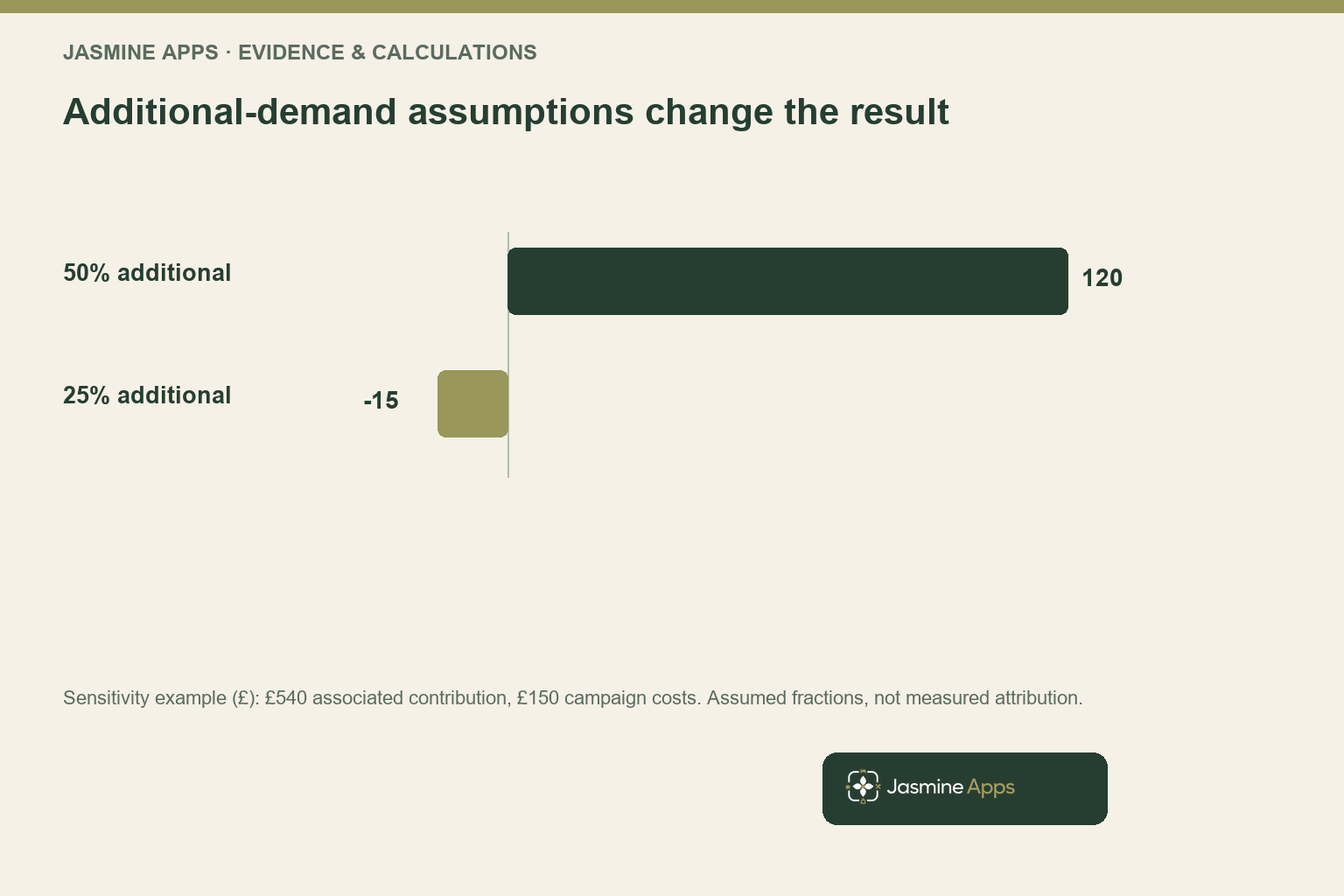
Return to the hypothetical £540 associated contribution. If your justified analysis estimated that half was additional, that gives £270 before the £150 campaign costs, leaving £120. If only a quarter was additional, the comparison becomes £135 less £150, or minus £15. These assumptions show sensitivity, not a measured attribution rate for your venue.
Your marketer should report the traced outcome and the additional-demand estimate side by side. That makes the decision clearer: you can see the record trail, the cost and how much uncertainty affects the result. The next campaign can then improve the measurement as well as the creative message, giving the manager a stronger basis for choosing where to invest.
Make the campaign report useful for the next decision
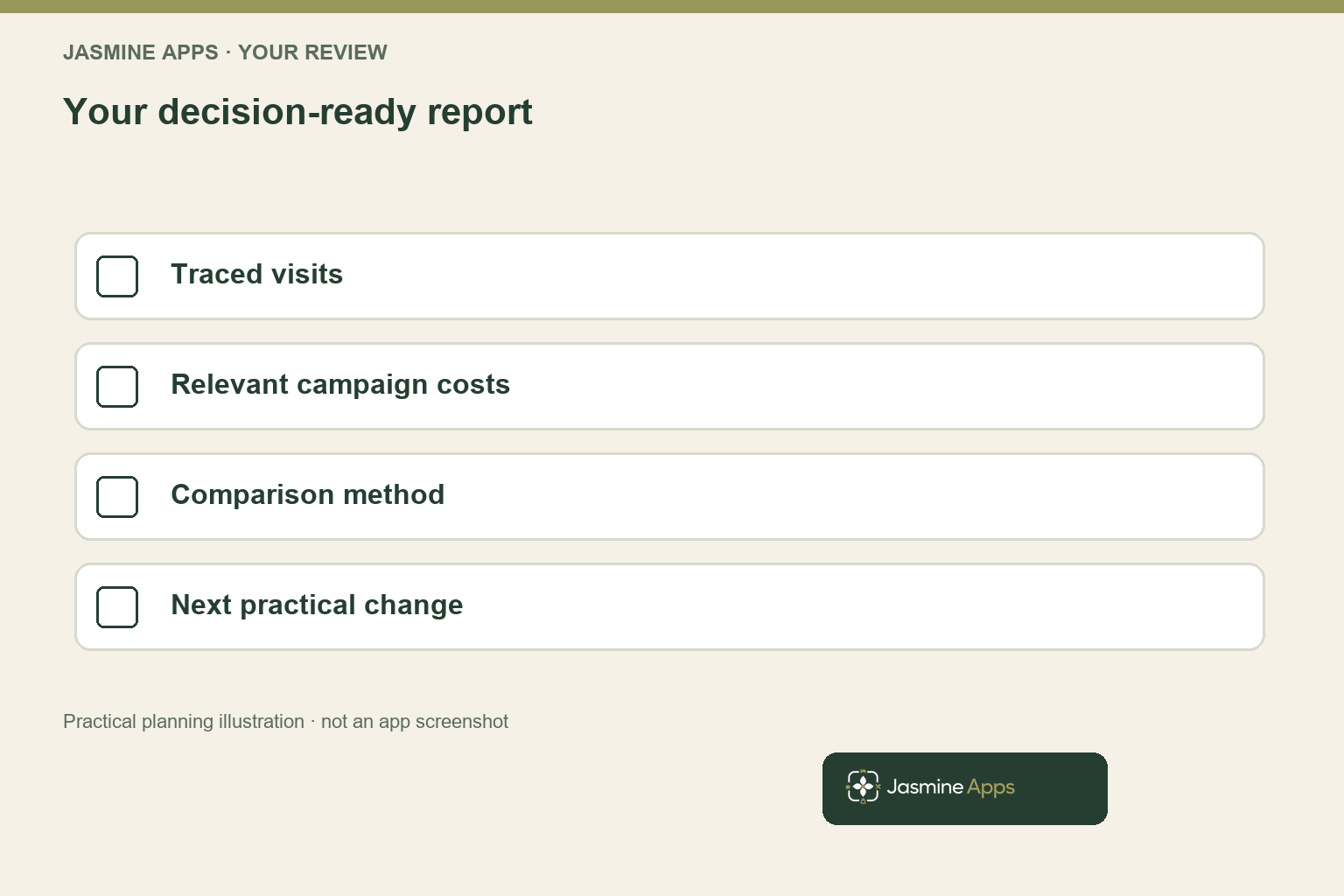
Keep your report short enough to review with the people who can act on it. Include the campaign brief, source references, bookings, completed visits, contribution and relevant costs. Add the comparison method and any important limitation, using plain language so the manager understands the result without reconstructing the analytics setup.
Jasmine Marketing Hub’s content workflow provides content and connected social-profile planning. Its current listed price is £19 per venue monthly or £190 annually, with a 10,000-email monthly description. Confirm email scope, supported channels, reporting and any required data connections in your quote, alongside setup and taxes, before building the measurement around an assumed integration.
Use the report to identify the next practical improvement. High enquiry interest with poor booking completion might call for clearer offer details or a simpler route, while completed visits with weak contribution may require a better incentive. Your hospitality marketing ROI guide helps you keep the commercial calculation joined to those decisions.
Check the data handover before expanding the campaign. A changed booking provider, new landing page or different contact route can break the reference trail even when the message remains successful. Test the supported journey with fictional information and confirm that staff know how to record an offline enquiry relevant to the offer.
Your strongest measurement process gets more useful through repetition. Keep the naming, completion rules and cost basis consistent, then improve the comparison where the evidence is weak. You can explain what followed the campaign and what may be additional, making your next marketing purchase or budget decision with a clear view of both the opportunity and the evidence.
Pro Tips
Test a tagged journey. Follow one approved test link through the supported website and booking route with fictional data. Confirm what reference survives before using the campaign report for a commercial claim.
Record completion rules. Define the event that counts as a fulfilled visit and how cancellations or no-shows are handled. Your attribution trail needs an outcome the operations team can reconcile.
Show sensitivity. Calculate the result under different clearly labelled additional-demand assumptions where the causal evidence is limited. Your manager can see whether the buying case depends on an optimistic interpretation.
Common Mistakes
Calling every traced booking incremental. You overstate impact when some guests already intended to visit. Keep attribution and additional-demand estimates separate.
Stopping the report at reservations. You overlook cancellations and incomplete service. Follow the record to the defined completed outcome before valuing contribution.
Assuming every platform preserves your reference. You can lose the trail when the guest changes route. Demonstrate the data handover and keep a suitable supporting process where needed.
Frequently Asked Questions
How do you track restaurant bookings from marketing?
You can use consistent campaign names, tagged links where supported and an agreed source-reference process for relevant enquiries. Confirm how those records survive the website and booking journey, including offline contact. Follow reservations through cancellation and completed service before calculating contribution. Your report should distinguish what you traced from what you believe the campaign added, with a clear comparison method rather than assuming every associated booking represents new demand for your venue.
Do UTM links prove that a campaign caused a booking?
Your tagged link can help identify the source, medium and campaign associated with traffic in a supported analytics setup. It does not establish that the guest would not have booked otherwise. You still need a suitable comparison to investigate additional demand, and a record route through booking and completion. Keep the traceable outcome and any incremental estimate separate so the commercial review explains both the evidence and its practical limits clearly.
Should you count cancelled campaign bookings as revenue?
You should keep cancellations separate from completed visits and apply the appropriate treatment to any retained payments. A reservation is potential business until the relevant outcome occurs, so counting its full expected bill can overstate the campaign result. Track the completed-service definition and relevant costs consistently. Your manager can then see whether the campaign created useful enquiries, fulfilled demand or a booking pattern that needs a clearer offer or operational follow-up.
How do you estimate additional sales from a hospitality campaign?
You can compare suitable periods or audience groups planned before the intervention where practical, while recording differences in demand, price and availability. Your method and sample determine how strong the conclusion can be. A small test may support a useful directional review without proving a precise uplift. Report traced completed visits, costs and the comparison separately, with labelled sensitivity assumptions where needed, so the next budget decision reflects the evidence you actually have.
Can Marketing Hub join every campaign automatically to a booking?
You should demonstrate the exact data and reporting route required in your proposed setup. The content workflow covers content planning and connected social profiles; automatic joins to every reservation or completed sale need separate confirmation. Agree a practical supporting record where staff involvement remains. Your measurement should use data the team can reliably obtain, with clear campaign names and completion rules, rather than assume an integration because the apps share the Jasmine brand.
Hospitality marketing booking attribution: your next step
Your hospitality marketing booking attribution should give your manager a usable trail from message to fulfilled visit. Request a Marketing Hub demonstration with your campaign reference, booking route and reporting question. You can agree the supported data handover and build a review that makes the next marketing decision clearer.