

Event Enquiry to Agreement: Find Where Good Bookings Get Stuck
· Yiannis Yiasemis

Sending the agreement sooner will not save a booking if the guest still does not understand what they are buying. Your event enquiry to agreement process can stall on a menu choice, room layout or payment question long before a signature becomes the next useful step. The first improvement is finding that unresolved decision.
Sign Jasmine supports the document and recipient workflow once your proposal is ready for agreement. Used within a clear sales handover, it can help your team see the document stage and next responsibility. Your aim is a confident guest decision, supported by accurate paperwork and a follow-up the coordinator can act on.
Key Takeaways
- Separate proposal decisions from document completion.
- Record one next action and owner for each enquiry.
- Send the agreement after the important details are clear.
- Keep recipient roles and signing order understandable.
- Measure completed bookings and elapsed waiting separately.
Map your event enquiry to agreement decisions
Start at the guest’s first useful enquiry, not the moment someone creates a document. Record the intended date, group size, occasion and the information needed to establish a suitable offer. Your coordinator can then distinguish an exploratory question from a booking that is ready for a specific commercial proposal.
List the decisions between enquiry and agreement: availability, space, menu, price, practical arrangements and any relevant payment terms. Each may require another colleague, so identify the owner and the answer needed. A guest waiting for a menu choice should not receive a generic request to sign a document that still leaves the choice unresolved.
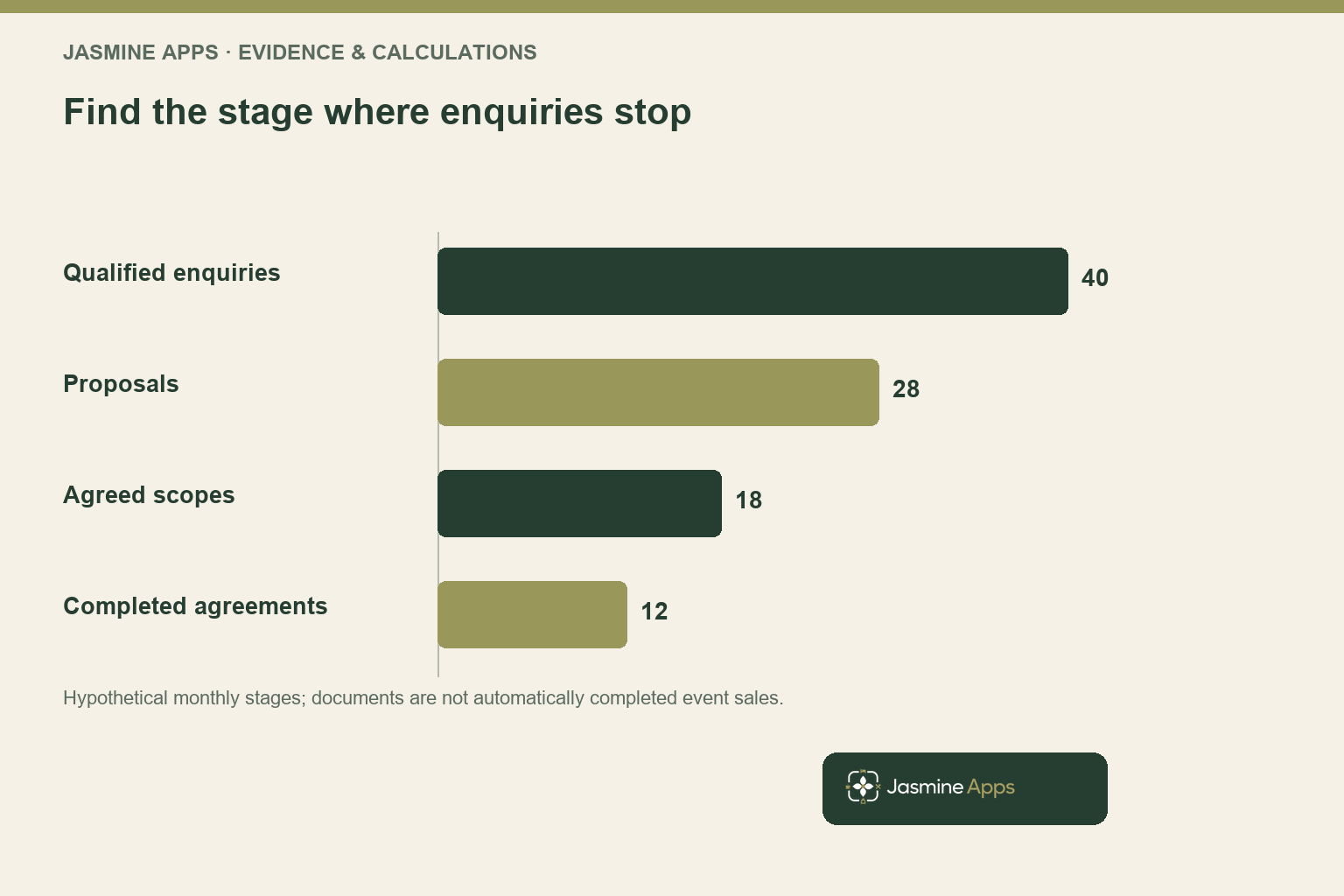
For a hypothetical month, suppose forty qualified enquiries become twenty-eight proposals, eighteen agreed scopes and twelve completed agreements. Those stages show different opportunities. You may need clearer initial qualification, a stronger proposal explanation or a better document handover, depending on why the guest stopped and which stage actually represents the buying decision.
Keep your definitions consistent. A signed document, a deposit and a confirmed event may be separate milestones in your venue’s process, so do not treat them as interchangeable without the applicable terms and operational rule. Your reporting should show what the guest has committed to and what the team still needs to arrange.
Your event agreement objections guide helps you answer the commercial questions before paperwork is sent. This funnel view adds the timing and ownership between those conversations. You can focus follow-up on the unanswered decision, giving suitable enquiries a clearer route towards a booking your venue can confidently fulfil.
Measure event enquiry to agreement waiting by its cause
Elapsed time is useful when you know what the process is waiting for. Separate venue response, guest decision, internal approval and document completion rather than assigning every delay to the client. Your coordinator may find that an internal menu approval takes longer than the signing stage, making a document-only intervention unlikely to solve the real problem.
Use a short next-action record with the current stage, owner, requested answer and agreed follow-up date. Keep the guest’s personal information to what the process needs and apply appropriate access. A clear action such as confirm dietary-information route or approve room layout gives the next colleague more direction than a status saying pending.
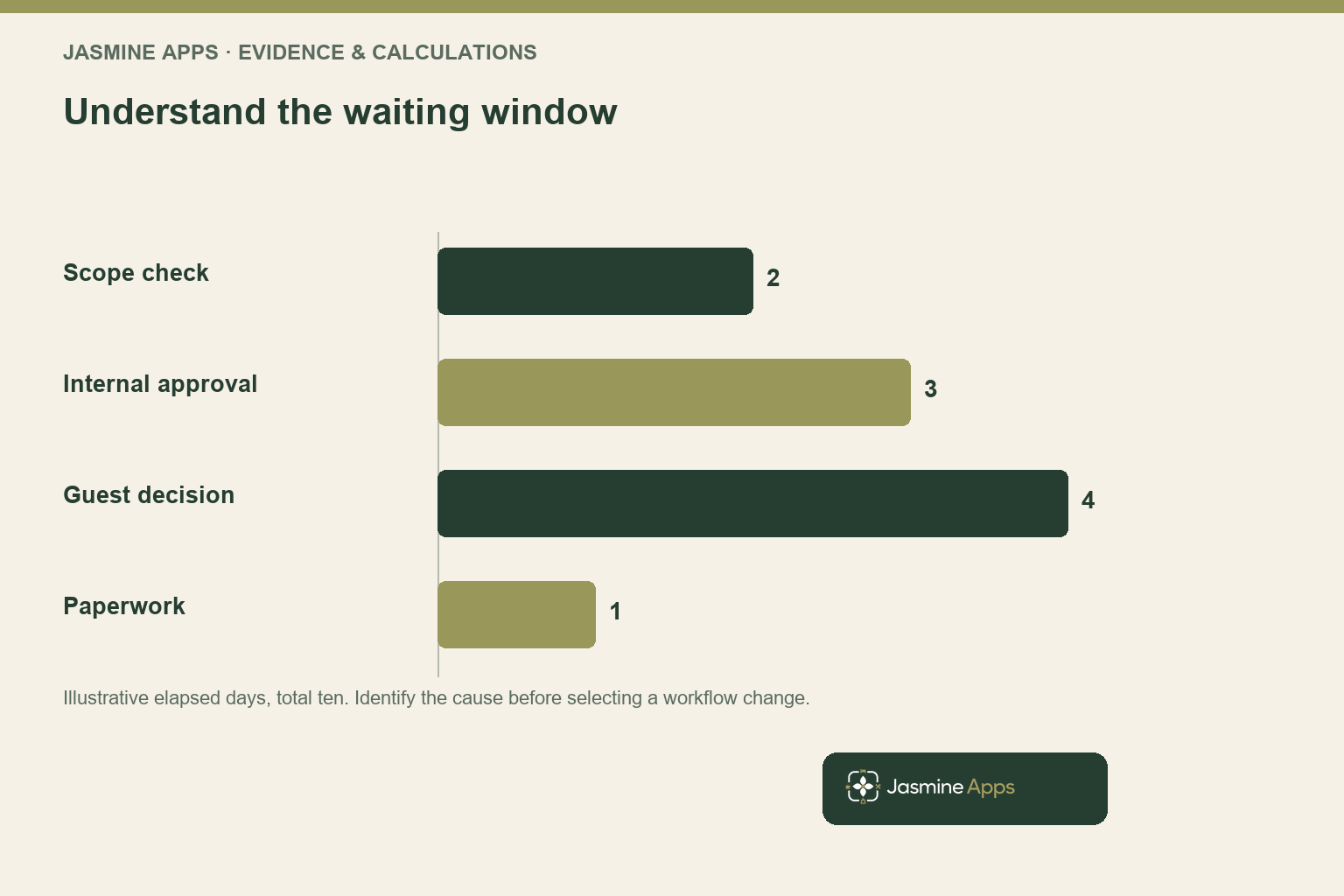
In a worked timeline, two days checking scope, three days approving the proposal, four days awaiting the guest’s decision and one day completing paperwork create ten elapsed days. A clearer internal handover that removes two approval days changes the total to eight, assuming other stages stay the same. The example identifies where to measure, rather than promising a typical conversion improvement.
Ask which waits are necessary for a sound decision and which arise from unclear information. A guest may reasonably need time to coordinate a group, while a venue colleague may simply not know the approval is waiting for them. Your process should help the second case without pressuring the first into an unsuitable commitment.
The CMA’s fair-contract guidance supports clear, transparent consumer terms. Present important conditions where the guest makes the decision, with appropriate review for your venue. Faster paperwork is commercially useful when it follows a clear offer, so the signature stage records an understanding the conversation has already established.
Use Sign Jasmine in your event enquiry to agreement handover
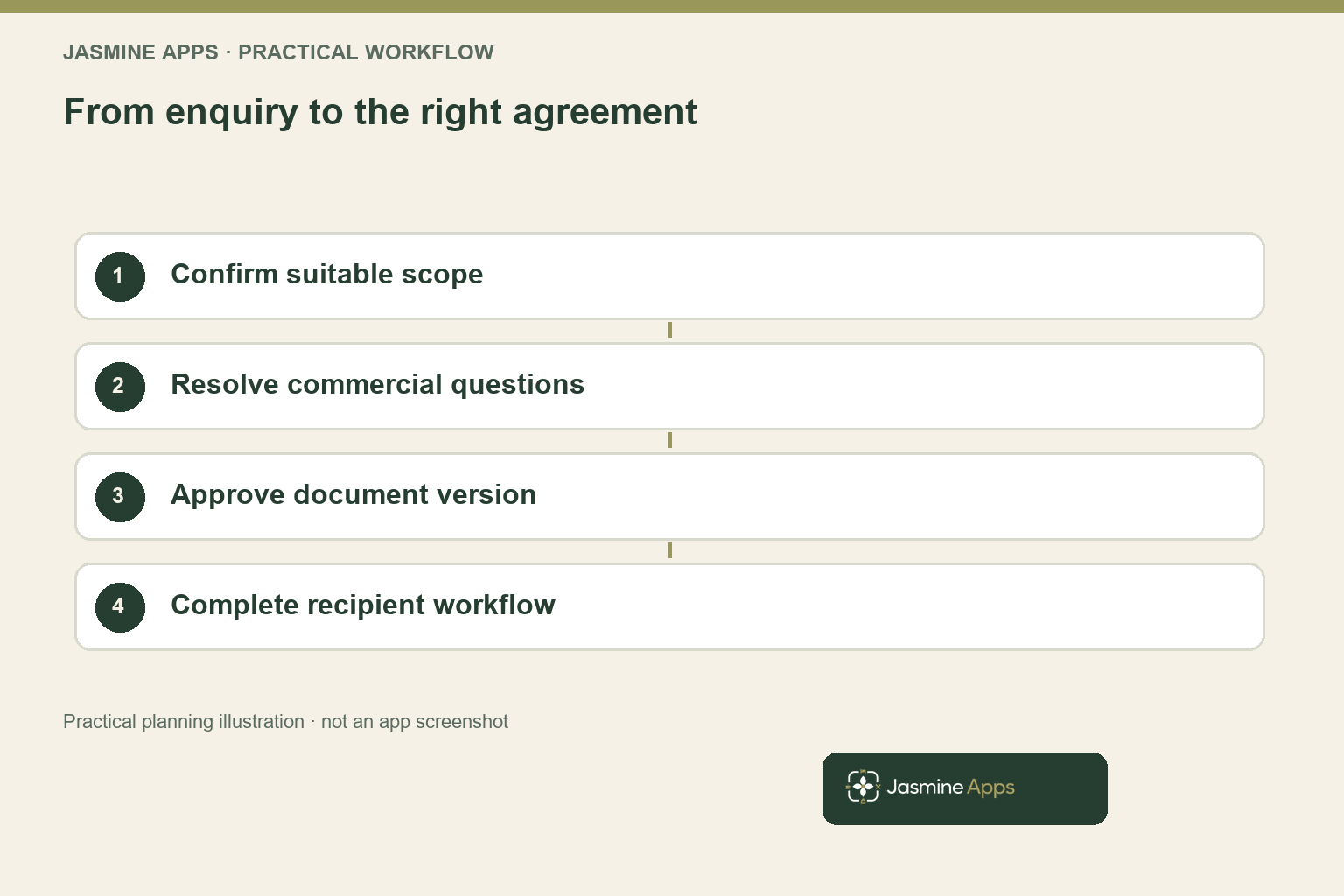
Once your scope is ready, assemble the correct approved document and a clear recipient message. Your coordinator should confirm the event details, relevant version and the people who need to act. That preparation reduces the chance of sending a technically usable link to paperwork that does not match the conversation the guest remembers.
Sign Jasmine’s content workflow includes a PDF, title, message, recipient roles and order, alongside draft, sent, in-progress, completed and voided states. Demonstrate the sequence with a fictional event and suitable test recipients. Ask how the staff member sees the next action and what happens when a recipient or document detail needs changing.
Your document version-control guide explains the underlying file discipline. Keep that process linked to the sales handover, with one approved version and a known route for amendments. A completed status is useful only when it relates to the correct document and the commitment your venue intended to record.
The Law Commission’s electronic-execution report explains that electronic signatures can be valid where the required intention and formalities are met. Your particular agreement and process still need appropriate review. Confirm recipient roles, any required witnessing and applicable requirements before treating a product feature as a guarantee for every document.
Jasmine Apps currently lists Sign Jasmine at £15 per venue monthly or £150 annually, with unlimited documents in its listed scope. Confirm your delivered features, setup, support and taxes in the quote. Bring the whole fictional enquiry-to-completion route to the demonstration so the subscription supports a practical stage in your actual sales process.
Turn the enquiry funnel into a useful weekly review
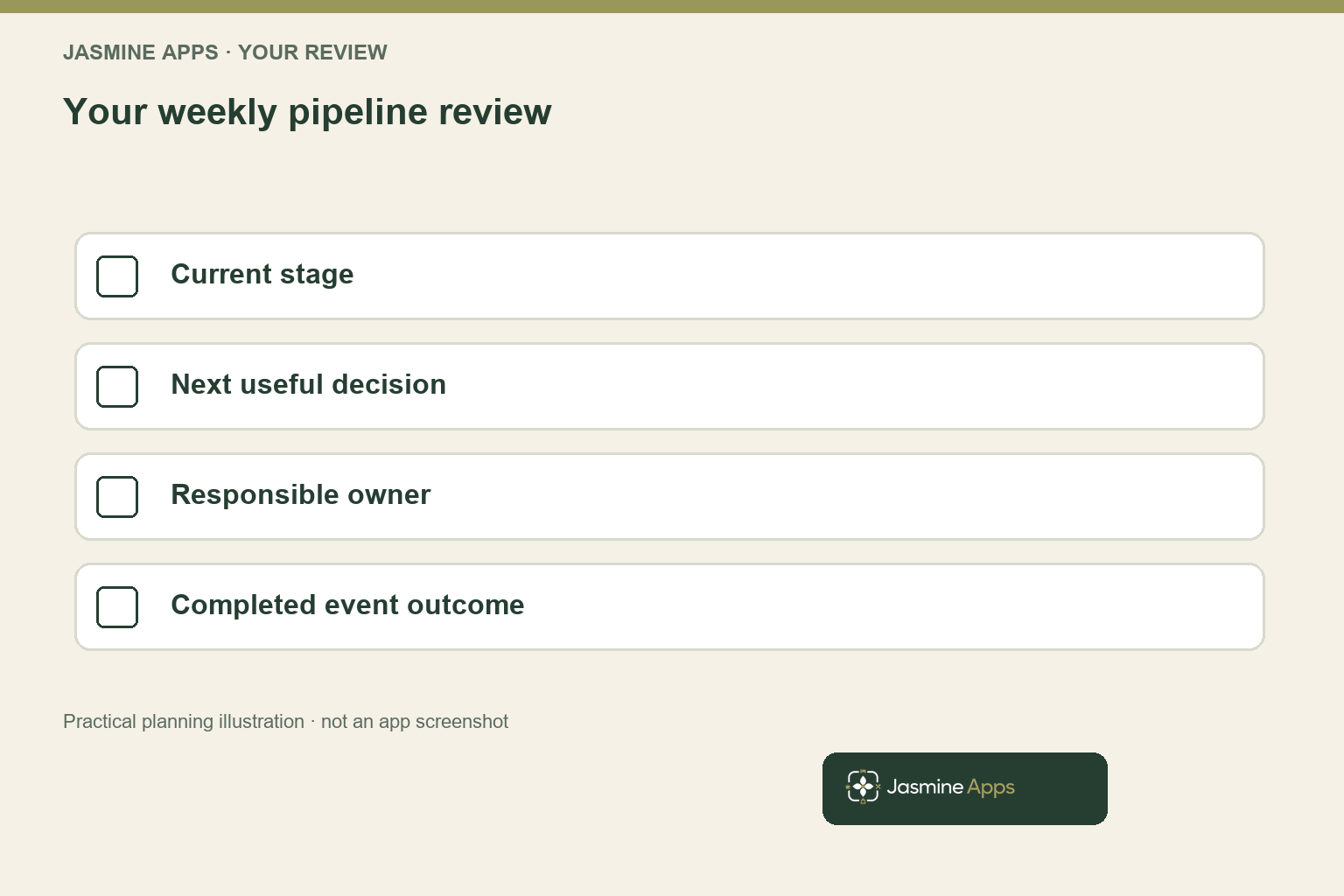
Review a small set of qualified enquiries with the coordinator responsible for follow-up. Look at the stage, next action, owner and elapsed wait, then identify the bookings that need a useful answer. Your meeting should help the team move work forward rather than create another list of unresolved opportunities nobody is accountable for handling.
Measure completed bookings separately from document speed. A faster signing stage may reduce administration without changing how many suitable enquiries become events, while a clearer proposal can improve the buying decision before the document exists. Keep those outcomes distinct so you can select the intervention that fits the actual bottleneck.
Track the contribution from completed events on a consistent basis. A sent proposal is potential business, not realised contribution, and a signed agreement may still have cancellation or fulfilment conditions. Your commercial review should account for the booking’s final outcome and relevant costs before assigning revenue value to a quicker workflow.
Use guest questions to improve the standard proposal. Repeated uncertainty about menu choices, deadlines or room arrangements can often be resolved with better information and ownership. Confirm the wording with the operational colleague who will fulfil the promise, so the faster sales process remains joined to the service your venue can deliver.
When the process works, make the handover repeatable. Your coordinator knows the next decision, your guest receives understandable information, and the document stage has a clear place in the journey. You can then expand the signing workflow with confidence, measuring practical administration and booking outcomes rather than assuming that every completed document represents additional sales.
Pro Tips
Qualify before drafting. Confirm the date, group and essential service fit before building a detailed agreement. Your coordinator can focus document work on enquiries that have a practical route to a suitable booking.
Give follow-up a question. Ask for the decision that is actually outstanding. A useful follow-up about menu scope or approval is easier for the guest to act on than a generic reminder to complete everything.
Keep stage definitions distinct. Define proposal acceptance, signing, payment and confirmed booking in your process. That prevents a document count from being presented as a completed-event result.
Common Mistakes
Sending paperwork before scope is clear. You invite questions or amendments that delay the next stage. Resolve the important offer decisions before requesting agreement.
Treating every wait as guest delay. You miss internal approvals and information gaps the venue can address. Record the owner and cause of the waiting period.
Counting signed documents as realised sales. You can overstate the outcome when fulfilment or cancellation conditions remain. Track completed events and contribution separately from document completion.
Frequently Asked Questions
How do you improve event enquiry conversion?
You should first identify where suitable enquiries stop and what decision remains unanswered. Define the stages from qualification through proposal, agreed scope and the required commitment, with a next-action owner for each. Improve the information or handover at the weak stage, then measure completed bookings separately from elapsed time. Your result depends on guest fit and fulfilment as well as paperwork, so a faster signing link alone may not solve the problem.
When should you send an event agreement?
You should send it when the important scope, price and practical conditions are clear enough for the guest to make the intended commitment. Confirm the approved document version and recipient roles before dispatch, with appropriate review of the terms and formalities. If a menu or room decision is still unresolved, give that question a clear next step first. Your agreement should record the understanding reached in the proposal conversation with your guest.
What should you track between an event enquiry and booking?
You can track qualified enquiries, proposals, agreed scopes, required documents, payments where relevant and completed events using clear definitions. Add the current next action, owner and waiting cause so the coordinator can move the process forward. Keep document completion separate from realised contribution. Your weekly review should identify the useful decision needed next, while your commercial reporting reflects the final booking outcome and the costs of fulfilling the event.
Are electronic signatures valid for event agreements?
Electronic signatures can be valid when the relevant intention and required formalities are met, as explained by the Law Commission for England and Wales. Your agreement and process need appropriate review for their circumstances, including any specific requirements. Confirm the approved file, recipient roles and signing route before rollout. Your software demonstration should show how the record is maintained, while legal suitability is assessed for the document and commitment you intend to use.
How much does Sign Jasmine cost?
Jasmine Apps currently lists Sign Jasmine at £15 per venue monthly or £150 annually, with unlimited documents in its listed scope. Your quotation should confirm delivered capabilities, setup, support and taxes. Demonstrate the PDF, message, recipient roles, order and completion route using a fictional event. Include amendment and exception handling so the subscription supports your actual enquiry-to-agreement handover, rather than only the simplest possible document-signing example for your team.
Event enquiry to agreement: your next step
Your event enquiry to agreement process should help a suitable guest reach a clear decision and your coordinator complete the next handover. Request a Sign Jasmine demonstration with a fictional event proposal and your approval route. You can leave with a practical document workflow and a funnel review that shows where valuable bookings need a better answer.