

Seasonal Hospitality Training: Check Skills, Not Just Completion
· Jasmine Apps

Your colleague can finish a course and still be unsure what to do when a real guest asks for help. Completion records show participation; they do not automatically show that learning transferred into service. Your seasonal hospitality training should connect a relevant refresher with an observable task your team needs to perform.
Clock Jasmine includes a live course catalogue with published and active controls. You can use a demonstration to assess that learning structure, while keeping your supervisor’s practical check central to the decision.
Key Takeaways
- Choose refreshers around role-specific seasonal tasks.
- Check published content and approval status before assigning learning.
- Pair completion with an observed task and a feedback conversation.
- Value training time honestly instead of assuming instant savings.
- Review what remains uncertain before the busiest service.
Choose seasonal hospitality training from the task backwards
You should start with the work that changes during the season. Your team may handle larger groups, different service timings or more frequent event handovers. Those changes create specific learning needs, even when the staff involved already know your venue.
Ask your supervisors where the task becomes uncertain. You might find that colleagues understand the routine but miss the exception, such as who owns an unresolved guest request. A focused refresher can address that point more usefully than asking everyone to repeat an unrelated course.
The CIPD learning-and-development guidance connects learning needs, design and evaluation. Your practical application is to define the required task before choosing the content and the measure. That method does not establish a guaranteed performance gain from any particular app or course.
Write a simple observable outcome. Your colleague should be able to explain the approved handover, demonstrate the relevant service sequence or identify the correct escalation route. Avoid vague targets such as becoming more confident unless you also define how useful confidence would appear in the work.
Your refresher should complement your venue-specific instructions. A general customer-service course can support a discussion, but it cannot establish your current event timings, menu changes or named responsibilities. Your supervisor needs to join the learning material to the operation your staff will actually deliver.
This article addresses returning or already inducted staff refreshing seasonal work. Use your existing induction arrangements for new starters and access setup. Keeping those purposes distinct prevents a seasonal learning programme from becoming a repeat of the same introductory checklist for every colleague.
Evaluate seasonal hospitality training beyond the completion tick
Your first measure can be whether the chosen learning is completed, but your review should not end there. Ask a supervisor to observe the relevant task with a consistent checklist. You then have evidence about the action you wanted to improve, rather than only a record that someone opened the material.
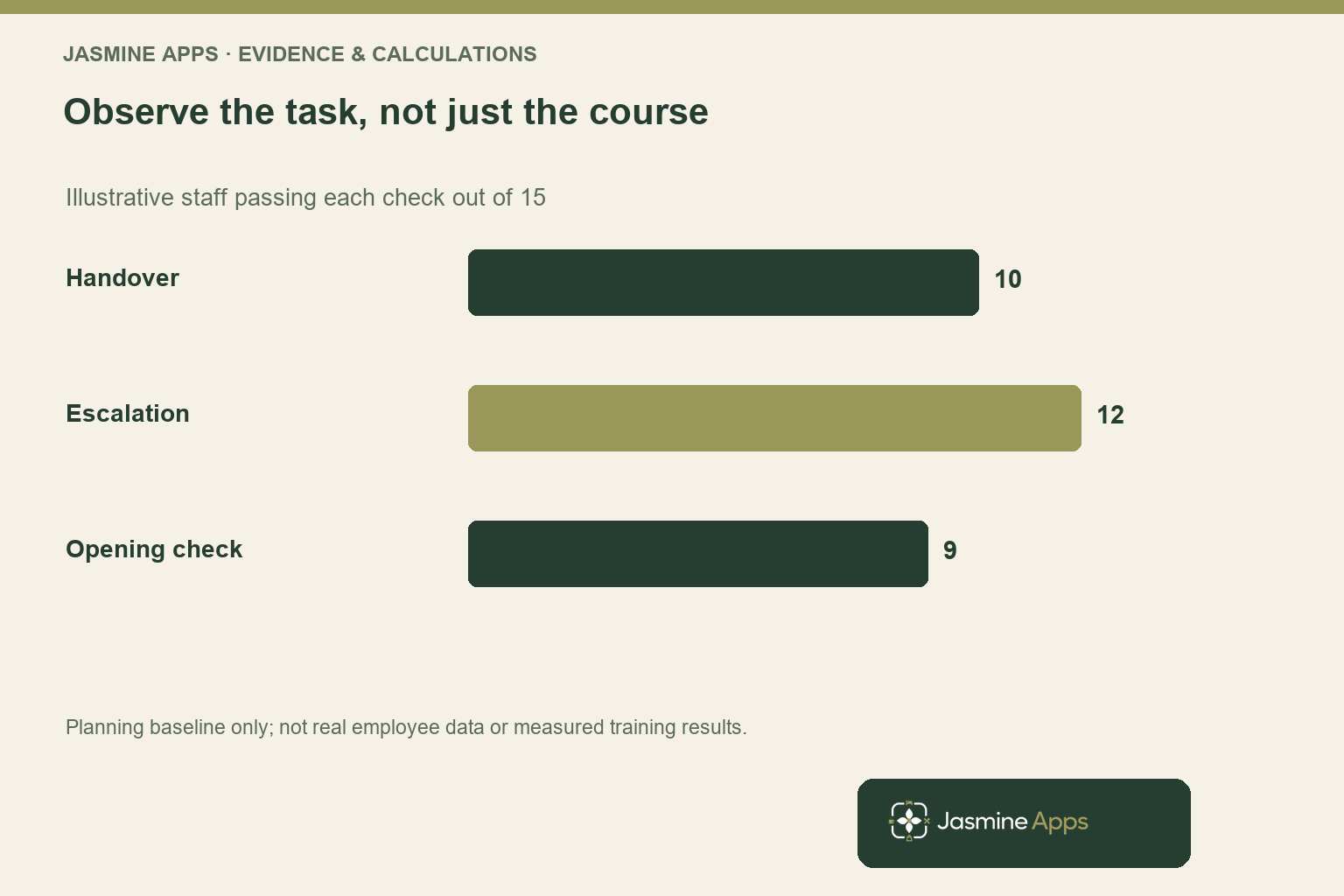
Consider an illustrative group of fifteen staff. Before a refresher, ten might demonstrate the agreed handover correctly, twelve might identify the escalation route and nine might complete the opening check. These values show how to structure a baseline; they are not findings from a Jasmine customer or an employee assessment.
You should repeat the observation using comparable conditions and the same definitions. Do not assume every difference comes from the course, because coaching, practice and changes to the instructions can also influence the outcome. Record those influences rather than presenting a simple before-and-after chart as proof of causation.
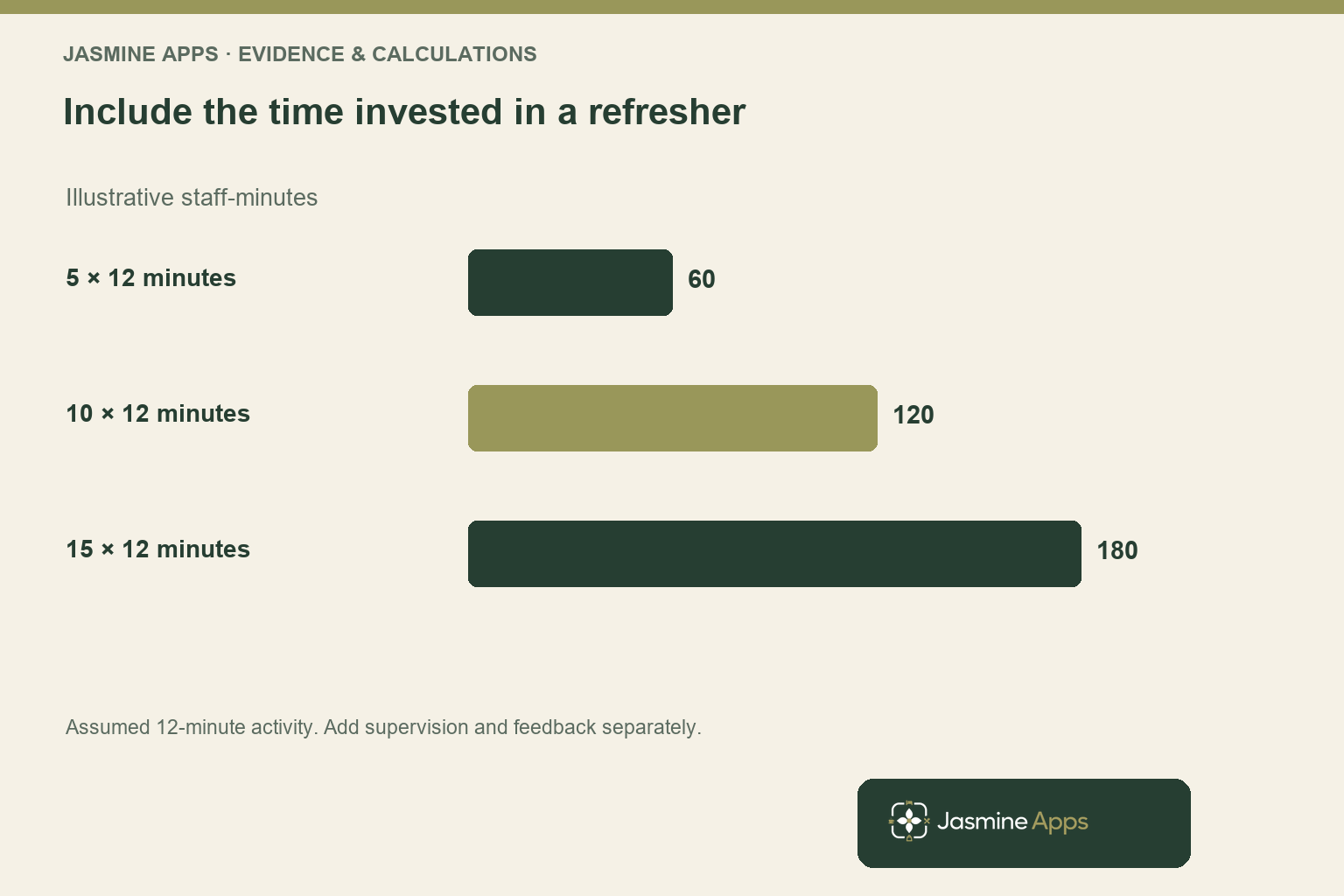
The training time also belongs in your decision. Fifteen colleagues spending twelve minutes each use three hours of capacity. At an assumed £18 hourly value, that is £54 of time value, before supervision or other costs. Your financial assessment should compare this investment with a measured benefit, not call training itself a saving.
You can use correction time as a practical follow-up measure if you define it carefully. Record avoidable rework connected to the specific task, while keeping necessary guest-service work separate. A busy event and a quiet shift do not provide identical conditions for comparison.
Your strongest result is a task your team can perform reliably when the season becomes demanding. That can support service quality and reduce uncertainty, but you should quantify a sales or cost claim only when your venue has evidence connecting the learning to that outcome.
Check seasonal hospitality training content in the live catalogue
The live Clock catalogue shows course records with draft, published and archived states, along with published and active controls. Its examples include opening and closing procedures, customer-service basics, complaints handling and cash-handling basics. You should inspect the actual content and status relevant to your team before planning the refresher.
The catalogue also uses an Internally Approved label. You should not describe that as an external qualification, accreditation or a guarantee of regulatory compliance. Some internal awareness material explicitly distinguishes its purpose from externally approved training.
Ask the demonstrator to show how the required course becomes available to the intended staff. Catalogue visibility alone does not prove every role assignment, notification or completion workflow you might want is configured. Bring a small fictional team and a specific task so the demonstration can resolve the actual sequence.
Your supervisor should review the course against your venue’s current procedure. If the general material uses a different service model, explain the local instruction and check that the colleague understands the distinction. You need one practical answer during service, not competing versions of the same task.
Keep any formal or legally required training decisions with the responsible person and appropriate professional advice. An internal refresher can support your operating preparation without replacing external requirements that apply to a role or activity. Your purchase discussion should describe that boundary clearly.
You should also provide a route for questions. If a colleague completes the material but remains unsure about the exception, the refresher is not finished from an operational perspective. Record the uncertainty, improve the instruction and let the supervisor check the task again before relying on it during a busy service.
Run a role-specific refresher before expanding the programme
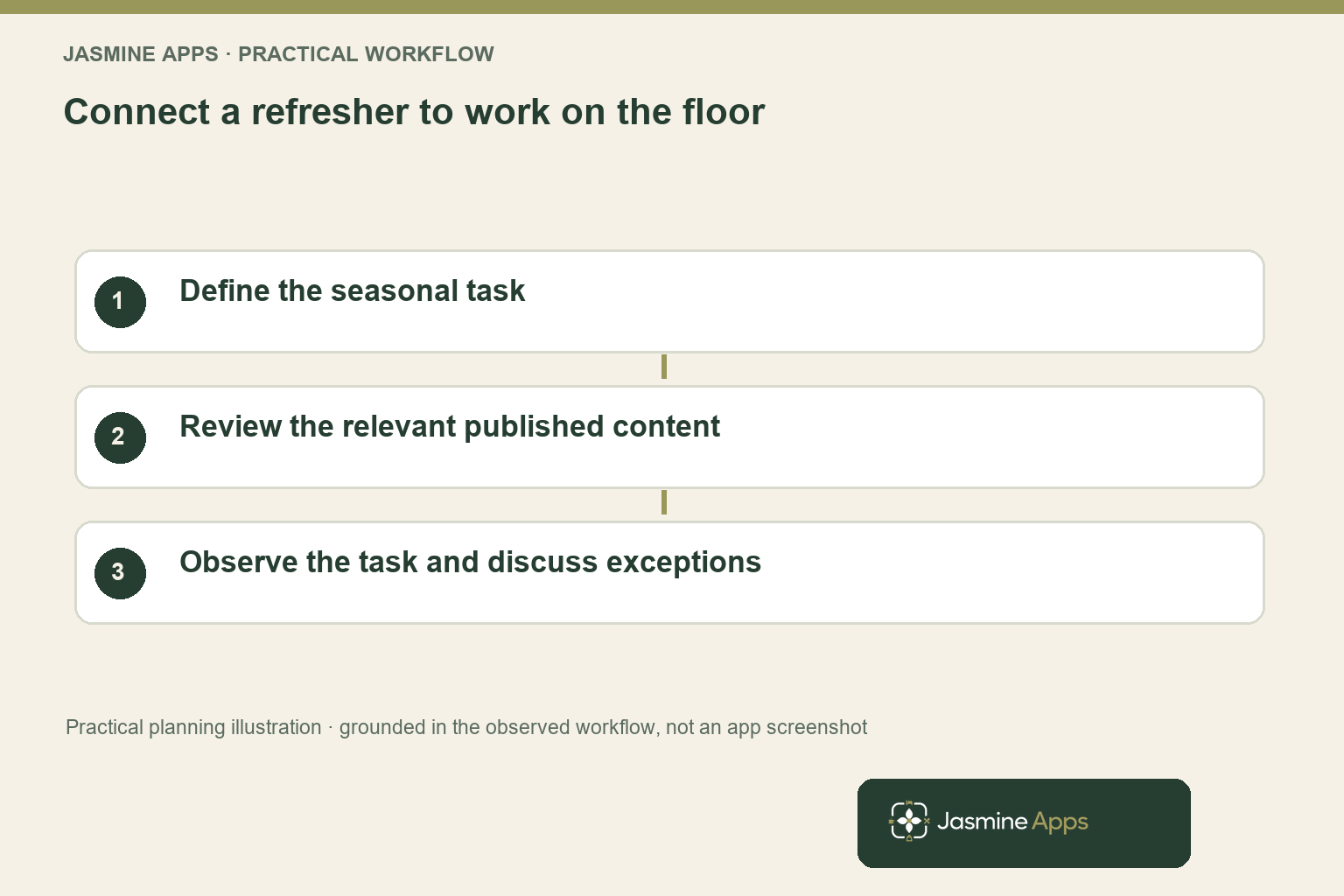
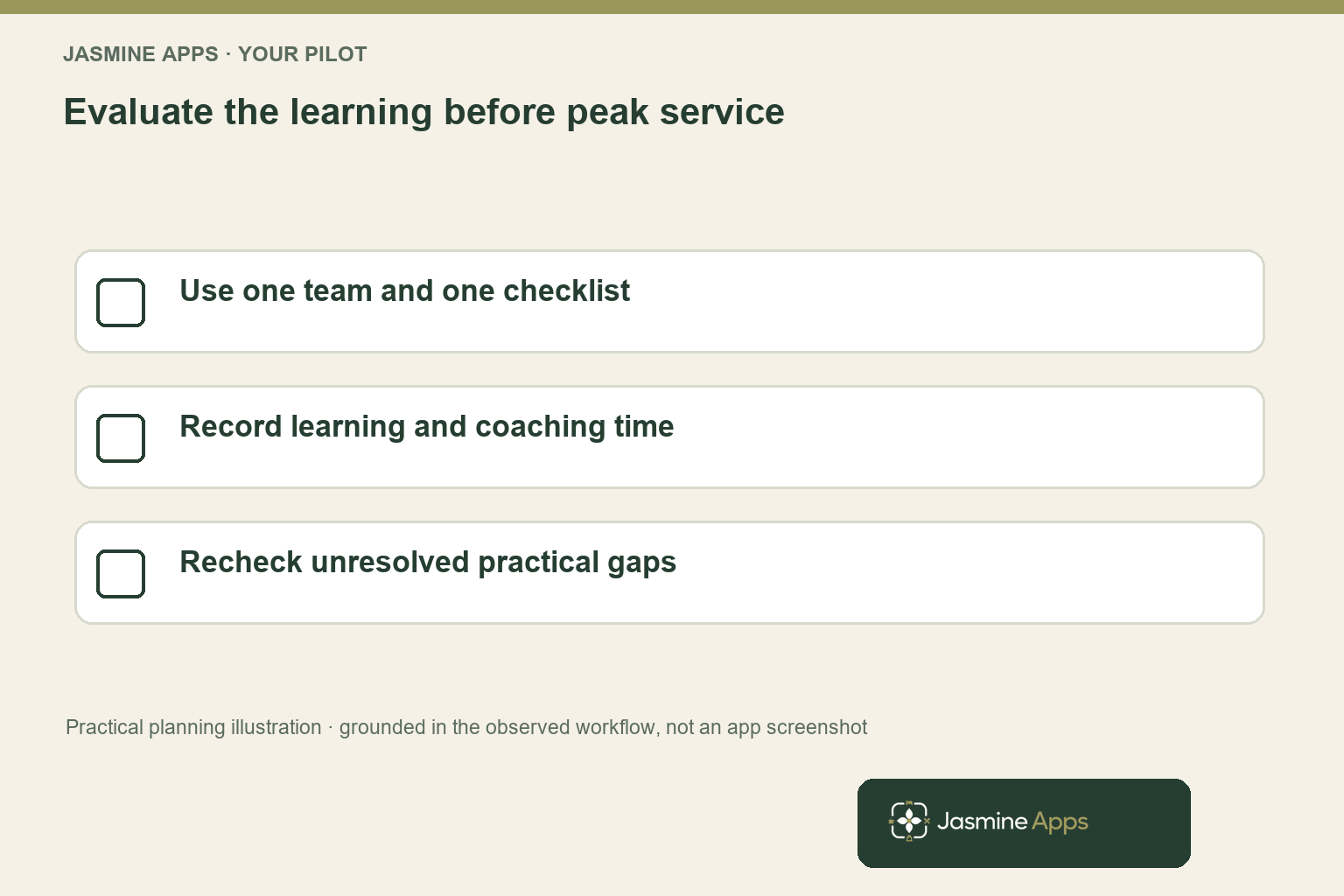
Choose one seasonal task and one relevant team for your first pilot. Confirm the current instruction, review the learning content and agree the observation checklist. Your programme becomes easier to evaluate when each element serves the same defined task.
Record the time needed for learning, supervision and feedback. You can then compare that investment with task reliability and any defined rework measure. Keep private individual results inside the appropriate staff process; use anonymised totals for your commercial review.
The CRM lists Clock Jasmine at £1 per employee per month with a £25 monthly minimum, and £10 per employee annually. Your quote should confirm the required learning scope, any annual minimum, tax basis and other agreed charges. Do not assume a visible course catalogue establishes every entitlement in every proposed package.
Review your findings before the busiest service, while there is still time to adjust the instruction. Your goal is to discover a gap early rather than collect a large completion total after the problem has affected guests. A short feedback loop makes the refresher useful to supervisors as well as staff.
The hospitality rota-changes article addresses a related handover problem. Your seasonal preparation can connect learning and scheduling, but they remain different decisions: a trained colleague still needs an approved shift, and a published shift does not prove competence.
Use the software-adoption guide when you expand beyond the pilot. Keep role relevance, supervisor ownership and observed transfer in the plan. Those details help your team use the learning for service rather than treat it as another administrative box to tick.
Pro Tips
Observe the exception. Check what your colleague does when the routine does not fit. You often discover the most important uncertainty at the escalation step.
Make the checklist specific. Use a clear action and an approved source. A broad impression that someone seemed confident is difficult to compare or improve.
Review before the peak. Leave time to correct the instruction and practise again. A completion report after the event cannot prevent the gap you have already encountered.
Common Mistakes
Calling internal approval accreditation. You misrepresent the course’s status. Use the actual catalogue label and confirm any separate qualification requirement.
Counting completion as competence. You miss whether learning transferred into the task. Pair participation with an appropriate observation and feedback.
Assigning every course to every role. You use time without a clear need and dilute the relevant message. Choose content around the work each team must deliver.
Frequently Asked Questions
What training should seasonal hospitality staff receive?
You should choose training around the tasks and exceptions your team will face during the season. Returning staff may need a refresher on changed service timings, group handovers or escalation routes rather than a complete repeat of induction. Review the content against your venue’s approved procedures and any separate formal requirements. You can then pair the learning with a practical observation so supervisors know what the team can deliver.
How do you know hospitality training has worked?
You should define the task before the training and observe it afterwards with a consistent checklist. Completion shows participation, while a practical check helps you assess whether the learning reached the work. Record coaching and other changes that could influence the result. You can also review a clearly defined rework measure, but should avoid attributing every service improvement or sales change to the course without supporting evidence.
Are Clock Jasmine courses externally accredited?
You should use the status shown for the specific course and confirm any separate requirement with the responsible person. The live catalogue includes an Internally Approved label, which you should not describe as an external qualification or accreditation. Review the material’s purpose and approval status before assigning it. Your internal refresher can support venue preparation without automatically replacing formal training or compliance obligations that apply to the role.
Should returning staff repeat new-starter induction?
You should assess the current need rather than automatically repeat every introductory task. A returning colleague may understand the venue but need an update on changed procedures or seasonal responsibilities. Keep essential induction and access checks where they are required, then choose a focused refresher for the relevant work. Your supervisor should verify the task and resolve exceptions, so the programme is both proportionate and useful before service becomes demanding.
Can training software save your restaurant money?
You may reduce avoidable rework or improve preparation when relevant learning transfers into a dependable task, but you should measure that outcome at your venue. Include staff learning time, supervision and feedback in the cost. Released capacity is not automatically a reduction in paid expenditure. Your strongest purchase case identifies a specific problem, demonstrates the learning workflow and records the operational result before making a broader financial claim.
Seasonal hospitality training: your next step
Your seasonal hospitality training should leave your team able to perform the work, not just complete the material. Request a Clock Jasmine learning demonstration with one seasonal task and your role groups. You can inspect the relevant course status, confirm the proposed scope and plan a practical check before your busiest service.