

Restaurant Kitchen Order Handover: Find Where Service Slows
· Yiannis Yiasemis
Your food can be ready while your guest is still waiting for their meal to begin. An unacknowledged change, an unclear course instruction or a plate waiting for the rest of its table can create delay outside the cooking itself. Your restaurant kitchen order handover needs to connect order entry, production and dispatch before another device can solve the problem.
Till Jasmine includes product fields for course and kitchen alongside your charging setup. Those details give you a concrete starting point for a demonstration, but the full handover also depends on your equipment, routing and team responsibilities. Map one table's journey first, then use the evidence to decide whether you need configuration, training, hardware or a different service rule.
Key Takeaways
- Separate entry, routing, preparation and dispatch time.
- Test changes and cancellations as well as new orders.
- Confirm your exact kitchen output and equipment scope.
- Give clarification and escalation a named owner.
- Measure complete tables and guest experience, not ticket speed alone.
Map your restaurant kitchen order handover before timing the chef
Start with the point when your server accepts an order, then follow what happens until the table receives the intended food. Your stages might include till entry, transmission, kitchen acknowledgement, preparation, pass assembly and delivery. Do not assume that a timestamp labelled order time represents the moment the chef started work or even received a usable instruction.
Watch one ordinary table and one order that changes after entry. Record the practical handovers with anonymous references, following your workplace policies. Your observer should distinguish waiting for clarification from active preparation, because those require different responses. Another cooking station will not remove a question about which dish replaces an item already being prepared.
Use a simple timeline with a clear definition for each boundary. If you record order sent, define whether that means the operator completed entry or the receiving equipment produced output. Where the system does not expose a stage, use an approved observation rather than inventing an automatic timestamp. Keep the method consistent so the next service can be compared sensibly.
Consider the whole table. Two dishes delivered quickly and two delivered late can produce a poor experience even when the average ticket time looks acceptable. Record whether the guests can start together under your service standard, and identify when the pass holds completed food while waiting for another part of the order.
Your bar queue improvement guide addresses the wider service flow. Here, focus on the information travelling from guest to production and back to the server. You will leave the observation with a short list of actual waiting points, rather than a general belief that the kitchen or the till is always the bottleneck.
Check restaurant kitchen order handover settings against the real menu
Review a small but representative set of products with the person responsible for your configuration. Include a starter, main, side, dessert and any product prepared in a different area. Your product names should identify the intended item clearly, while your operational fields should match the way the venue actually organises preparation and service.
Till Jasmine's product record includes course and kitchen fields. Demonstrate how those fields affect your proposed output with your actual equipment and configuration. Confirm whether the installation uses printers, displays or another supported route, and what happens when a product has no intended kitchen destination. A visible field alone does not establish every routing behaviour or hardware entitlement.
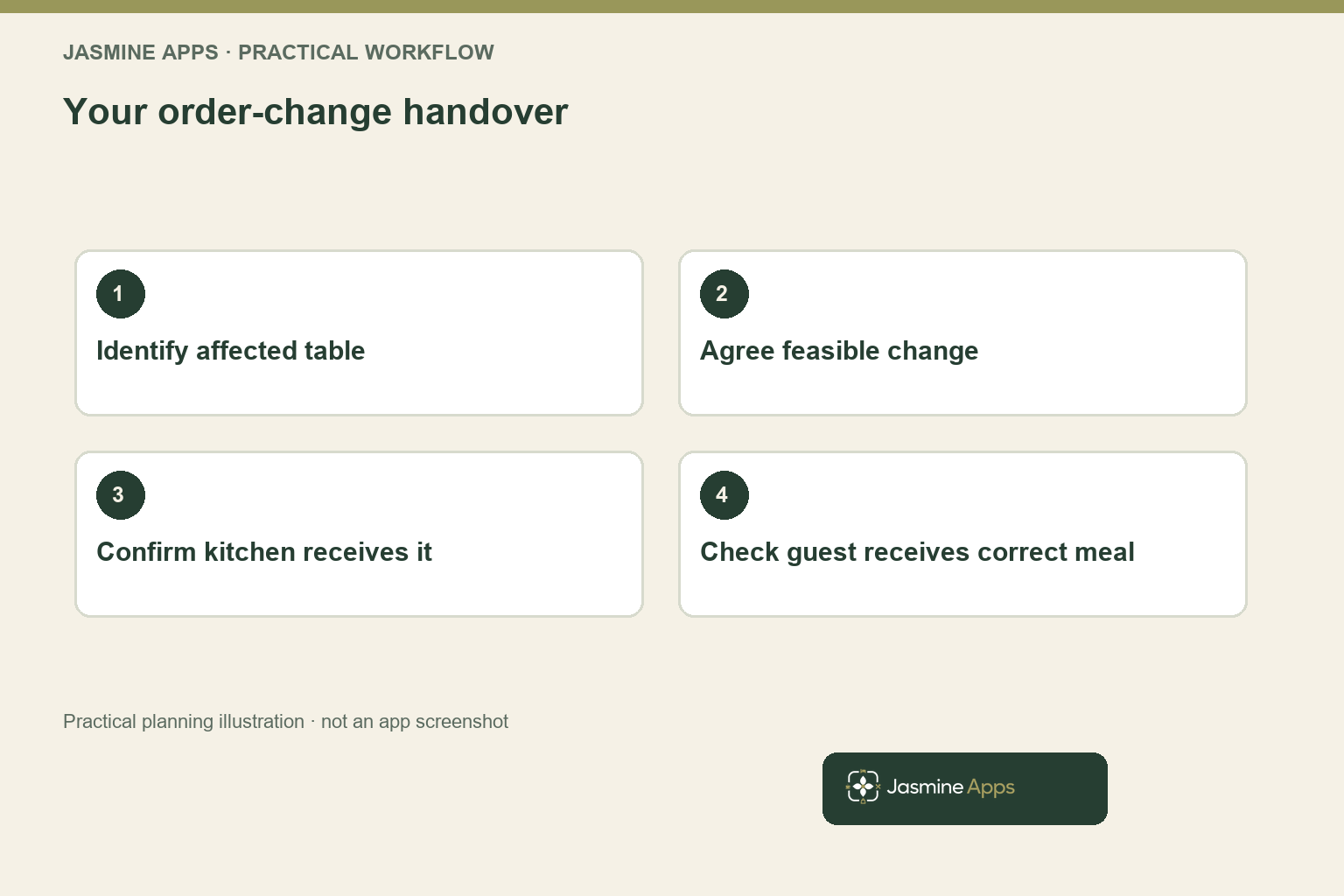
Use fictional orders in an approved test environment. Check the receiving output for table identity, product, quantity, relevant changes and course instructions. Your kitchen colleague should explain what they would prepare from that output without the server translating it verbally. If they need another explanation, improve the naming, configuration or agreed process before assuming the technology is finished.
Test the products your team finds awkward, not only the simplest item in the catalogue. A set menu, repeated side or item prepared by a separate station may expose a different handover. Confirm the supported handling of your particular request rather than assuming that every modifier, split course or production sequence behaves identically.
Keep the successful test cases with your configuration notes. When your menu changes, you can repeat the relevant examples before publishing the new layout. Your EPOS migration checks provide a broader changeover framework; this routing check becomes one part of maintaining a menu that your kitchen can interpret reliably throughout normal service.
Test restaurant kitchen order handover when the guest changes their mind
Your most revealing test begins after the original order has reached the kitchen. Ask what happens when the guest changes a dish, cancels an item or adds a request while preparation is underway. Your process must make the current instruction understandable without leaving the kitchen to guess whether a new message replaces or supplements the first.
Define who confirms a change has been received and who decides what can still be altered safely. A server should not assume that updating the bill stops food already cooking. Your manager needs an agreed handover for the operational change, with a practical escalation route when the kitchen cannot fulfil it or a price adjustment needs approval.
Allergen communication requires particular care. Your Food Standards Agency guidance reference sets the context for accurate allergen information; follow your approved procedures and involve the responsible trained colleague. A note on a ticket should never be treated as a guarantee that a changed meal can be made suitable without checking ingredients and preparation conditions.
Include an interruption in the demonstration. Your operator might be serving another table when the chef asks a clarification question, so decide where that question goes and how it is closed. If the answer lives only in a conversation with someone who then leaves the station, the next colleague may act on the old instruction despite every device working correctly.
Keep your correction record factual and useful. Record the affected order, what changed, the agreed response and whether the guest received the intended outcome, using only appropriate information. You can then distinguish training needs, configuration problems and reasonable last-minute requests instead of grouping every correction under a single category called kitchen error.
Measure waiting time separately from cooking time
Your timing review should separate stages that can be improved through information from stages determined by the dish and safe preparation. Compare similar orders under similar demand. A long preparation time for a deliberately slow-cooked menu item does not mean your handover failed, while a short cooking time can hide several minutes spent finding a missing clarification.
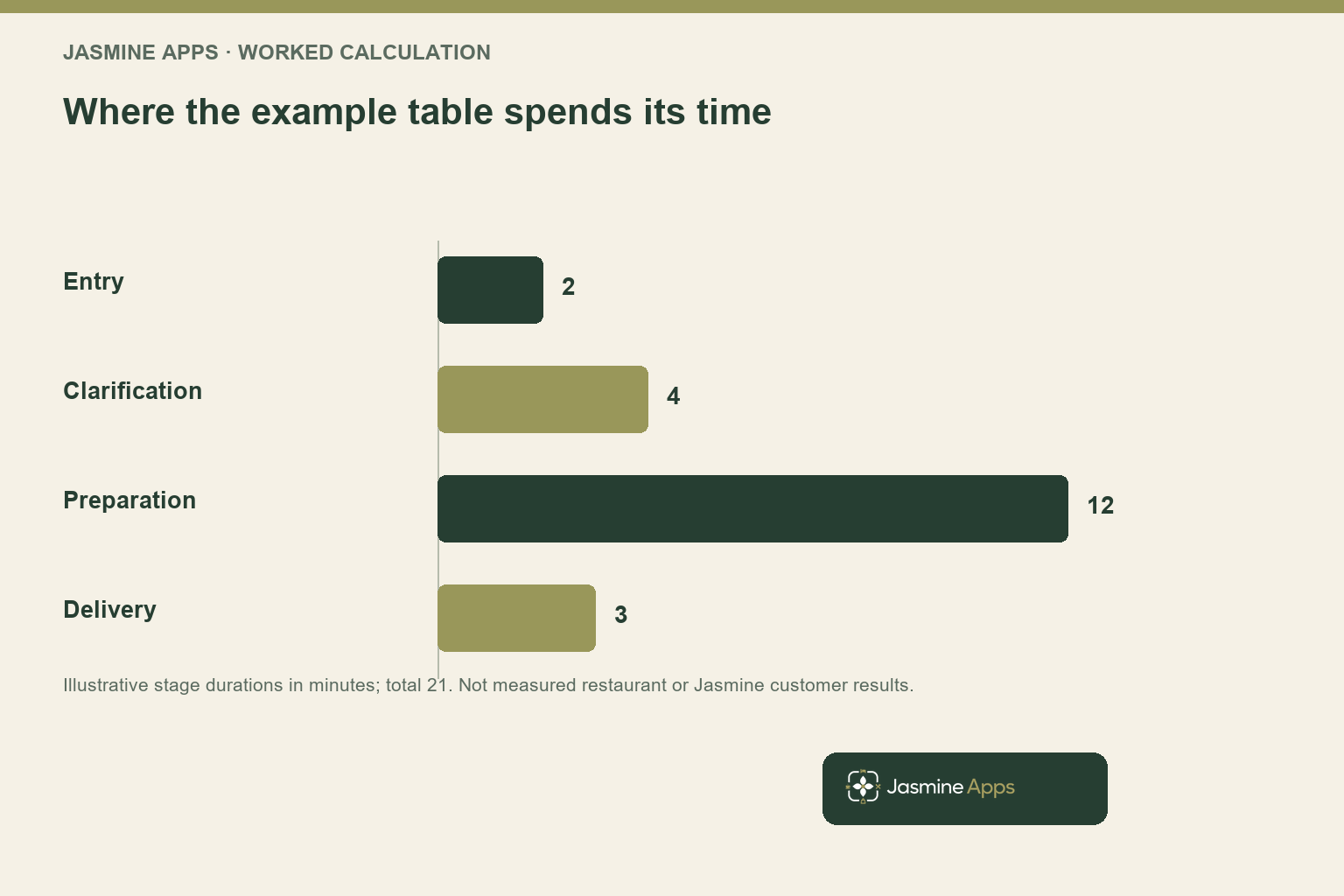
For a hypothetical table, assume entry takes two minutes, clarification four, preparation twelve and pass-to-table delivery three. The total is twenty-one minutes. Clarification and dispatch account for seven minutes outside entry and preparation, giving your team specific questions to investigate. These are illustrative stage durations, not a benchmark for your restaurant or a promise about the software.
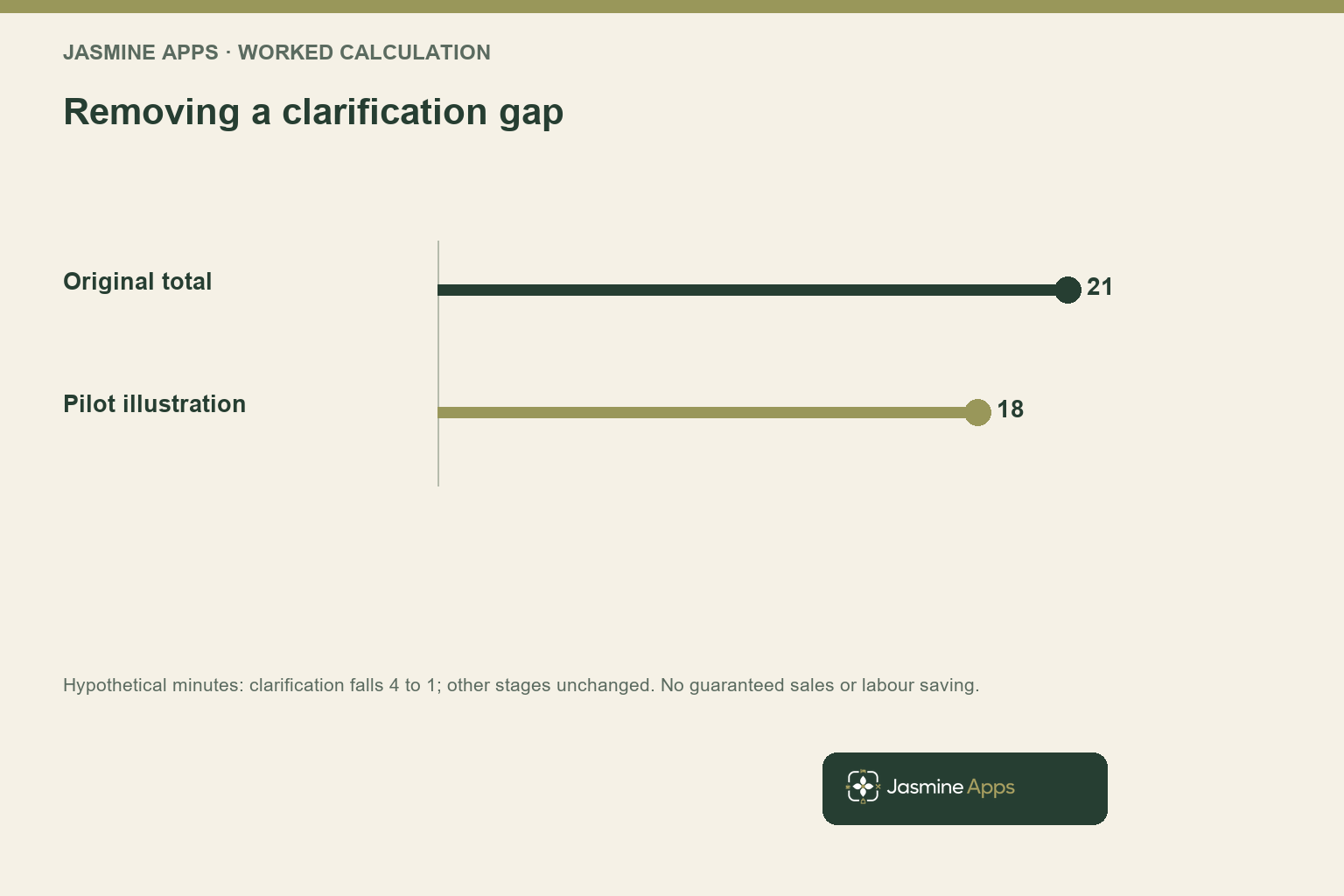
Suppose a pilot reduces clarification from four minutes to one while every other stage stays the same. The modelled total becomes eighteen minutes, a three-minute reduction. It does not follow that you can sell another table or remove paid labour. Your capacity and staffing decisions depend on the complete service window, demand and whether the change holds when the venue is busy.
Review variation rather than relying only on an average. Record a manageable sample and investigate the longest waits alongside ordinary cases. A process that works for standard orders but repeatedly fails when a guest changes a course may need a targeted handover rule, not a broad instruction to every server to enter orders faster.
Bring the kitchen and front-of-house team into the same review. Ask which delays were avoidable, which protected food quality and which came from a missing decision. Your improvement should reduce uncertainty and unnecessary waiting while preserving the time the kitchen needs to produce the meal properly, giving you a service measure that the whole team can use.
Assess equipment and resilience as part of the complete purchase
Once you understand the failing stage, choose the equipment and configuration that address it. A printer problem, unclear routing and a missing acknowledgement rule are different buying questions. Ask your supplier to demonstrate the exact output and recovery process you need, including the devices and connections that will exist in your venue rather than an ideal showroom arrangement.
Till Jasmine is currently listed from £59 per venue monthly or £590 annually, with a quote required for scope. Your kitchen installation may involve equipment, networking, configuration, support and payment arrangements beyond that subscription. Request those elements in writing so a low entry price does not become your only comparison between proposals that deliver different operational setups.
Test the interruption you can realistically encounter. Ask how the proposed system identifies an unavailable output device, what the operator sees and how the team confirms which orders need attention. Do not assume offline transmission, automatic rerouting or reliable replay unless your supplier demonstrates that behaviour in the specific configuration you are buying.
Use the restaurant internet outage plan to frame your fallback discussion. Your venue needs a safe, understandable manual process for continuing or pausing service, plus an agreed reconciliation step afterwards. Keep responsibility clear so the kitchen does not prepare a duplicated order when someone retries an instruction through another route.
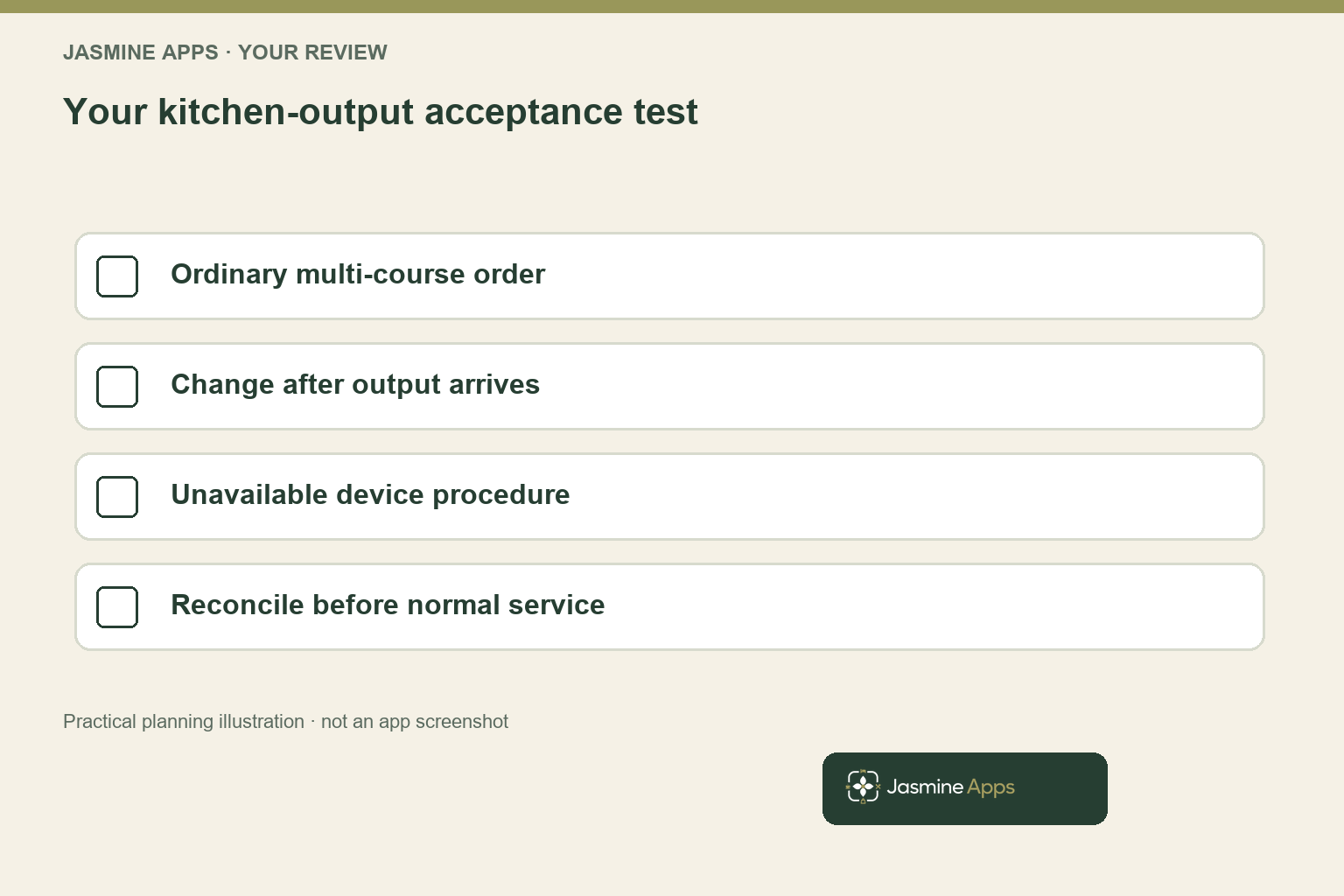
Write an acceptance checklist before installation. Include a normal table, separate preparation destinations, a changed order, an unavailable device and the return to normal operation. Your supplier and manager can then agree what success looks like, making the purchase about a demonstrated service outcome rather than the number of screens or a feature name on the quotation.
Turn the handover review into a practical service routine
Begin each menu change with a brief routing review and a small set of fictional test orders. Your kitchen lead should approve what the receiving output means, while your front-of-house lead confirms how staff find and amend the products. A clear shared reference prevents informal shortcuts from becoming the only explanation of how the system works.
Use your pre-service briefing to communicate exceptions that matter today. Identify unavailable items, unusual preparation limits and the person handling clarification questions. Keep the briefing specific enough that a new colleague can act on it, rather than announcing that everyone should communicate better without describing the route they should use when a guest changes an order.
Keep food safety and service recovery within the appropriate professional processes. HSE's human-factors guidance on communication highlights the role of effective information exchange in managing work. For your venue, translate that principle into named responsibilities and understood messages, with safety-critical questions escalated to the competent person rather than buried in a generic ticket note.
At the end of a selected service, review a few exceptions together. Ask whether the current instruction reached the right person, whether the response was confirmed and whether your guest received the agreed meal. Record the process change you intend to test next time, keeping private staff or guest information out of general training examples wherever possible.
Your lasting improvement is a dependable handover that survives busy periods and changes of staff. Revisit the acceptance tests when you change devices, menu structure or preparation areas. You can then show that the system and team still support the way your restaurant works, reducing unnecessary waiting while keeping the kitchen's preparation decisions clear and controlled.
Pro Tips
Time the question. Record how long an order waits for clarification before measuring preparation speed. You can then direct the improvement at missing information rather than asking the chef to compensate.
Test the second instruction. Include a change after the original output has arrived. Confirm how the kitchen recognises the latest instruction and avoids preparing both versions.
Observe the whole table. Measure whether the table receives its intended courses together under your service standard. A fast individual ticket can hide a poor shared dining experience.
Common Mistakes
Buying a screen before identifying the delay. You may reproduce an unclear process on a different device. Map the failing handover before choosing equipment.
Assuming a billing correction stops production. Your kitchen may already be cooking from the original instruction. Confirm the operational change separately through your agreed route.
Treating every long ticket as slow cooking. You overlook clarification, station coordination and dispatch. Separate the stages so your response addresses the actual cause.
Frequently Asked Questions
Why do restaurant orders get delayed between the till and kitchen?
Your delay may arise during entry, routing, clarification, production coordination or dispatch. Follow a representative order through each stage before attributing the wait to one device or colleague. A changed dish or unclear course instruction can expose a different problem from a normal ticket. Record consistent stage definitions and review complete tables, then choose configuration, equipment or training that addresses the specific handover your observation identified.
Can kitchen routing alone solve slow restaurant service?
You can improve the information route while still facing preparation limits, overloaded stations or a weak dispatch process. Routing helps only when the output reaches the right destination and the receiving team understands the current instruction. Test the whole table, including changes after preparation begins. Your service review should separate avoidable information delays from the time needed to prepare food safely and deliver the meal to the guest properly.
What should you test in a restaurant kitchen printer demonstration?
You should test a realistic table with products for each preparation destination, clear quantities and the course information your service requires. Add a change or cancellation after the original output has arrived, then demonstrate an unavailable device and recovery. Confirm the exact equipment and networking scope. Your kitchen colleague should interpret the output without a supplier translating it, giving you evidence that the setup supports your actual service process.
How do you measure order-to-table time accurately?
You define consistent boundaries for order acceptance, entry, receipt, preparation and delivery, then use supported records or approved observation for each stage. Keep similar orders and demand conditions together, and investigate unusually long cases separately. Your total should follow the guest's meal rather than a convenient device timestamp. A shorter time is useful when it preserves food quality and improves the experience, not simply because it makes a report look faster.
Does Till Jasmine include every kitchen device in its subscription?
You should obtain a written quotation for your required equipment, configuration, installation, networking and support. The current entry subscription does not by itself establish the complete hardware or kitchen-output scope for your venue. Demonstrate how the product course and kitchen fields affect your proposed setup, and ask how interruptions are handled. Your acceptance checklist should cover ordinary orders, changes, unavailable output and reconciliation before you commit to the installation.
Restaurant kitchen order handover: your next step
Your restaurant kitchen order handover should give every colleague the information needed for the next decision. Arrange a Till Jasmine demonstration with a sample table, a changed order and your kitchen layout. You can test the exact output, identify the waiting point and choose an installation that supports a calmer, more dependable service.