

Off-peak Loyalty Rewards: Fill Quiet Hours Without Buying Old Sales
· Jasmine Apps
Your reward can bring twenty redemptions and still make the venue worse off. If those guests would have purchased at the same time without it, you have funded existing demand rather than filled a gap. Your off-peak loyalty rewards should therefore begin with the visit you want to create and the capacity you can use.
Jasmine Loyalty gives you reward rules to investigate, but you should confirm any timing restriction in a demonstration. Your campaign design must match the actual earning, redemption and staff processes you can deliver.
Key Takeaways
- Target useful spare capacity rather than a vaguely quiet day.
- Separate new demand from visits that would happen anyway.
- Include reward fulfilment and displaced contribution.
- Confirm timing eligibility instead of assuming automatic restrictions.
- Measure the campaign separately from your overall membership tier.
Plan off-peak loyalty rewards around a specific capacity gap
You should name the service period you want to strengthen. A café’s quiet afternoon and a restaurant’s early weekday sitting present different occasions, staffing arrangements and guest needs. Your reward should fit the relevant visit rather than offer a general discount throughout the week.
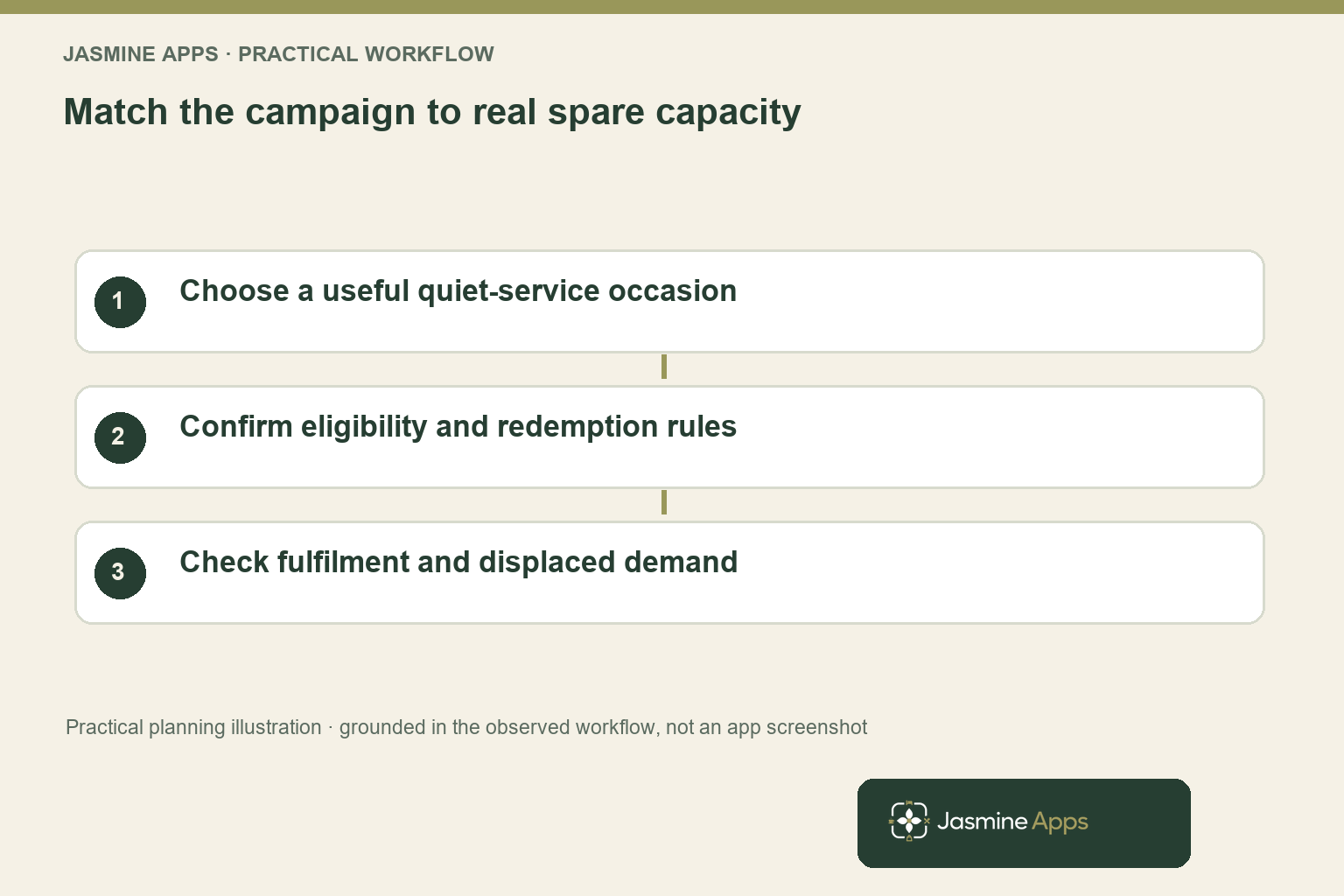
Check that your available capacity is useful. Empty tables are not enough if the kitchen is closing or the team cannot fulfil the offer. Approve the service, items and timing with the people who will deliver the experience before you communicate it to guests.
You should then identify whom the offer is intended to influence. A guest who normally visits in the quiet period may not need an incentive, while someone who only visits at a busy time may simply move an existing purchase. Your campaign can still be valuable, but those behaviours create different contribution outcomes.
The loyalty-programme research on self-selecting members examines the difficulty of separating programme effects from existing customer behaviour in grocery retail. You can apply that measurement caution to your own venue, without importing a retail result as a hospitality uplift forecast.
Start with a proposition that suits the occasion. You might focus on a relevant afternoon purchase or a clearly defined quiet-service benefit, subject to the rules your deployment supports. A generous reward with unclear eligibility can create disagreement rather than useful demand.
Use the restaurant midweek-bookings article for the wider spare-capacity question. Your loyalty version adds the challenge of distinguishing reward-driven visits from purchases your existing members already make.
Calculate off-peak loyalty rewards with displaced demand visible
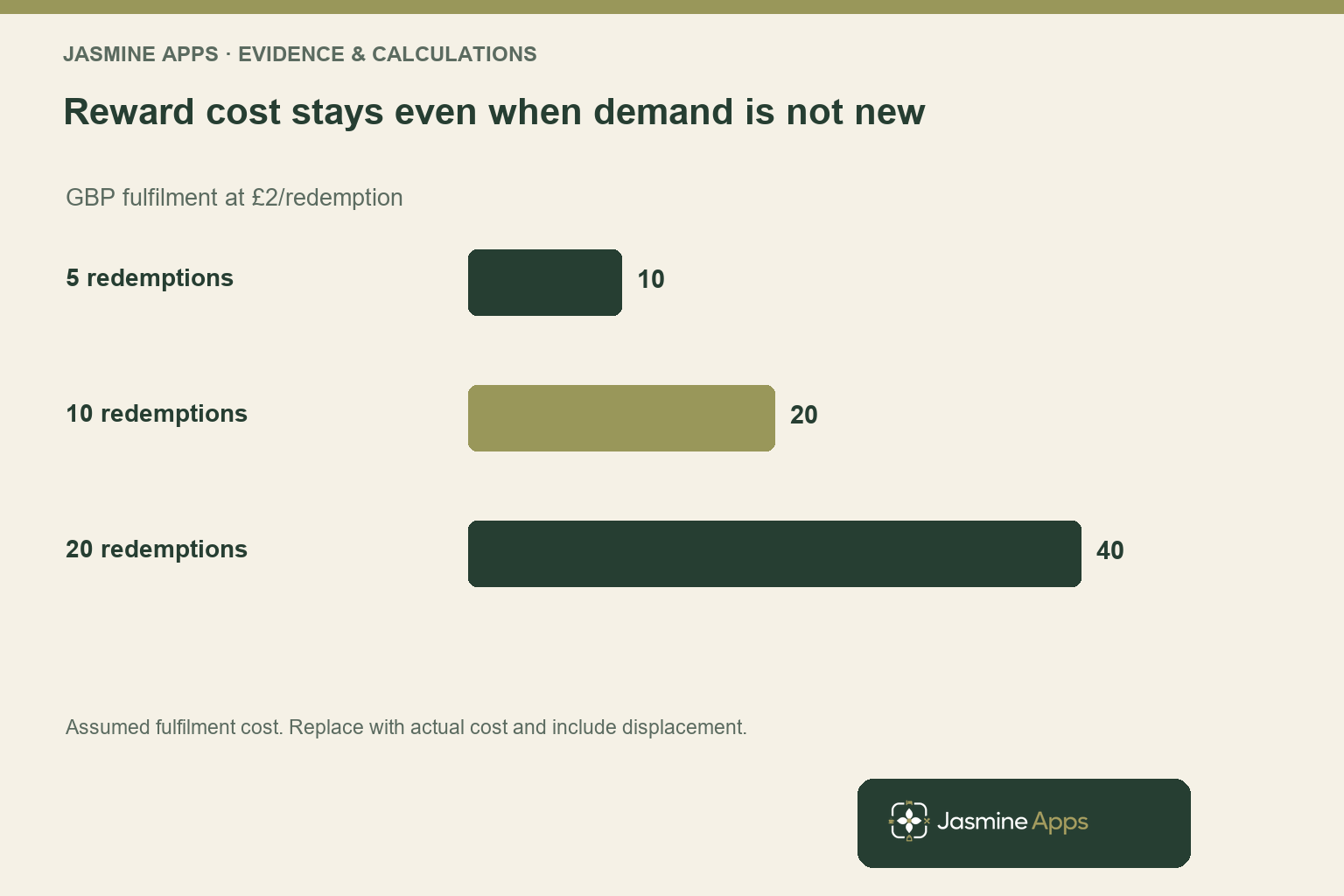
Your simple model should distinguish genuinely additional visits from rewarded visits that would have happened anyway. Use contribution before the reward, then subtract the actual fulfilment cost and relevant campaign expenses. State which costs remain outside the model.
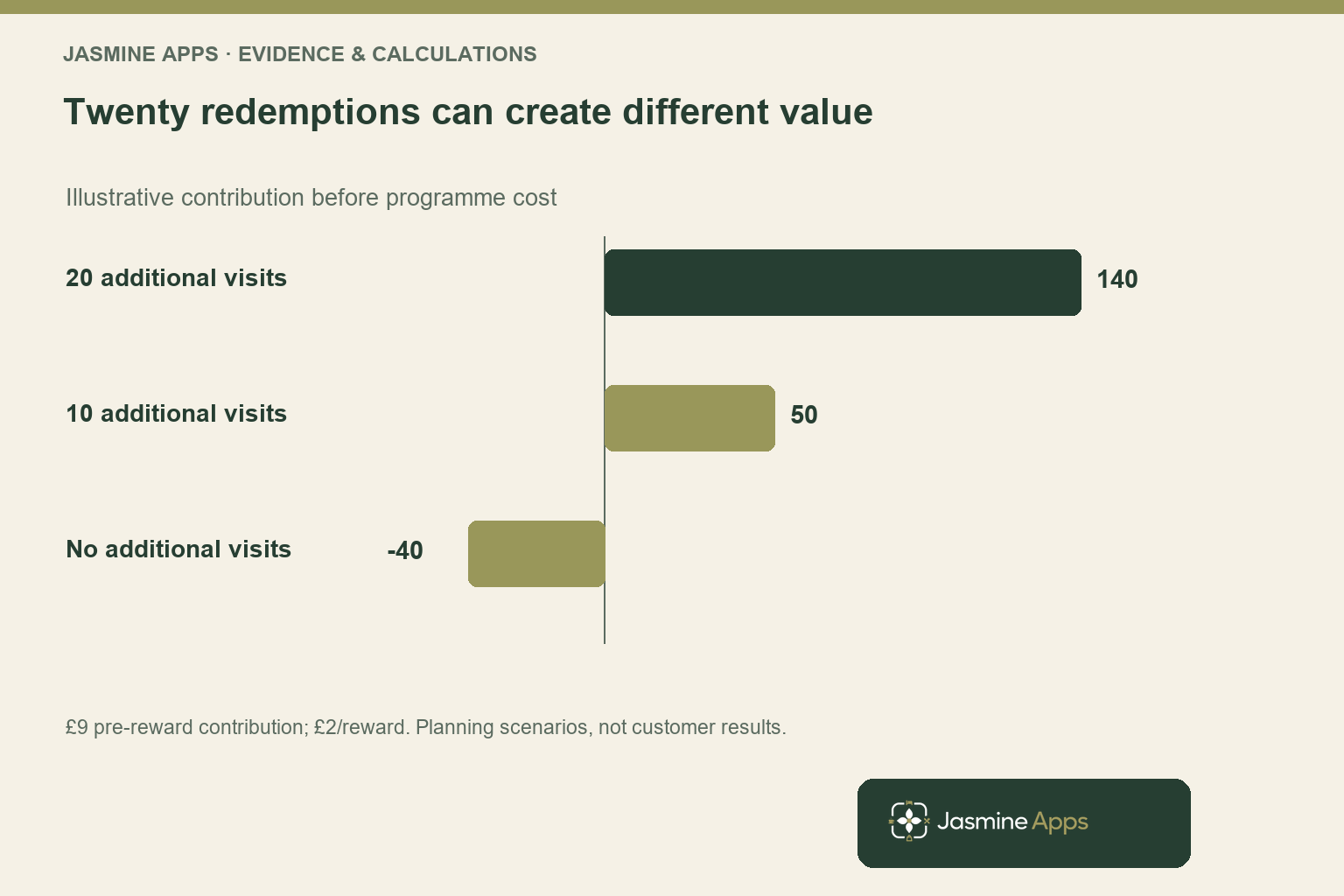
Consider an illustrative offer with twenty redemptions, £9 contribution per genuinely additional visit before the reward and £2 reward fulfilment per redemption. If all twenty visits are additional, your simplified contribution is twenty times £7, or £140 before the programme subscription and other campaign costs.
If ten visits are additional and ten would have happened anyway, the new visits contribute £70 after their rewards, while the existing visits cost another £20 in unnecessary rewards. Your simplified incremental result is therefore £50. The redemption count remains twenty, but the commercial outcome is very different.
If none of the visits is additional, the reward costs £40 without creating new visit contribution. These are hypothetical planning cases, not measured Jasmine results. Your own fulfilment cost, purchase mix and guest behaviour need to replace the assumptions.
Moving a guest from a busy service to a quiet one also requires careful treatment. If you refill the released peak capacity with useful demand, the change may help the venue. If you do not, the apparent quiet-period growth may simply relocate revenue while adding reward cost.
The CRM’s Loyalty tiers are £29, £39 and £59 per venue monthly for the stated member limits. Include the relevant subscription in your overall programme decision, but avoid charging an existing programme’s whole cost to one incremental campaign without explaining why. Your finance lead should see the campaign and programme comparisons separately.
Deliver off-peak loyalty rewards through confirmed rules and staff checks
Your live Loyalty admin includes points earning, bonus-visit settings, redemption thresholds, exclusions and expiry controls. Those observations support a discussion about reward design, but do not independently prove an automatic weekday or hour-of-day eligibility rule. Ask for the exact timing workflow you want to use.
If the proposed campaign depends on a restriction, confirm how your deployment enforces it and what staff see. Do not advertise an automatically limited offer unless that behaviour is demonstrated. A manual operating arrangement also needs clear approved conditions and a workable staff process.
Your participating venues and redemption route must match the guest promise. The observed till-barcode workflow depends on relevant venue participation. You should test a fictional member’s journey with the intended location before telling guests where they can redeem.
Keep the explanation short enough for staff and guests to understand. State the qualifying purchase, relevant timing, reward and important exclusions together. A long set of exceptions can make an offer appear generous while becoming difficult to use during the very service you want to improve.
Your team needs an approved exception route when the guest believes they qualify but the record or rule suggests otherwise. Ask who resolves the question and how the correction is recorded. A loyalty conversation should protect trust rather than force frontline colleagues to improvise commercial policy.
Read the loyalty reward-exclusions guide for the broader rule review. Your off-peak campaign should focus on capacity and incremental demand, while relying on a consistent earning and redemption process your venue can demonstrate.
Review the campaign before increasing the incentive
Choose a defined quiet period and a limited pilot. Record your ordinary eligible demand, the proposition, the fulfilment cost and the supported rule arrangement. Your team should know what a successful additional visit means before the first redemption is counted.
Compare the relevant periods with context. Note changes in opening hours, local events, service availability and other promotions. You can collect guest feedback about what prompted the visit, but a self-reported answer does not remove every uncertainty about what would have happened without the reward.
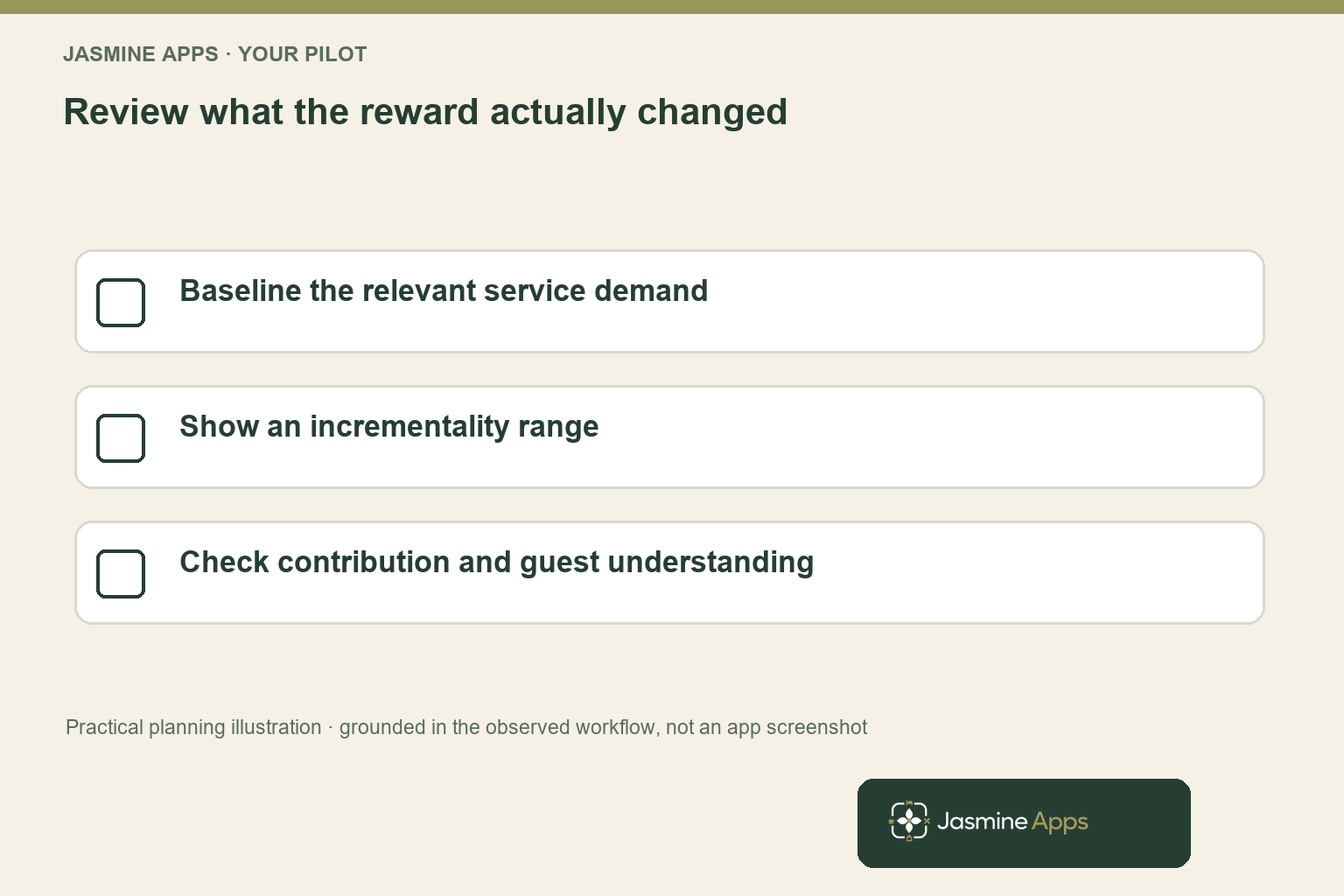
Your review should include a range for incrementality when the evidence is incomplete. The twenty-redemption illustration shows why that range matters: the same activity can produce positive contribution or an unnecessary cost. A cautious range helps you decide whether the next test deserves more spend.
Ask staff whether the rule worked without repeated explanation. Your reward can fit the financial model while creating practical friction at the till. Check exception frequency, corrected redemptions and the service experience alongside the contribution estimate.
If the campaign underperforms, investigate the occasion and eligibility before increasing the reward. Your audience may not want the service at that time, or may not understand the proposition. A more expensive incentive can amplify the wrong design rather than solve the actual problem.
Keep the restaurant second-visit strategy as a separate test when your objective is a first return. You can combine objectives later, but a narrow pilot gives you a clearer answer about whether this timing-based offer creates useful demand in your quiet capacity.
Pro Tips
Model a no-new-demand case. Show the reward cost when every guest would have purchased anyway. Your decision becomes more robust when the downside is visible.
Check the peak you release. If guests move from a busy period, assess whether that capacity is refilled. Quiet-hour growth alone does not establish a venue-level gain.
Confirm the restriction first. Demonstrate the eligibility rule before publishing the offer. Your campaign must fit the actual system and operating process.
Common Mistakes
Calling redemptions additional visits. You confuse activity with incrementality. Include guests who would buy without the reward.
Assuming automatic time restrictions. You may promise a rule your deployment does not enforce. Confirm the exact workflow before launch.
Making the reward larger before diagnosing the problem. You can increase cost while the occasion remains irrelevant or unclear. Test the reason to visit and the explanation first.
Frequently Asked Questions
Can loyalty rewards fill quiet restaurant or café hours?
You can test a reward aimed at a specific spare-capacity occasion, provided your venue can deliver it and the eligibility process is clear. Your benefit depends on genuinely additional useful demand rather than the number of redemptions. Include fulfilment cost and guests who would have purchased anyway. You should also assess whether moved peak visits create a venue-level gain, especially when the released busy capacity is not refilled.
How do you know an off-peak reward is profitable?
You should calculate incremental contribution after reward fulfilment and relevant campaign costs. Estimate how many rewarded visits are genuinely additional and show a range when that is uncertain. The same redemption count can produce different outcomes if many guests would have visited without the offer.
Record the cost basis and review the whole venue when purchases move between periods. Your gross reward-linked revenue alone is not a profitability measure.
Can Jasmine Loyalty restrict rewards to certain weekdays?
You should ask for a demonstration of the exact timing rule you intend to use. The live admin shows earning, thresholds, exclusions and expiry controls, but that does not independently confirm automatic weekday or hour-of-day eligibility. Your campaign must match the supported deployment and any approved staff process. Confirm how guests and staff see the rule, how exceptions are handled and which participating venues can fulfil it before advertising the offer.
Should you reward customers who already visit at quiet times?
You should consider whether the reward changes a useful behaviour or simply reduces contribution on an existing purchase. Recognition can have a broader relationship purpose, but that is different from an incremental quiet-capacity campaign. Keep the objectives and costs clear. Your pilot should examine the relevant visit behaviour and guest experience rather than treating every regular’s redemption as proof that the offer created another sale.
Is a larger reward better for an off-peak promotion?
You should not assume generosity resolves a weak occasion or unclear eligibility. Your guest may be unable or unwilling to visit at the proposed time, regardless of reward size. Test the proposition and explanation before increasing the fulfilment cost.
A larger reward also increases the cost of visits that would have happened anyway. Your best next step follows the reason the pilot underperformed, with contribution and service quality kept visible.
Off-peak loyalty rewards: your next step
Your off-peak loyalty rewards should buy useful additional demand, not subsidise a number that looks impressive. Request a Jasmine Loyalty demonstration with your quiet service, intended rule and reward cost. You can confirm eligibility, test the guest journey and decide whether the campaign earns its place in your venue.