

Restaurant Midweek Bookings: Fill Gaps Without Blanket Discounts
· Jasmine Apps
Your empty Wednesday tables are not necessarily a pricing problem. A guest may have no clear reason to choose that evening, or may struggle to find an offer that fits their plans. Your restaurant midweek bookings should connect a specific dining occasion with capacity you can genuinely fulfil.
With Table Jasmine, you can organise the booking journey and review the service that follows. Your commercial test should measure completed visits and contribution, rather than celebrating reservations that never become a meal.
Key Takeaways
- Identify spare capacity for a specific service and party size.
- Give guests a clear occasion instead of discounting everything.
- Join the promotional promise to a workable booking journey.
- Measure completed covers and contribution after campaign costs.
- Check displaced full-price demand before claiming incremental sales.
Start restaurant midweek bookings with capacity you can sell
Your quiet-service opportunity starts with what your operation can accommodate. Count the covers you can serve with the team, kitchen and table layout you intend to use. A building with forty seats does not automatically provide forty sellable covers at every moment.
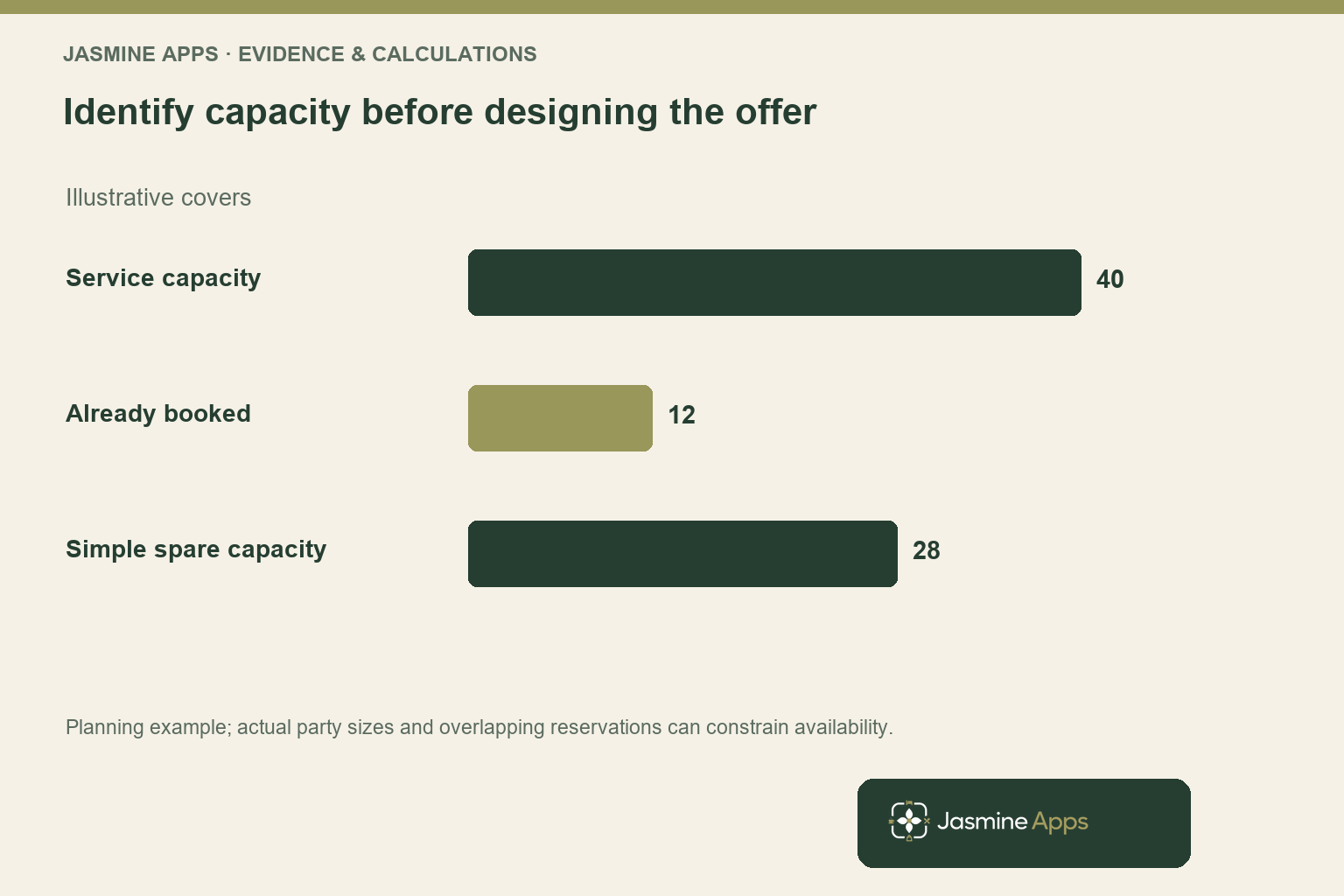
Consider an illustrative Wednesday with capacity for forty covers and twelve already booked. That leaves twenty-eight covers in the simple example, but your actual remaining availability may depend on party sizes and overlapping reservations. A group of eight needs a workable arrangement, not merely eight unallocated seats spread across the room.
The live Table Jasmine booking setup treats capacity through overlapping guests, rather than simply counting how many table bookings begin at the same time. You should test the relevant service duration and party sizes in a demonstration. Your promotion needs to fit the booking configuration your venue actually uses.
Choose the service you want to strengthen before choosing the offer. A neighbourhood early dinner, a weekday celebration or an uncomplicated meal after work creates a different guest decision. Your message should tell that audience why the occasion fits this day, including timing and the next booking step.
Do not promise an experience that requires staffing or ingredients you have not arranged. Your quieter service may operate with a smaller team, so a complex tasting offer could create more pressure than an ordinary busy night. Speak with the kitchen and floor manager before publishing the proposition.
Use your own service records to distinguish a repeatable gap from an unusual week. You can then choose a pilot with enough relevant capacity to accommodate the demand you seek, while preserving the standard your guests expect from the venue.
Price restaurant midweek bookings around additional contribution
Your target is additional useful demand, not a large discount-redemption count. You should estimate what a completed extra cover contributes after the variable costs you include, then deduct the campaign and any additional operating expense. Make the cost definition clear before comparing offers.
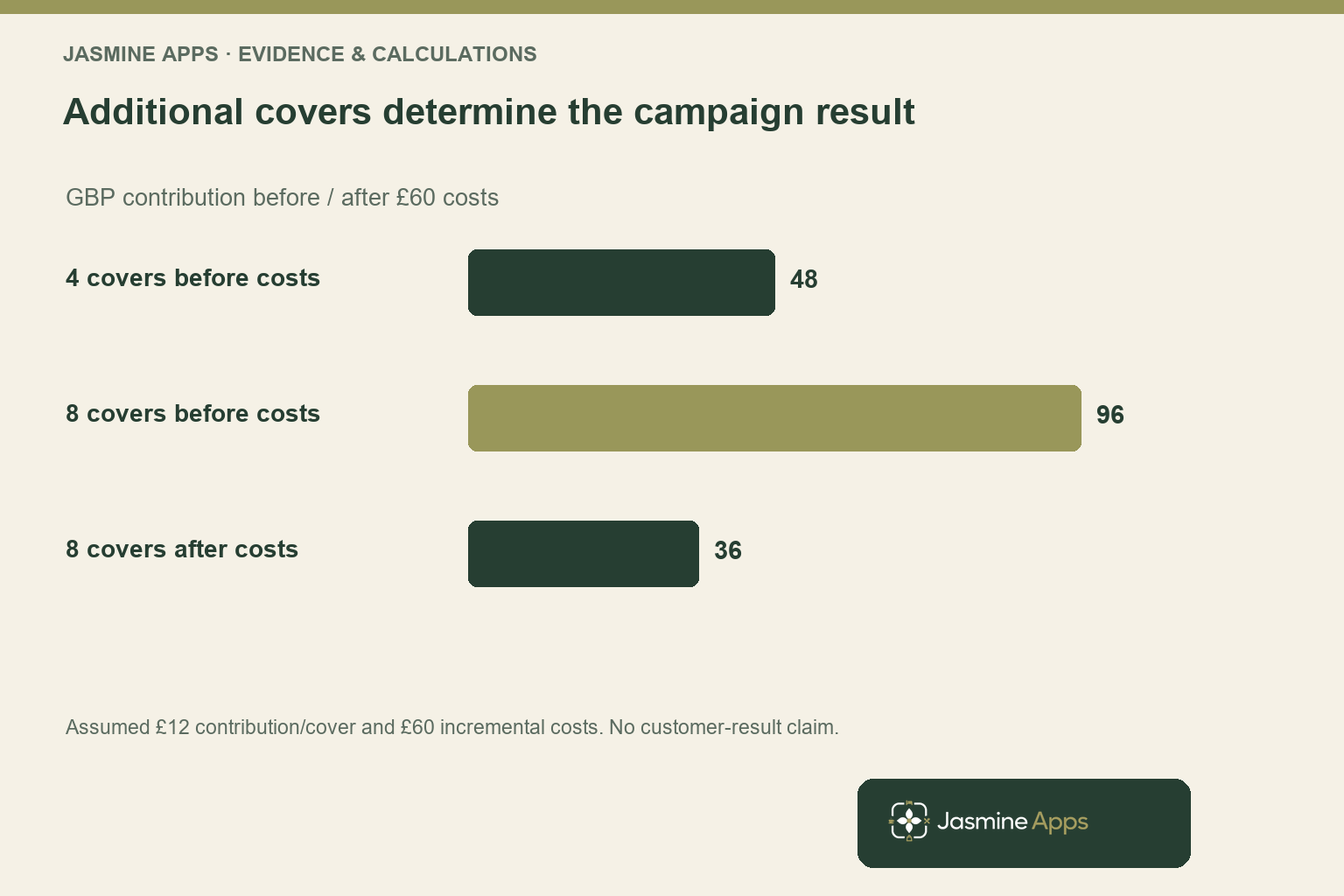
Suppose your illustrative offer brings eight genuinely additional covers, each contributing £12 after the defined variable costs. That gives £96 of contribution. If your campaign costs £40 and the offer requires another £20 of incremental operating expense, the simplified result is £36 before other costs not included in the model.
If only four covers are additional, the same £60 of incremental costs leaves a £12 shortfall in that simplified calculation. Your outcome depends on the new demand you actually create, not on a headline revenue figure. The graphs show planning scenarios, not observed Table Jasmine results.
You should also account for guests who would have visited without the offer. If your promotion gives them an unnecessary discount, the extra reward reduces contribution without creating the visit. A quiet-service offer can still be worthwhile, but you need to identify displacement rather than assume every booking is incremental.
Your capacity limits also matter when an offer becomes popular. Demand that arrives after the useful service is full may disappoint guests or push them towards a time you did not intend to subsidise. Keep the proposition and availability aligned so the promotion remains commercially controlled.
For your wider software comparison, the CRM lists Table Jasmine at £69 per venue per month or £690 annually with unlimited bookings. Your quote should clarify tax, setup and optional services. Do not assign the full subscription cost to one Wednesday campaign unless that is genuinely the only purpose of your purchase.
Connect restaurant midweek bookings to a complete guest journey
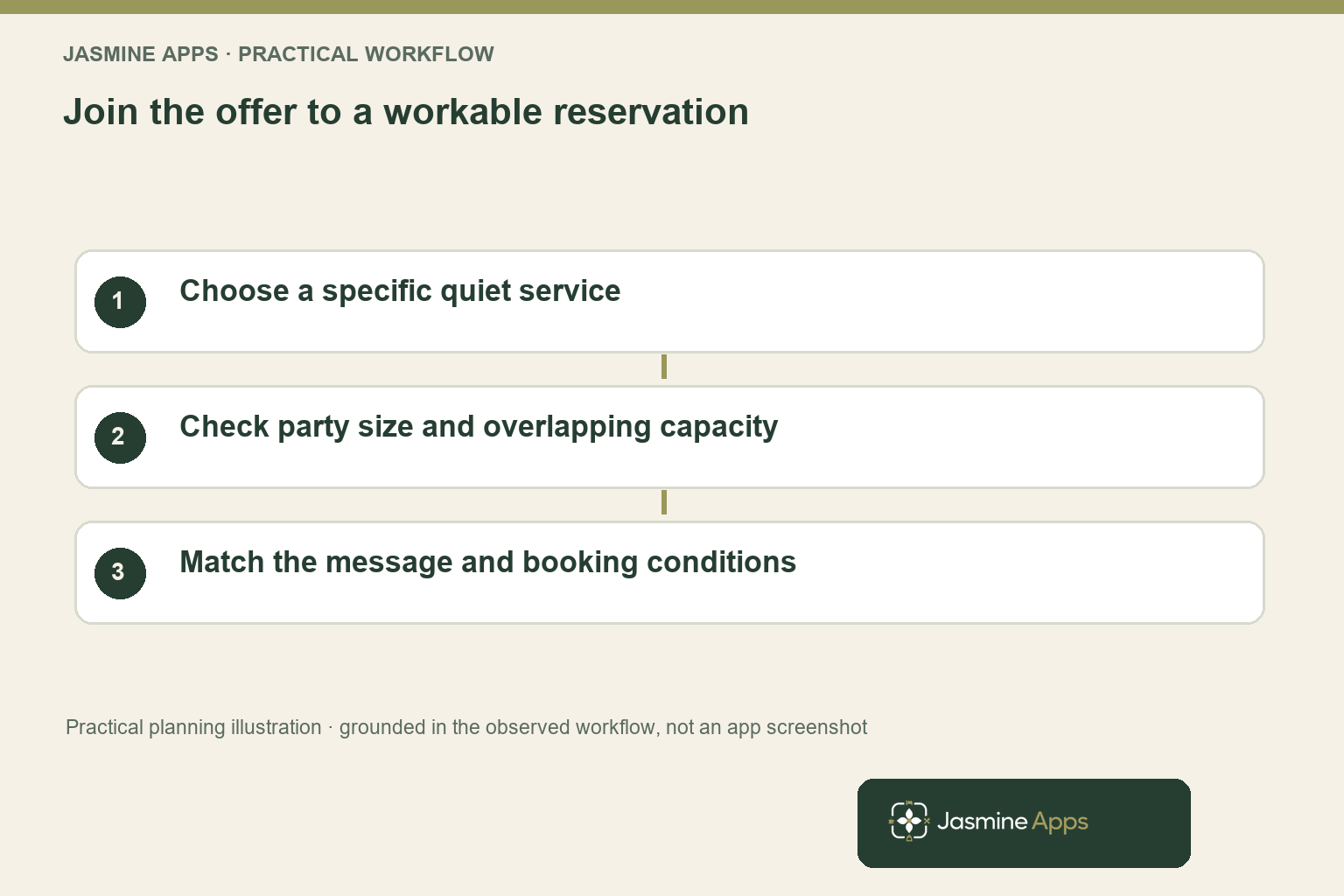
Your guest should encounter the same offer details in the promotional message and booking route. State the service, eligible date or time, price basis and any limits clearly enough to make a decision. If a guest has to telephone to discover every important condition, you have not completed the self-service journey.
Check the booking page on the devices your audience uses. Your practical test is whether a guest can find the intended day, choose a workable party size and understand what happens next. Review the journey without submitting a test booking into your live diary unless you have a controlled testing arrangement.
If discovery through Google is part of the plan, the Google Business Profile booking-provider guidance explains the provider-based context. The CRM lists Google Reserve as a separate £12-per-month Table extension. You should confirm eligibility and the actual provider connection before promising that every venue will receive a particular booking button or placement.
You can use other approved routes as well, including your website and existing promotional channels. Keep the campaign promise consistent, but avoid claiming that a booking platform automatically creates demand. Your offer and distribution still need to reach a relevant audience.
Once the reservation exists, your service team needs the right context. Use the booking information and statuses your workflow supports, while keeping any offer entitlement and operating instructions clear. A guest who arrives expecting an approved package should not have to renegotiate it at the door.
Read the restaurant booking-conversion article for the broader journey. Your midweek pilot should concentrate on one spare-capacity service and one reason to visit, rather than trying to repair every channel at once.
Evaluate the completed service before repeating your offer
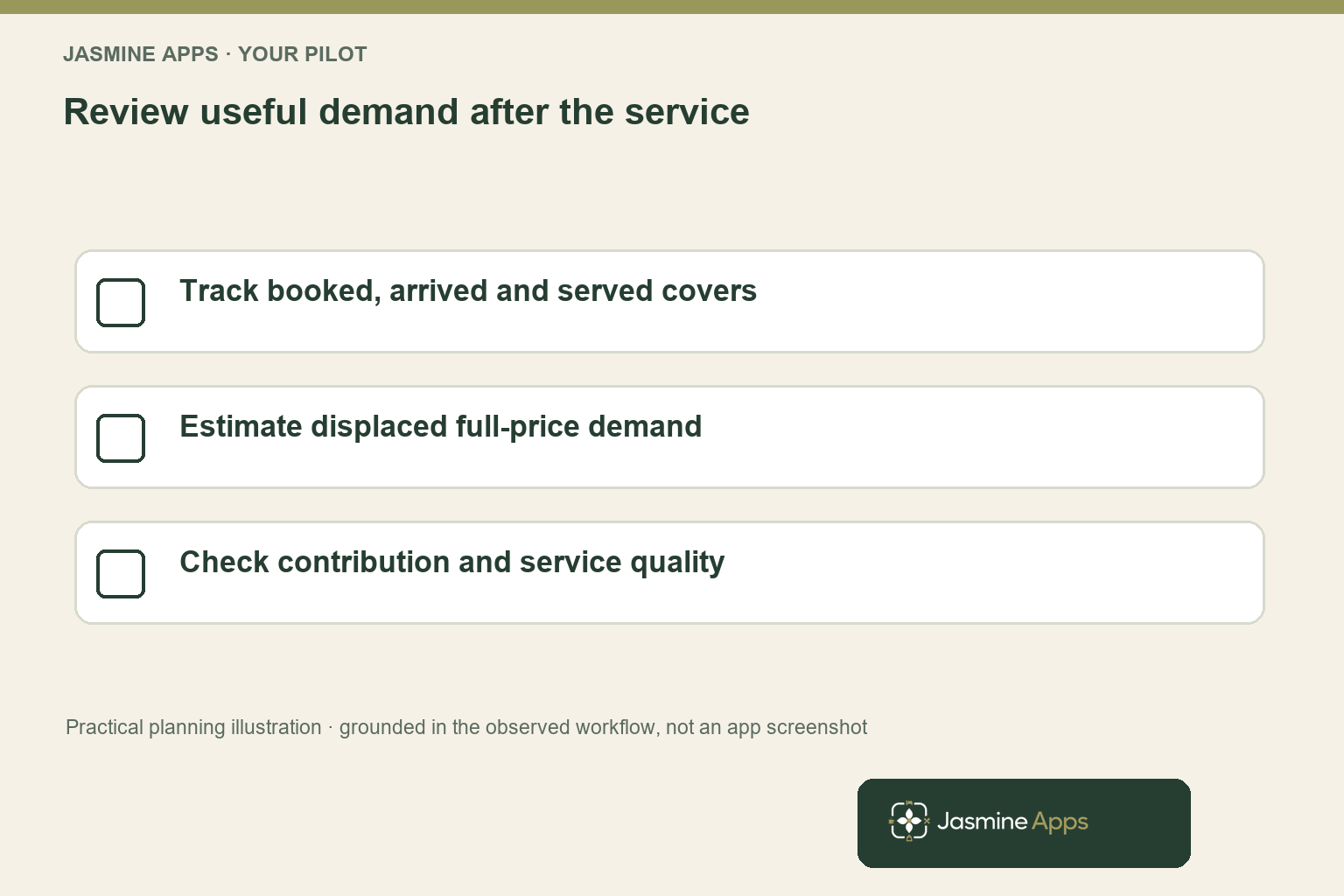
Your first review should distinguish reservations, arrivals and completed visits. Table Jasmine’s live statuses include confirmed, arrived or waiting, seated, has left, no-show and cancelled states. You should agree how your team uses those labels before treating a status count as a commercial result.
Record the campaign period and the actual covers served, then compare similar services. Note local events, weather disruption, changes in staffing and other promotions that may influence demand. You cannot infer a causal uplift simply because one Wednesday has more bookings than the previous one.
Your financial review should use contribution rather than gross takings alone. Include the offer’s variable fulfilment cost and incremental campaign or staffing expense. If you cannot identify which guests were additional, present a range of outcomes rather than a confident single return figure.
Ask the floor and kitchen teams what the additional demand did to service. A promotion that fills space but creates late meals or confused entitlement can cost trust. Your repeat decision should reflect both commercial contribution and the experience you delivered.
Keep the next iteration small. You might clarify a timing message, narrow the audience or change the offer structure without changing every element. A controlled improvement helps you learn why guests choose the service instead of simply increasing promotional spend.
The restaurant booking-add-ons comparison can help you assess the next recurring problem. If message chasing or meal choices become the constraint, investigate the relevant extension with your actual workflow. Add the service that resolves a measured need rather than assuming every optional feature will improve the campaign.
Pro Tips
Name the occasion. Describe who the service suits and why that day works. A specific dining decision gives your audience more to act on than a general statement that tables are available.
Use a contribution range. Model low and high incremental-cover cases. Your uncertainty about displacement should be visible in the decision.
Review the service as well as the diary. Ask whether the kitchen and floor handled the promised experience. A filled diary is useful only when your venue can deliver the visit.
Common Mistakes
Discounting your whole week. You can reduce contribution on services that already sell well. Target the capacity gap you actually want to address.
Counting every reservation as extra demand. Some guests would have booked anyway and others will cancel. Measure completed visits and state your incrementality assumption.
Ignoring party-size constraints. Available seats do not always form a suitable table. Test the actual capacity and booking overlap before advertising availability.
Frequently Asked Questions
How can you increase restaurant bookings during the week?
You can start with a specific quiet service, identify the audience and give them a clear reason to choose that occasion. Match the proposition to the capacity your kitchen and floor can fulfil, then make the booking route easy to understand. You should measure completed additional covers and contribution after campaign costs. A blanket discount can attract bookings while reducing value, so test a focused offer before expanding it.
Do midweek restaurant offers need a discount?
You do not always need to reduce the price. Your audience may value a convenient timing, a clear package or a suitable occasion that removes planning effort. You should test the reason to visit before assuming price is the obstacle.
If you do use a discount, calculate its effect on contribution and guests who would have visited anyway. Your offer should create useful additional demand rather than subsidise existing purchases.
How do you measure a midweek dining promotion?
You should distinguish bookings, arrivals and completed covers, then compare similar service periods. Record the variable fulfilment cost, campaign expense and any incremental staffing cost. Include a range for guests who would have visited without the offer if you cannot establish that precisely.
Your review should also cover service quality and capacity. A higher reservation total alone does not demonstrate extra contribution or a successful guest experience.
Can Google booking links help fill quiet restaurant services?
A relevant discovery route can help guests reach your booking journey, but you should confirm your venue’s eligibility and the actual provider connection. Google’s guidance describes the booking-provider context, and the CRM lists a separate Google Reserve extension. You should not assume every restaurant receives the same placement. Your offer, availability and completed booking process still need to work together before the channel can support useful demand.
What does Table Jasmine cost for a restaurant?
The CRM lists £69 per venue per month or £690 per year with unlimited bookings. Optional extensions carry separate listed prices, so you should choose them around a recurring need and confirm the scope in your quote. Ask about the tax basis, setup and any other agreed costs. Your purchase case should consider the complete booking operation, while a particular midweek campaign can be evaluated on its own incremental costs.
Restaurant midweek bookings: your next step
Your restaurant midweek bookings should fill a useful gap while preserving contribution and service quality. Request a Table Jasmine demonstration with one quiet service, your party-size limits and a proposed offer. You can test the journey, confirm the quote and set a pilot that measures completed visits rather than just a busier-looking diary.