

Hotel Recurring Fault Investigation: Find the Cause Before Another Repair
· Yiannis Yiasemis

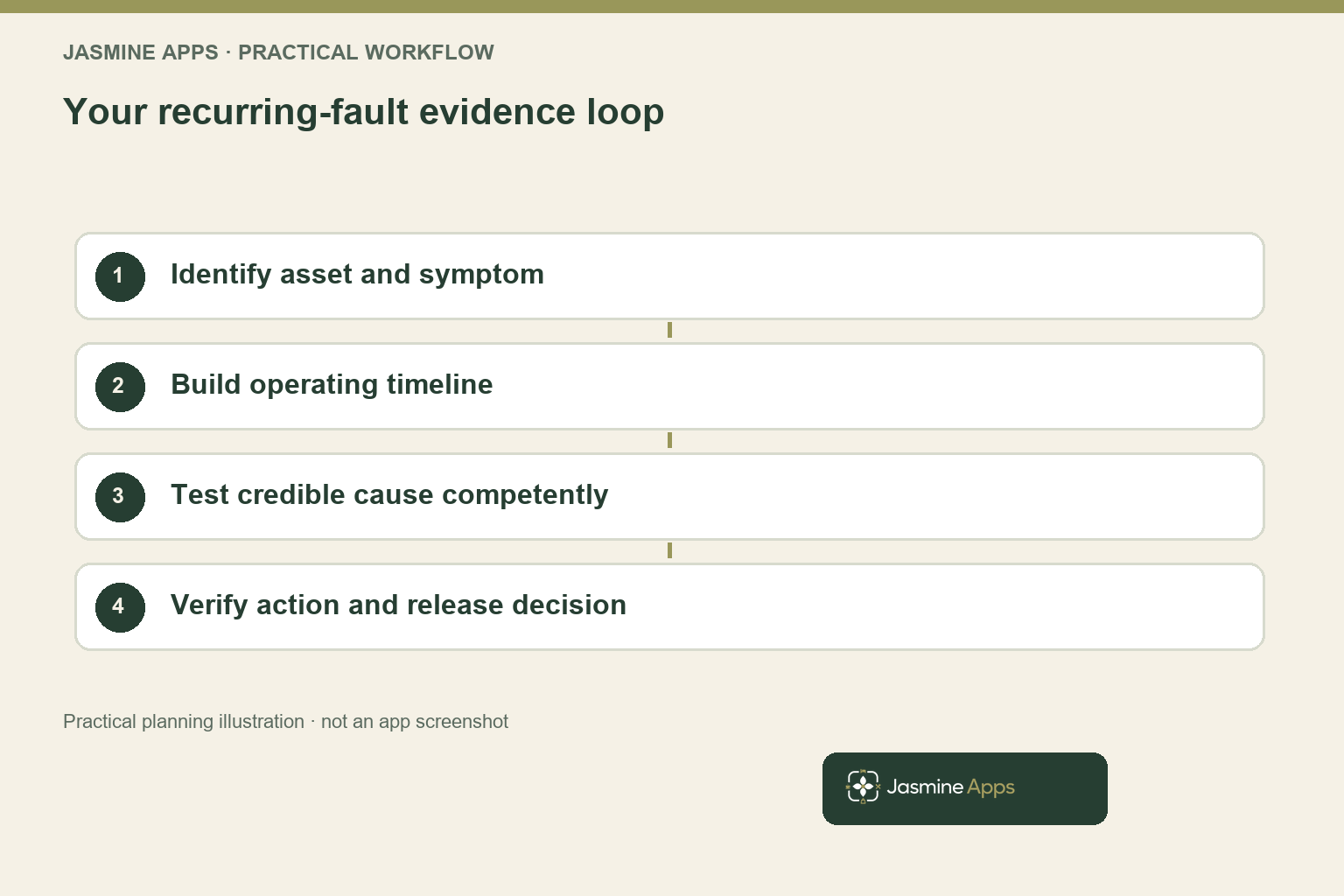
Three tickets saying air conditioning noisy may describe one unresolved fault, three different problems or an operating condition nobody recorded. Counting repeat words alone cannot tell you which. Your hotel recurring fault investigation needs a consistent asset reference, a factual symptom and evidence of what changed before you authorise another repair that may only remove the immediate complaint.
Jasmine Maintenance's room and issue workflow gives your team a place to organise the operational problem. Your investigation should connect those records with competent technical judgement and a follow-up check under relevant conditions. You can then distinguish a repair completed from a cause addressed, directing your maintenance budget towards a more dependable result for the next guest.
Key Takeaways
- Group by the same asset and symptom, not wording alone.
- Separate observations from suspected causes.
- Keep immediate safety action ahead of investigation.
- Test corrective action under relevant conditions.
- Review recurrence and total impact before claiming success.
Define the question in your hotel recurring fault investigation
Begin with a precise statement of the repeated problem. Identify the room or asset, the observable symptom and the circumstances in which it appears. Your colleague should be able to recognise the same event again without interpreting a vague phrase such as equipment not good. A factual description gives the competent person a better starting point than an unsupported diagnosis.
Check whether the records refer to the same physical item. Room numbers can stay the same after equipment is replaced, while similar assets may have different service histories. Use the identifiers your venue can maintain and record relevant replacement or relocation dates, so you do not combine an old unit's history with the new one's performance without explaining the change.
Separate recurrence from a reopened administrative record. A ticket might remain open because evidence is missing, or a new complaint might concern a different symptom after an unrelated repair. Your investigation should establish the operational event and the record relationship, rather than treating every reopened status as proof that a technician's previous work failed.
ASQ's cause-analysis tools distinguish methods for organising possible causes and examining patterns. Use those tools to structure questions, with technical conclusions made by the appropriate competent person. A diagram or repeated why question is not evidence on its own, and the most plausible story still needs a way to test whether it explains the observed problem.
Connect this investigation with your recurring-fault reporting article. That earlier piece explains why ticket totals can mislead; this one follows the evidence and corrective-action test. Your aim is a question narrow enough to investigate, with the immediate operating impact and responsible owner clear before the team starts gathering more information.
Build an evidence timeline for your hotel recurring fault investigation
Collect the relevant sequence without filling gaps with assumptions. Record when the symptom was reported, the conditions described, the immediate response, work completed and the point when the equipment or room returned to use. Use the supported records and appropriate contractor information, keeping the source of each observation visible where it affects the interpretation.
Ask which operating conditions matter to the competent investigator. A fault may occur only under a particular load, after a long running period or in a certain environmental condition. Your staff should report what they safely observe, not perform technical tests beyond their competence. The investigator can then specify what information is useful and how it should be obtained appropriately.
For an illustrative timeline, suppose a room has four reports over six weeks, each appearing after a similar operating condition. Two repairs changed one component and two reset the equipment, but no follow-up reproduced that condition. The pattern gives your investigator a question worth testing; it does not prove a particular cause or justify repeating the same repair automatically.
Keep parts, contractor findings and settings changes in the timeline where relevant. If several things changed together, record them rather than selecting the one that makes the explanation sound simplest. Your later verification will be stronger when the team knows which intervention was actually performed and which potential cause remains untested, with uncertainties stated plainly in the technical record.
Use your fault-reporting guide to improve the next symptom description. A clearer observation can reduce repeated clarification work and help distinguish events that initially sound alike. Your evidence timeline should become a concise working reference for the investigator, not a large collection of messages that hides the sequence the team needs to understand.
Use hotel recurring fault investigation to separate containment and correction
Your immediate response protects people and service while the cause is investigated. That may mean restricting or withdrawing an asset through the relevant safety procedure, arranging a suitable alternative or informing reception of the room impact. Do not delay necessary protective action while collecting more information for a commercial review or waiting for a convenient investigation meeting.
The HSE maintenance guidance emphasises competent work and suitable maintenance arrangements. Use the relevant qualified or competent people for diagnosis, isolation and repair, following the appropriate procedures. An operational blog or software status should never be treated as an instruction for untrained staff to open, reset or test equipment in unsafe conditions.
Distinguish the temporary measure from the proposed corrective action. A reset or replacement of an immediately failed part may restore operation without resolving why the failure recurs. Your technical record should state what the intervention is intended to address and what evidence would support that explanation, with limitations and further work identified by the competent person.
Ask what alternative explanations remain plausible. The issue could involve equipment, installation, operating practice, environment or the way the symptom was interpreted. Do not use a cause-and-effect diagram to assign blame to the nearest colleague; use it to make hypotheses visible and decide which can be investigated with appropriate evidence and expertise.
Give the manager an understandable decision: the current operating restriction, the proposed work, the reason it may address recurrence and the verification required. Your repair-or-replace analysis provides the wider capital discussion. Here, the priority is knowing whether the next intervention tests a credible cause or merely repeats the action that temporarily made the last ticket disappear.
Verify the corrective action before calling the recurring problem solved
Agree the verification method before the work is treated as successful. Your competent investigator should define the relevant operating conditions, safe test and evidence required. A quiet unit after a reset may not establish that a symptom occurring after several hours has been resolved, so the follow-up needs to match the behaviour the investigation is trying to explain.
Separate technical verification from room release. Even when a repair passes the appropriate check, housekeeping and the responsible manager may still need to confirm the room's readiness. Jasmine Maintenance's impact statuses can support the operational record, but demonstrate the actual approval and handover route required by your venue rather than assuming a resolved issue automatically makes every related room suitable to sell.
Set a follow-up period meaningful to the fault's opportunity to recur. A unit used only occasionally has fewer exposure hours than one running throughout a busy week. Your record should include enough context to interpret a no-repeat result, because the absence of another complaint can mean successful correction, limited use or simply that nobody reported the symptom again.
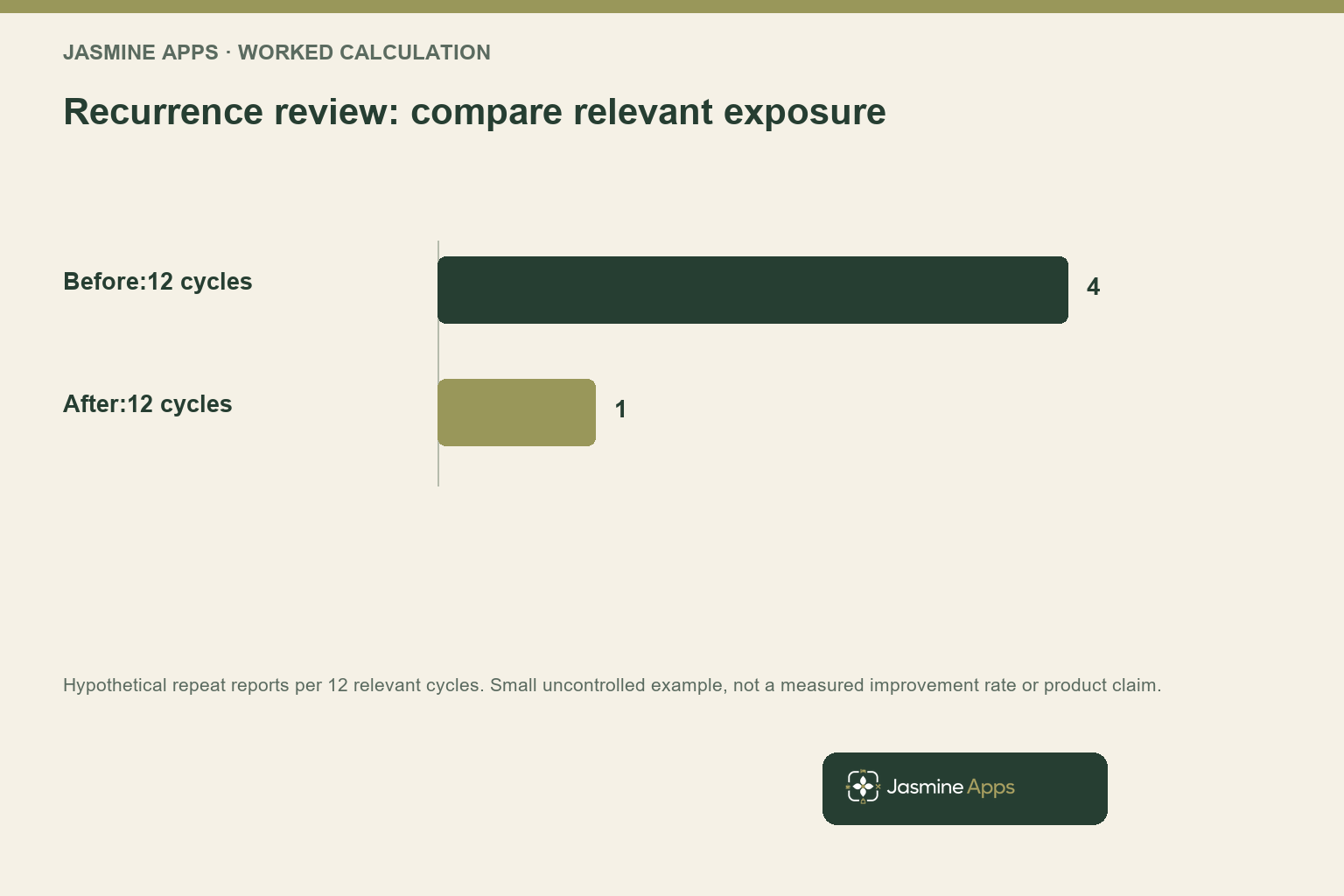
For a hypothetical check, compare twelve relevant operating cycles before and after the corrective action, with four reported repeats before and one afterwards. Those counts can inform the review, but a small uncontrolled comparison does not establish a universal improvement rate. Record changed conditions and ask the competent person whether the remaining event supports or challenges the proposed explanation.
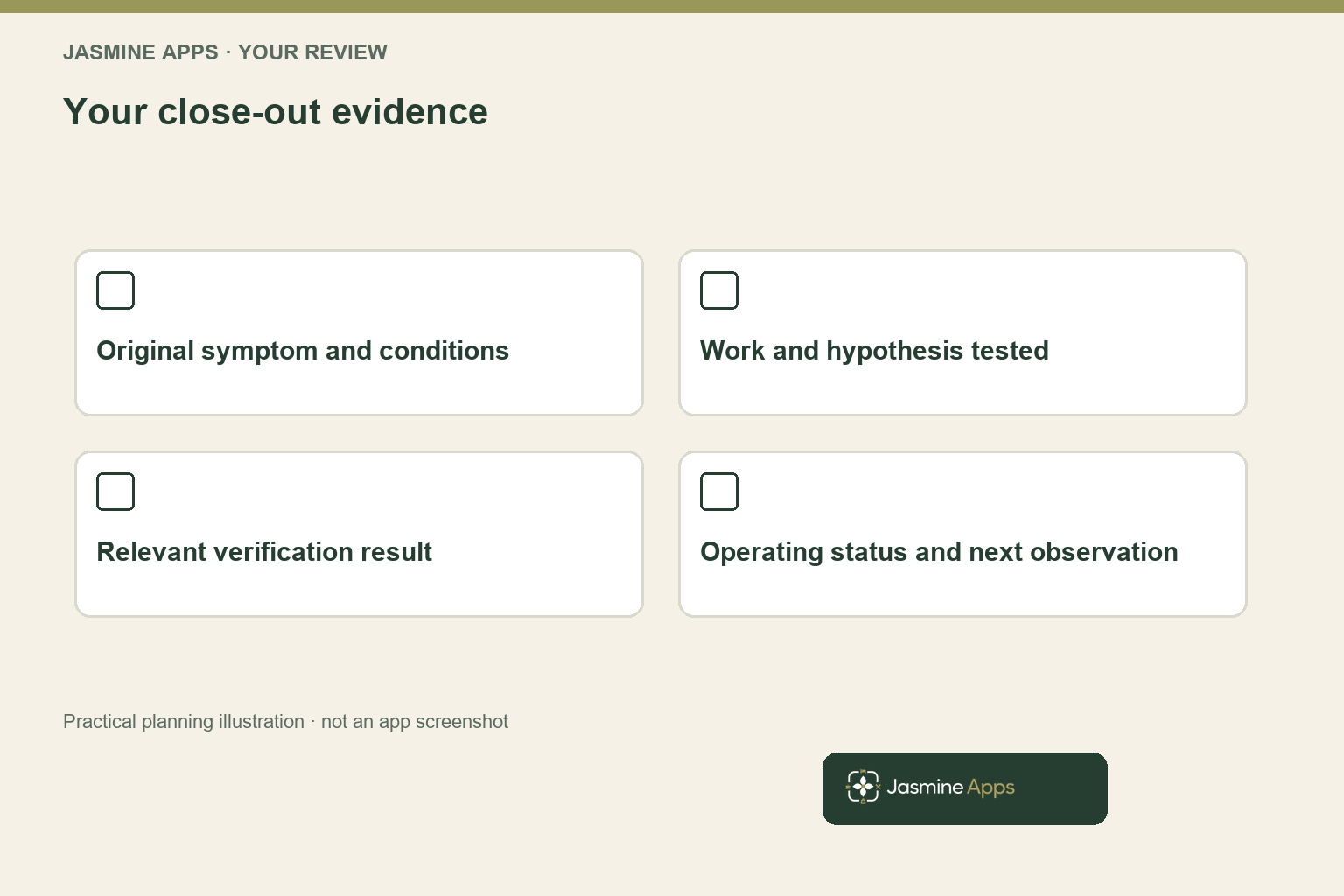
Keep the verification outcome with the action and the original symptom. Your manager can then understand what was tested and why the issue was accepted as resolved, retained for observation or returned for further investigation. The result is a stronger close-out decision, supported by the relevant evidence rather than an optimistic note that the equipment seemed fine at the moment the technician left.
Calculate the full cost of recurrence without exaggerating lost sales
Your cost review should include repeated attendance, parts, temporary measures and other genuinely incremental expenses. Keep the tax basis consistent and distinguish a contractor invoice from internal time valued for planning. If the same cost appears on a consolidated invoice and a ticket estimate, reconcile it rather than adding both and overstating the expense of recurrence.
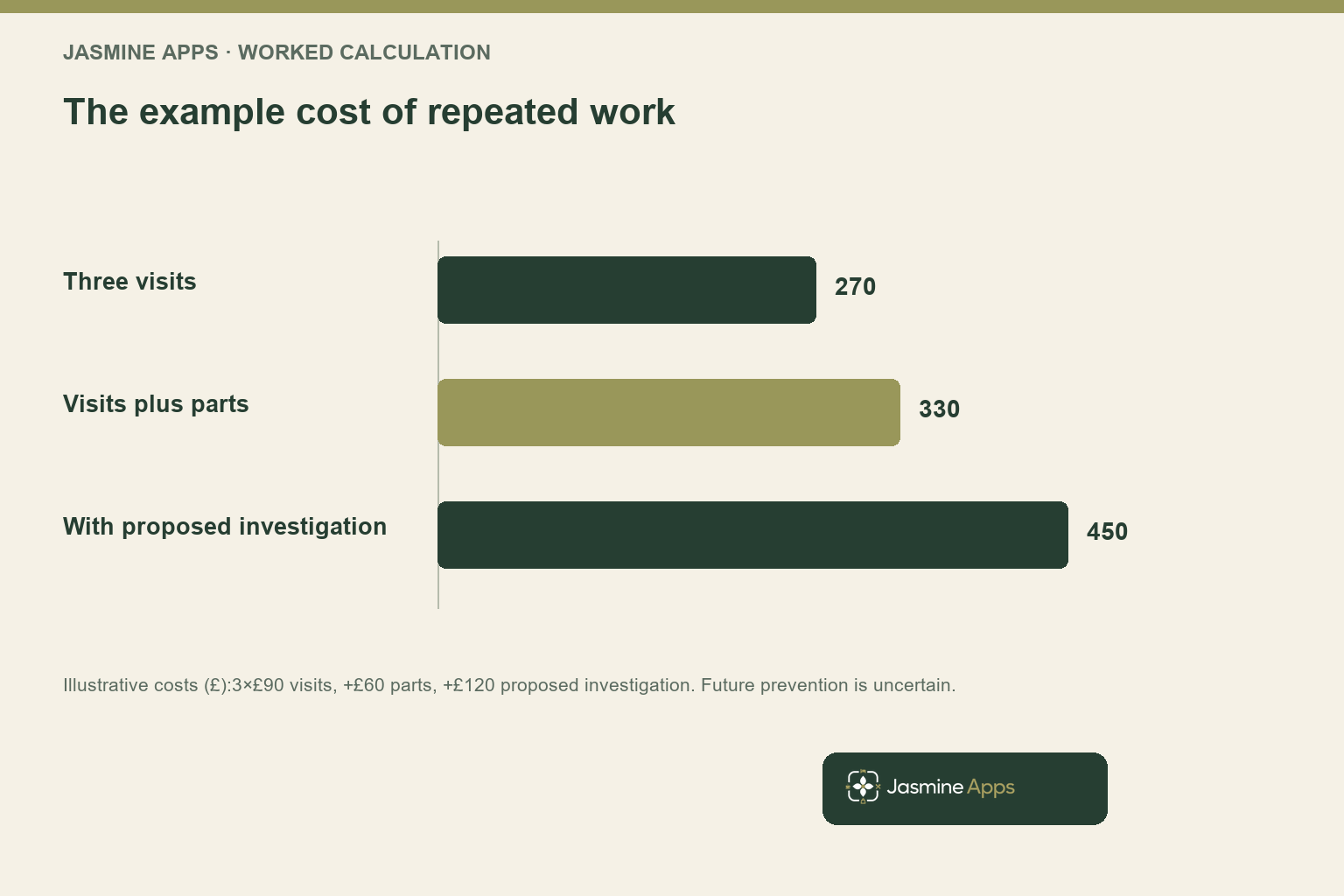
For an illustration, assume three repeat contractor visits cost £90 each, parts total £60 and a further £120 investigation is proposed. Repeated attendance and parts have cost £330; including the proposed investigation gives £450 before other effects. Those assumptions help frame the decision, but they do not prove that the investigation will prevent another visit or establish the right technical intervention.
Assess operating impact separately. A blocked room-night is unavailable capacity, not automatically a lost sale. Estimate displaced demand and contribution using appropriate booking evidence, subtract relevant avoided costs and account for useful recovery. Your room downtime cost framework provides that calculation, keeping potential capacity and realised financial loss distinct.
Jasmine Maintenance is currently listed at £79 per venue monthly or £790 annually, with current availability and delivered scope requiring confirmation because the public product has carried a coming-soon description. The system can support a more organised record, but your buying case should include the people, contractor work, setup and reporting needed to use that record effectively.
Compare the proposed investigation and corrective action with a realistic continuation scenario, not an unlimited series of assumed failures. Show which future costs are uncertain and what evidence would change the decision. Your manager can then authorise a justified next step with a clear technical question and a transparent commercial model, avoiding a promise that closing one recurring issue pays for every part of the software indefinitely.
Turn one investigation into better fault records across the hotel
After the investigation, update the practical information that would help someone recognise the symptom next time. That might include a clearer asset identifier, relevant observation field or instruction to contact the responsible specialist. Keep technical work within competent procedures; your general staff guidance should help colleagues report and escalate safely, not encourage unauthorised diagnosis or adjustment.
Review whether the maintenance plan needs a competent reassessment. A recurring fault may reveal a missing inspection, an unsuitable operating arrangement or a condition that the current schedule does not consider. Do not change intervals casually from a ticket trend alone; involve the appropriate professional and record the approved reason for any revised task, method or timing.
Share the operational lesson without exposing private guest or employment information. A useful team example can describe the symptom, the reporting gap and the improved handover using anonymous references. Your aim is to strengthen the process, so focus on what the next colleague should notice and do rather than naming someone whose earlier observation happened to be incomplete.
In your software demonstration, ask how the proposed records link room, asset, symptom, action and follow-up evidence. Confirm search, reporting, documents and export scope where those are required, rather than assuming a dedicated root-cause module exists. You can use a secure supporting investigation record if needed, provided the relationship and responsible owner remain clear to authorised colleagues.
Your review should finish with the current operating decision and the next check, not simply a more detailed history. Retain the evidence that explains the result and the practical change that prevents the same information gap recurring. Over time, your hotel builds a more useful maintenance memory, helping managers and contractors spend effort on a better technical question before another guest experiences the same unresolved symptom.
Pro Tips
Test the cause statement. Ask what observation would challenge the proposed explanation. A useful hypothesis should guide an appropriate test, not simply sound convincing after the repair.
Count exposure. Record relevant operating cycles or use conditions alongside a no-repeat period. A quiet asset offers less evidence than one tested under the circumstances that previously produced the symptom.
Keep containment visible. Label the temporary measure separately from corrective action. Your next colleague should know whether operation was restored while the underlying cause still needs investigation.
Common Mistakes
Grouping every similar phrase as one fault. You can combine unrelated assets or symptoms. Confirm the physical item and observable event before analysing recurrence.
Calling a reset a verified cure. You may remove the immediate symptom without testing the cause. Agree relevant follow-up evidence before close-out.
Valuing every blocked night as a lost booking. You overstate the commercial impact when demand or recovery differs. Estimate displaced contribution from appropriate evidence.
Frequently Asked Questions
How do you investigate a recurring hotel maintenance fault?
You identify the asset and factual symptom, assemble the relevant sequence of reports and work, then involve the competent person in testing plausible causes. Keep immediate protective action ahead of the investigation and distinguish temporary containment from corrective work. Agree verification under the conditions that previously produced the problem, with an appropriate follow-up record. Your outcome should explain the current operating decision and remaining uncertainty rather than rely only on a ticket being marked closed.
What is the difference between fixing a fault and finding its root cause?
You may restore operation by replacing a failed part or applying an approved temporary measure without establishing why the failure occurred. A cause investigation examines the evidence and tests an explanation for recurrence through competent technical work. Your corrective action should address that explanation and have a relevant verification method. Keep those steps distinct so the manager understands whether the equipment is restored, the cause is supported or further investigation remains necessary before confidence is justified.
How do you know whether a hotel repair has worked?
You use the appropriate competent verification under relevant safe operating conditions, then follow the asset through a meaningful opportunity for recurrence. The absence of another complaint is useful only with context about use and reporting. Keep technical acceptance separate from housekeeping and room-release checks, and record the evidence and limitations. Your decision may be resolved, observe further or investigate again, depending on what the test establishes rather than how reassuring the equipment appears immediately after work.
Can maintenance software diagnose hotel equipment faults automatically?
You should confirm the exact functions available rather than assume that an issue record provides automatic technical diagnosis. A useful workflow can organise location, symptom, operating impact, action and follow-up evidence, while competent people investigate the equipment appropriately. Demonstrate the records and reporting required for your venue, including any secure supporting documents. Your buying decision should assess how the system helps the team reach a better question and maintain the evidence, not replace specialist judgement.
When is a recurring fault worth a deeper investigation?
You should consider safety, repeated operating disruption, technical advice and the full recurring cost, rather than wait for a universal number of tickets. Keep immediate risk within the required procedure. For the commercial review, reconcile repeated visits, parts and relevant displaced contribution, then compare the proposed next step with a realistic continuation scenario. Your manager needs a clear technical question, competent investigation scope and evidence that would justify the resulting corrective decision.
Hotel recurring fault investigation: your next step
Your hotel recurring fault investigation should make the next repair decision better informed than the last. Request a Jasmine Maintenance workflow and availability demonstration with an anonymous repeat-fault timeline. You can confirm how symptoms, actions and follow-up evidence stay connected, giving your team a clearer route from repeated complaints to a verified operational decision.