

Hotel Asset Replacement Decisions: Repair Again or Replace?
· Jasmine Apps
Your cheapest next repair can become your more expensive two-year decision. A low invoice tells you little about repeat faults, future maintenance or the work needed to keep the room available. Your hotel asset replacement decisions should compare complete options over the same period, with uncertain costs clearly identified.
Jasmine Maintenance can be explored through the room and fault workflow shown in the admin. Confirm current availability and the asset-history scope before assuming it automatically builds a lifecycle-cost report for your property.
Key Takeaways
- Compare repair and replacement over one agreed time horizon.
- Include installation, maintenance and evidenced disruption costs.
- Use repair history to question a forecast, not guarantee the next failure.
- Keep safety and suitability ahead of a narrow cost comparison.
- Confirm current product availability and the delivered asset workflow.
Frame hotel asset replacement decisions over a common horizon
You should decide what each option must achieve before comparing prices. Your replacement should provide a suitable level of service for the relevant room or task, while the repair option should restore an acceptable operating condition. An inexpensive alternative that cannot meet the need is not a like-for-like choice.
Choose a common comparison period. If you show one repair invoice against the full purchase price of a new unit, you have compared a short-term action with a longer-term asset. Your forecast needs the expected costs of each option across the same horizon.
The US Department of Energy lifecycle-cost guidance discusses costs beyond acquisition, including operation, maintenance and disposal. You can apply that general decision method to your hotel. Its federal purchasing context should not be presented as a UK legal requirement or a Jasmine performance claim.
Define the costs you can support with records or quotations. Your list might include purchase, installation, anticipated repairs and measured operating costs. Keep estimates separate from confirmed prices, and document the source of each assumption so your reviewer can challenge it.
You should also identify differences in useful life and service quality. A two-year comparison may be a manageable first view, but a materially different expected lifespan can change the decision. Your finance lead can advise on the appropriate longer-term method and any relevant treatment of future cash flows.
Safety and suitability remain separate gates. A narrow financial model does not authorise continued use of an unsafe or unsuitable item. Your responsible technical person should assess the condition before the commercial comparison becomes a purchase recommendation.
Calculate hotel asset replacement decisions without hiding uncertainty
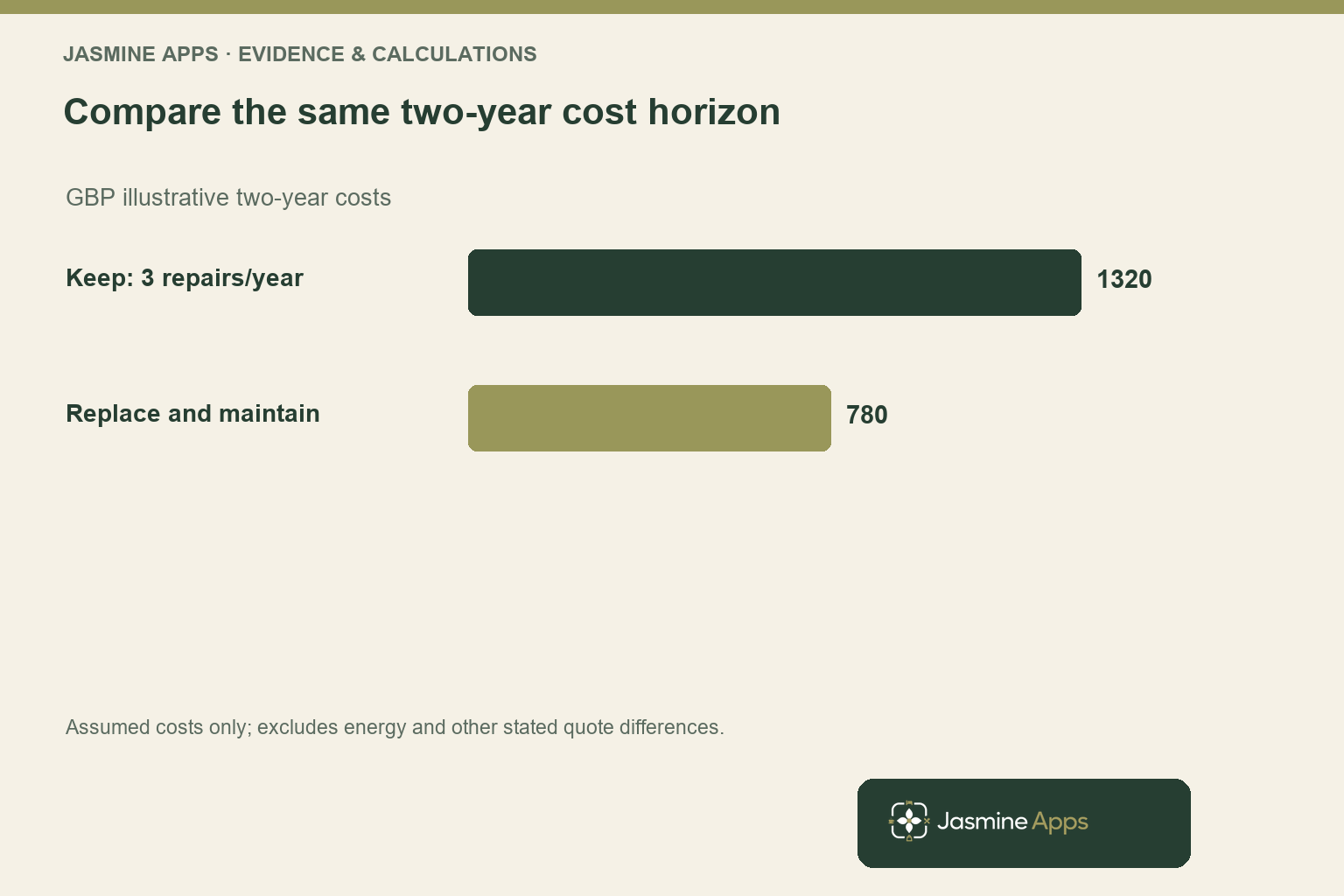
Consider an illustrative old unit expected to require three repairs per year at £180 each, plus £120 of separately evidenced annual disruption cost. Your two-year model is £660 per year, or £1,320. The disruption input needs a defensible basis; an unavailable room does not automatically mean a lost sale.
For the replacement option, suppose the purchase is £600, installation £100 and maintenance £40 per year. Over the same two-year period, the simplified total is £780. The illustrative difference is £540 in favour of replacement before any costs omitted from the comparison.
These values are planning assumptions, not a supplier quotation or a Jasmine customer result. Your actual repair likelihood, useful life, energy use and disruption can change the answer. Label the exclusions rather than presenting a partial model as complete ownership cost.
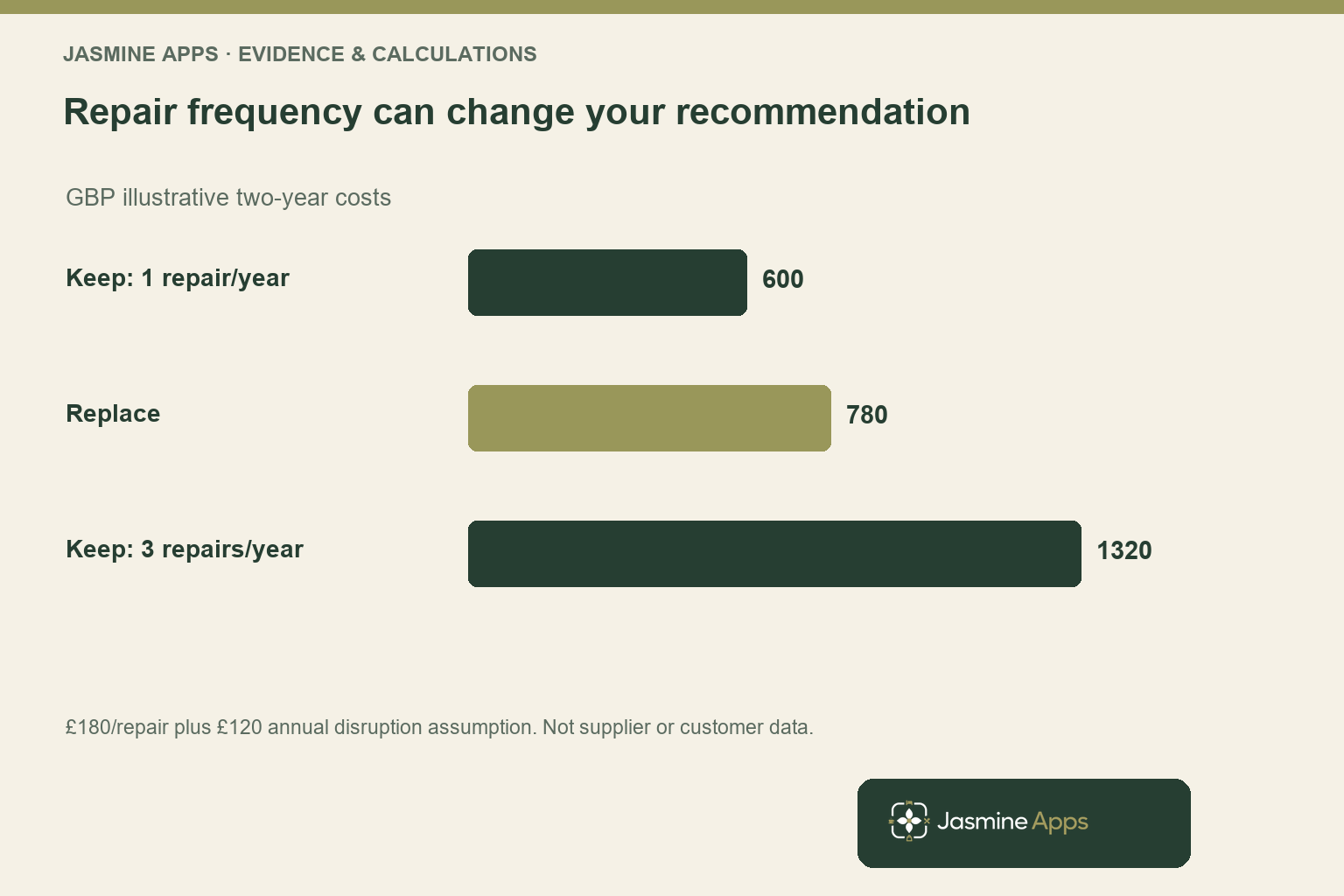
Now test a lower repair-frequency assumption. If the old unit needs only one £180 repair per year and the same £120 annual disruption allowance, its two-year total becomes £600. Under that scenario, the £780 replacement costs £180 more during the chosen horizon.
Your conclusion therefore depends on the forecast, not just the arithmetic. The sensitivity comparison gives your manager a useful question: what evidence supports expecting one repair rather than three? Your job history and technical assessment can help answer that without pretending to predict the future exactly.
Use the recurring maintenance-faults guide to organise repeated symptoms. Your replacement review goes further by joining that evidence to comparable cost options and a documented decision threshold. Record both forecasts beside the confirmed costs.
Use hotel asset replacement decisions to organise better evidence
The live maintenance preview identifies the venue, room and reported symptom, with room-impact states such as blocked, restricted and can sell. It also shows open and resolved fault states. That structure supports a discussion about practical fault records and operating impact.
You should confirm the delivered asset-history and cost functionality before promising an automated replacement recommendation. A commercial description of asset maintenance is not proof that your installation links every invoice, forecast and unit serial number. Bring the exact evidence you need to your demonstration.
Your useful history should distinguish repeat symptoms from confirmed causes. Several reports about a noisy appliance may relate to one unresolved issue, separate faults or an operating condition outside the unit. Ask the technical person to interpret the pattern before assigning a future repair probability.
Keep invoices and supplier quotes on the same scope. A repair quote may exclude parts or call-out work, while a replacement price may exclude installation or removal. Your comparison should reveal those differences rather than favour whichever option has the shorter headline price.
For downtime, separate the period the equipment is unavailable from the period the room cannot be sold. A temporary approved alternative may preserve the room’s use, while a short repair may require a longer verification or release process. Record the operational impact your venue actually experiences.
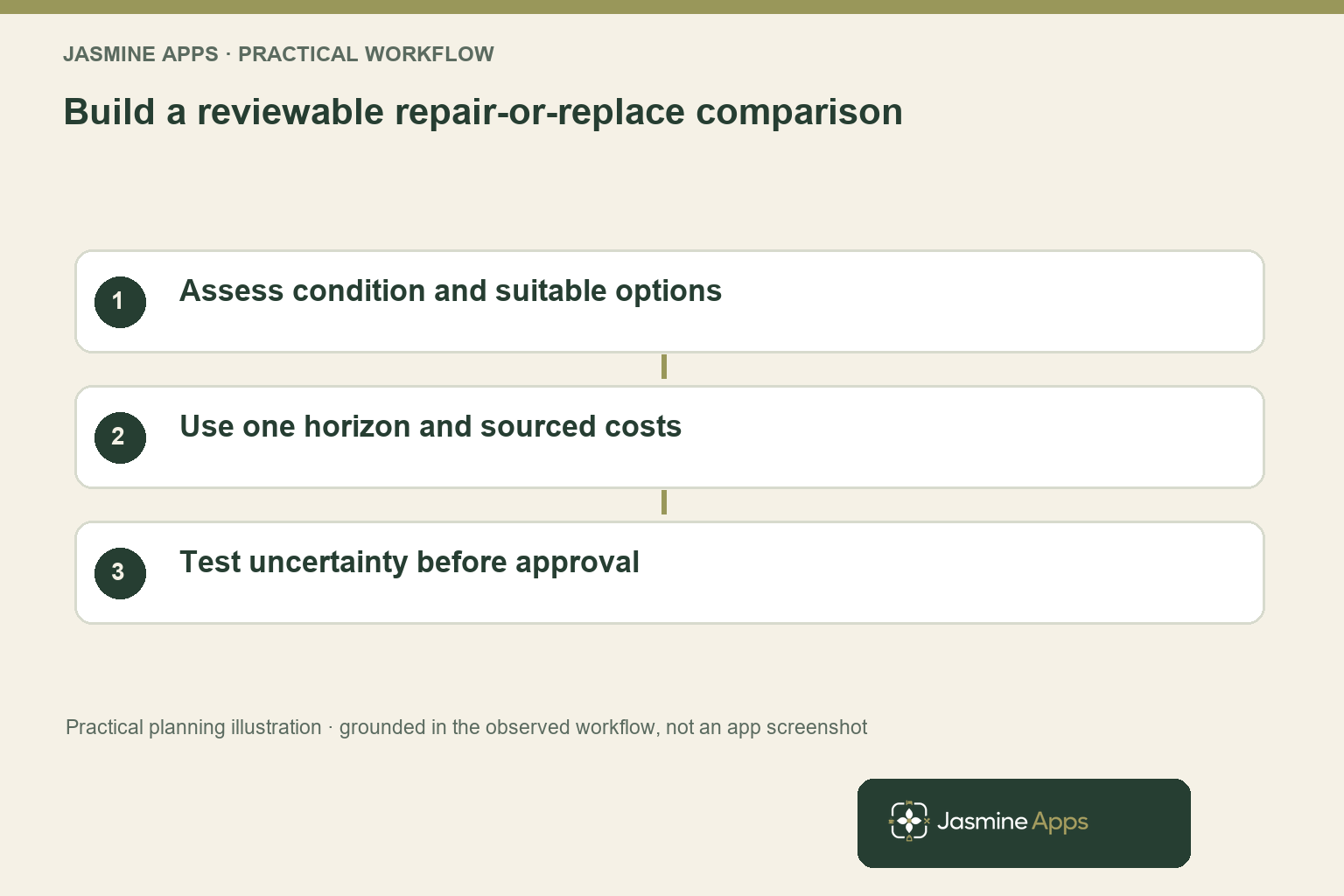
You can then assemble a decision sheet with the condition assessment, approved options, common horizon and sources. Your system may help hold or organise parts of that workflow, but your manager still needs to review the assumptions and authorise a suitable purchase through the venue’s normal process.
Make the purchase recommendation reviewable before committing
Your recommendation should state what you know, what you estimate and what would change the decision. Show a base case and a plausible lower or higher repair-frequency case. Your reviewer can then see whether the result is robust or depends on one uncertain assumption.
Confirm the replacement’s installation, support and disposal arrangements with the supplier. You should also ask how the proposed unit fits the room’s actual requirements. A financially attractive model becomes less useful if the installation creates an unplanned operational constraint.
The CRM lists Jasmine Maintenance at £79 per venue per month or £790 annually. The public product page also indicates coming-soon status, so you should confirm current availability and the delivered scope before purchase. Your quote needs the tax basis, setup and relevant terms, rather than an assumption that every described feature is already deployed.
Keep the software decision separate from the equipment decision. A fault-record process may help you assemble evidence, but buying it does not prove replacement is the right answer for an individual asset. Assess the complete maintenance workflow rather than assigning the entire subscription to one appliance comparison.
The maintenance response-times article examines another source of room disruption: waiting between stages. A replacement may address repeated equipment faults while leaving handover delays untouched. Your review should identify which problem each action resolves.
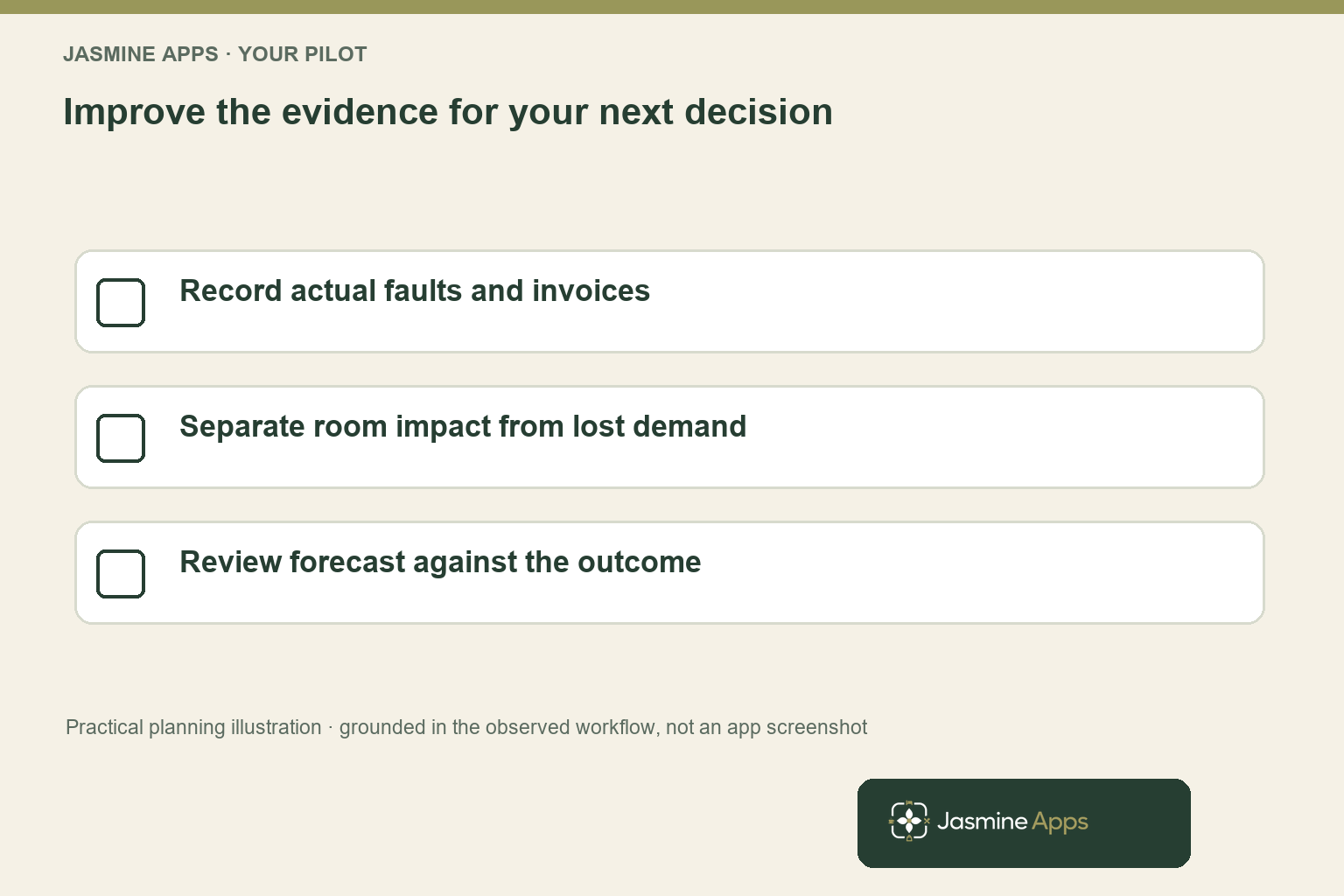
Before approving either option, agree how you will review the actual outcome. Record repair events, costs and service impact over the chosen period. You can then improve your next decision with real property evidence instead of repeating a confident forecast that nobody checks.
Pro Tips
Use one service requirement. Compare options that can perform the same necessary task. A cheaper unsuitable unit does not provide a meaningful saving.
Show the repair-frequency sensitivity. Your forecast often matters more than the precise invoice total. Make the decision-changing assumption visible.
Validate disruption separately. Use actual room impact and demand evidence. Equipment downtime is not automatically lost room revenue.
Common Mistakes
Comparing one repair with the entire purchase. You use different time horizons and can favour the short-term invoice. Compare complete options over the same period.
Treating repeated symptoms as proven future failures. You may count duplicate reports or misdiagnosed causes. Obtain a technical interpretation before forecasting.
Assuming automatic lifecycle-cost reporting. You promise more than the demonstrated scope. Confirm asset links, cost records and availability in your deployment.
Frequently Asked Questions
When should you replace hotel equipment instead of repairing it?
You should compare suitable options over the same time horizon after the responsible person has assessed condition and safety. Include confirmed and estimated costs separately, then test how repair frequency and operational impact change the result. Your cheapest immediate invoice may not be the best longer-term choice, but replacement is not automatically better either. Document the assumptions and the evidence that would change your recommendation before authorising the purchase.
How do you calculate hotel equipment lifecycle cost?
You should include the relevant acquisition, installation, operation, maintenance, repair and disposal costs over an agreed period. Use reliable records or quotes where available and label forecasts clearly. Keep the service requirement comparable between options.
A simplified two-year model can help frame the decision, while longer horizons may need your finance lead’s advice. Your calculation should show exclusions and uncertainty rather than claim precision from guessed inputs.
Can maintenance history prove an asset needs replacement?
Your history can reveal recurring reports and help question a repair forecast, but it does not independently establish the cause or predict the next failure. Several symptoms may refer to one unresolved issue or another operating condition. Ask the technical person to interpret the pattern and assess suitability. You can then join the evidence to supplier options and a common cost horizon, with uncertainty kept visible in the recommendation.
Does Jasmine Maintenance automatically compare repair and replacement?
You should confirm the actual delivered asset and cost workflow in a demonstration. The live preview shows room, symptom, impact and fault states, which supports practical reporting discussions. That does not prove an automated lifecycle-cost recommendation or every invoice integration.
Bring your intended evidence and decision sheet, then ask what the deployment supports. You should also confirm current availability because the public product page indicates coming-soon status.
Should blocked-room time be counted as lost revenue?
You should distinguish operational unavailability from an actual lost sale. A room may have remained unsold anyway, or your hotel may have accommodated the guest elsewhere. Use demand evidence and the relevant contribution basis before assigning a monetary loss.
Your decision can still value reduced disruption, but the financial label should match what you can establish. Record the unavailable period and the commercial consequence as separate measures.
Hotel asset replacement decisions: your next step
Your hotel asset replacement decisions should be clear enough for another manager to challenge and approve. Discuss Jasmine Maintenance with one recurring fault, your repair history and a replacement quote. You can confirm current availability, inspect the evidence workflow and build a comparison that protects both service and budget.