

Hotel Recurring Maintenance Faults: Why Closing More Tickets Can Hide the Real Problem
· Jasmine Apps
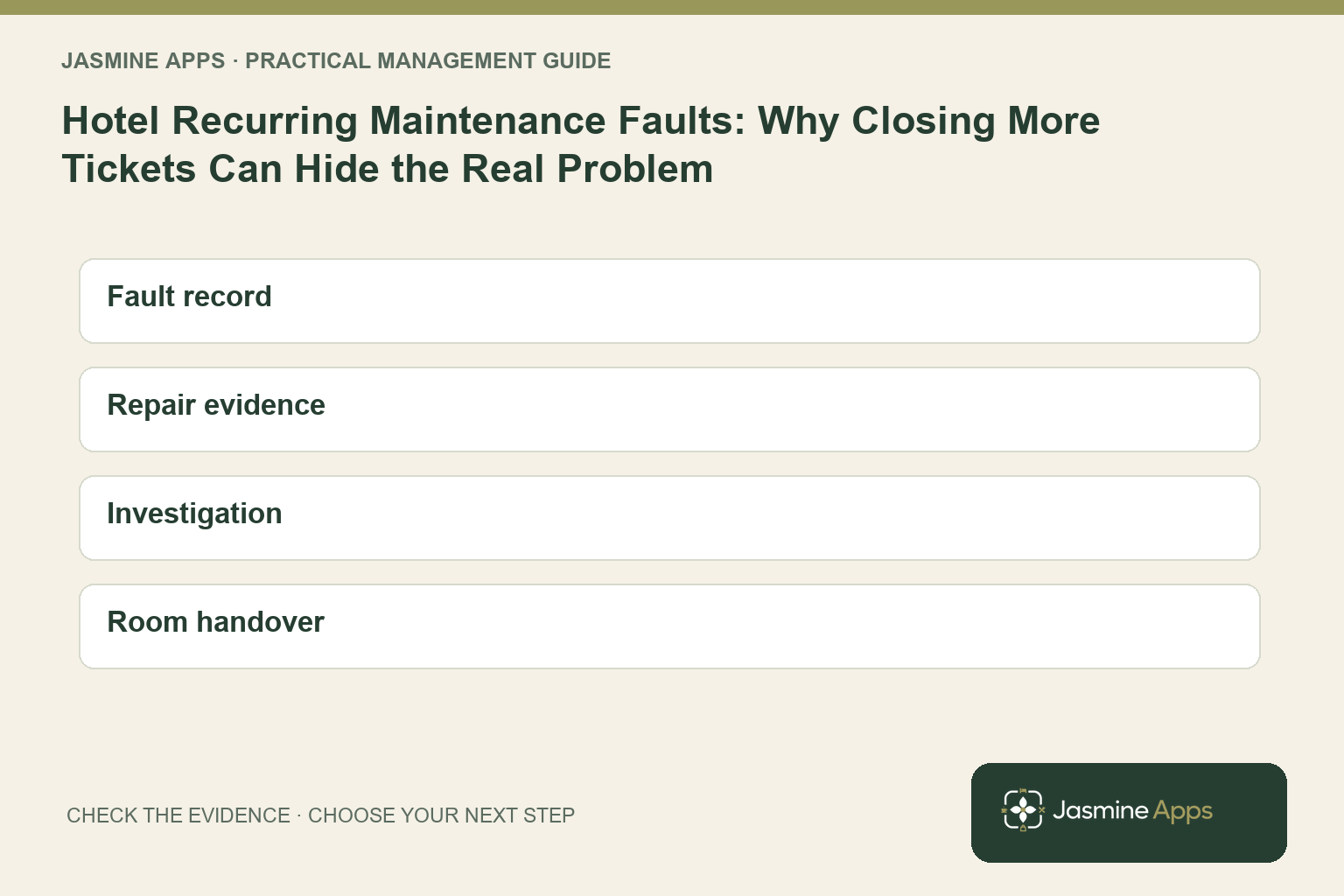
Your maintenance team can close the same room fault several times and still leave you with an unreliable room. A growing total of completed jobs may show effort, while the repeated symptom shows the underlying problem remains. Your hotel recurring maintenance faults review needs to connect the events rather than celebrate each closure in isolation.
You should preserve what was observed, what was done and what was checked afterwards. This guide helps you build that review around practical evidence, while keeping technical diagnosis and room-readiness decisions with the people qualified and authorised to make them.
Key Takeaways
- Group repeated observations without assuming they share a proven cause.
- Keep the repair action and verification result separate.
- Record the room and the relevant operating conditions.
- Give the recurring problem one investigation owner.
- Confirm availability and release checks through your approved process.
Identify hotel recurring maintenance faults from consistent records
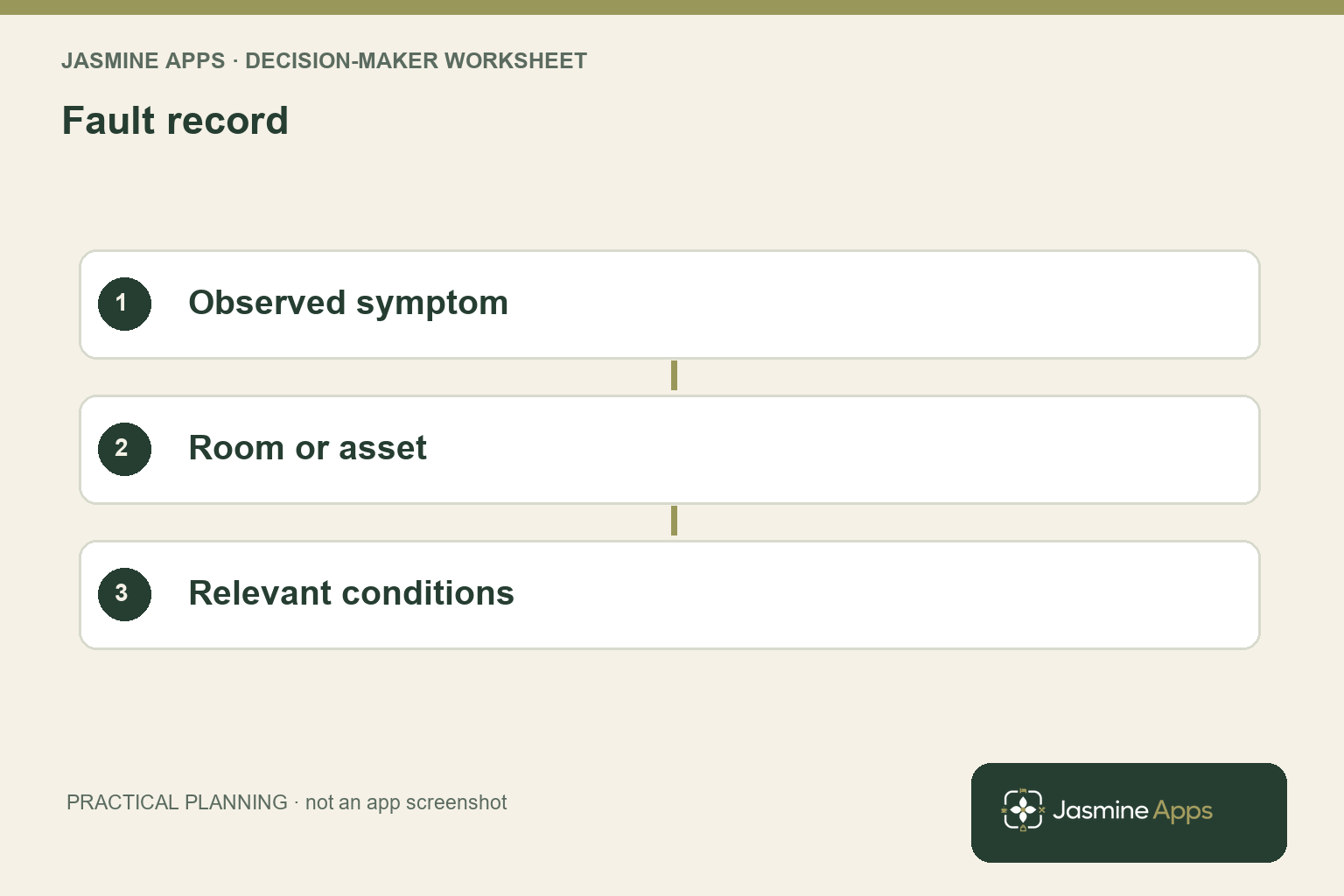
Write the symptom clearly enough to compare it with a later report. “Bathroom problem” gives your reviewer little to connect; an observed issue with location, time and relevant conditions gives the next person a useful starting point. Keep a suspected cause distinguishable from the actual observation. Your staff should not need technical certainty to report a fault accurately.
Use consistent room and equipment references. If the same asset appears under several names, your review can scatter one recurring problem across unrelated records. Check the venue first, then the room and the affected item where your system supports it. Your reviewer should be able to locate the physical context without relying on the employee who wrote the original note to remember what they meant.
Keep related occurrences visible without merging away their history. The same reported symptom can have different causes, and similar timing can matter to the investigation. Preserve each observation, repair and verification result, then create your management summary from those records. Your aim is a traceable pattern, not a cleaner list that removes the evidence needed to understand why the room returned to the issue queue.
The ASQ root-cause analysis guidance describes investigating underlying causes as part of improvement. Use that approach to frame your questions rather than as a do-it-yourself instruction for electrical, structural or other specialist work. Your authorised technician and responsible manager should determine the appropriate diagnosis and intervention. A repeated symptom deserves better evidence, not an unqualified repair attempt prompted by a chart.
Keep the observation date distinct from the repair date so your reviewer can identify the actual recurrence interval instead of comparing administrative closure times.
Review hotel recurring maintenance faults through repair evidence
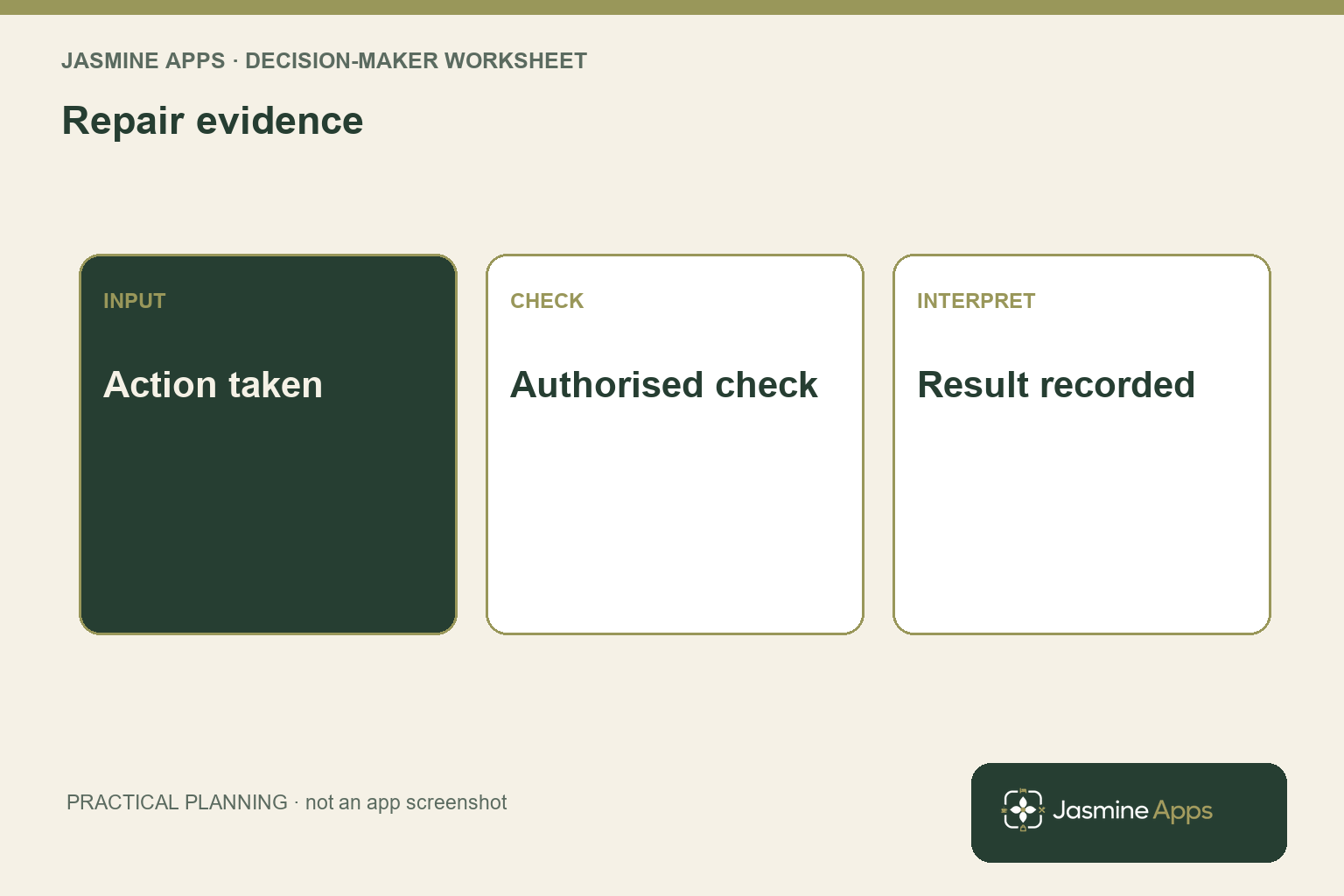
For each occurrence, record the action taken and the check performed afterwards. Replacing a part, resetting equipment and verifying operation are different events. Your closure note should explain what the technician or authorised colleague actually confirmed. “Fixed” is difficult to compare with a later recurrence because it does not establish which condition was tested or whether the symptom could be reproduced.
Include the conditions that can help the investigation. Your authorised report might identify that an issue occurs during a particular operating period or returns after a repeated usage pattern. Keep those observations factual and relevant. Do not fill the record with a guessed mechanism or unrelated guest details, especially when a photograph can show the affected area without identifying anyone.
The actual Jasmine Maintenance administrative preview separates the venue, room, observed fault and availability state. Availability can be Blocked, Restricted or Can sell, with a separate process-to-fix area. The public product is currently marked coming soon, so confirm supported access and the current release before relying on it in live operation. Those observed controls inform this planning example; they do not establish an automatic connection to your external room inventory.
Use the room setup guide for consistent room identity, with publication and access checked before rollout. Your management review should connect the fault record to the approved room-readiness process. A completed repair step is not the same as the final decision to release a room, and a changed maintenance label does not prove every other system or department received the update.
Act on hotel recurring maintenance faults without losing context
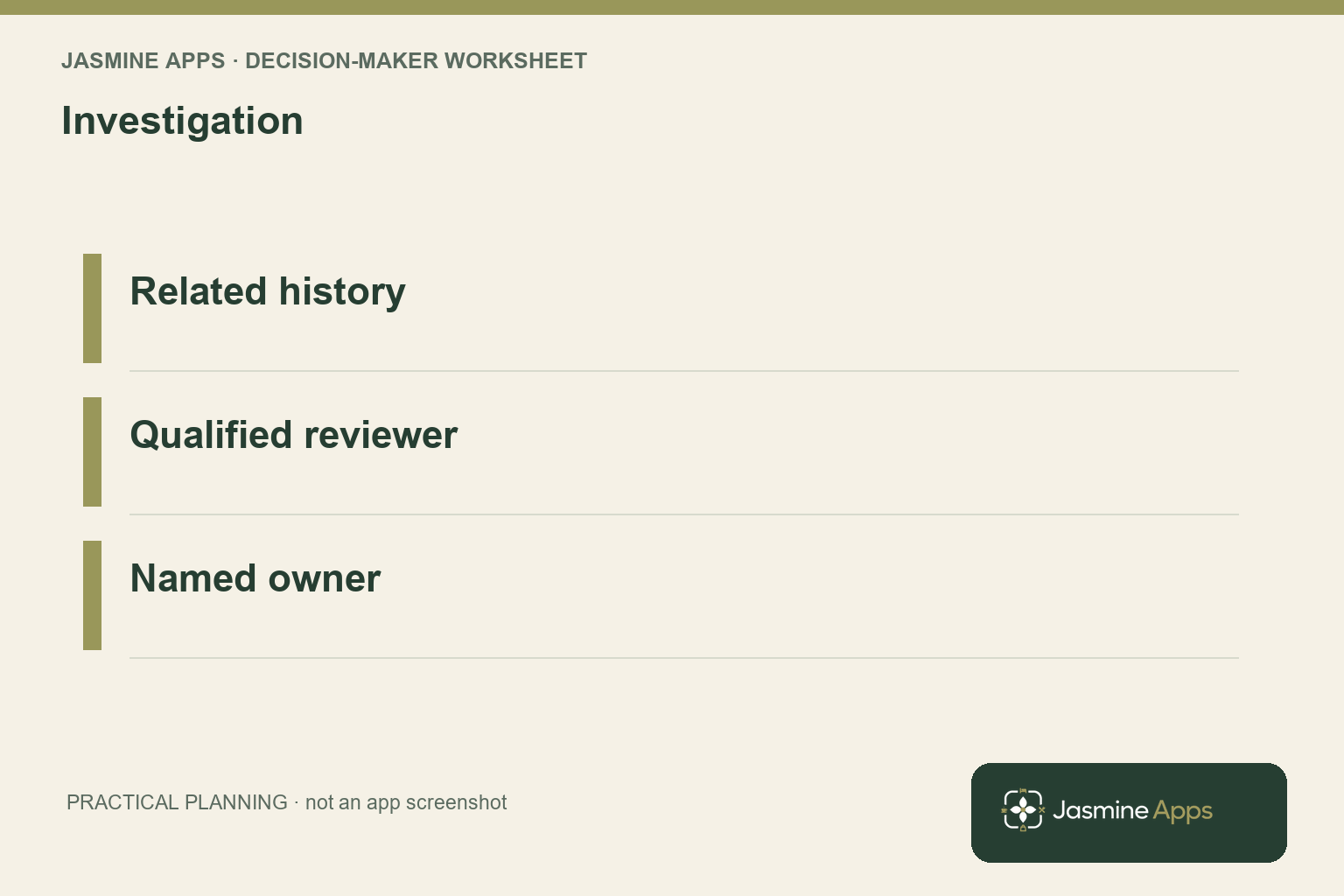
Give the investigation a named owner who can coordinate the relevant evidence. That person should know which technician or responsible manager reviews the pattern and who communicates the operational consequence. Keep the room’s current availability decision clear while the investigation continues. Your staff should not infer that a historical resolved ticket makes today’s room suitable for sale.
Prioritise the action using your approved risk and operating process. The number of occurrences is useful context, but it should not override the significance of the fault. A rare serious issue can require more urgent attention than a frequently reported cosmetic problem. Your qualified responsible people should make that judgement, with the recorded observations available rather than a simplified score pretending to replace it.
After intervention, define what evidence would indicate that the problem has been addressed. Your authorised check may need a relevant operating condition and a follow-up review, not just a momentary change in the symptom. Preserve the date, action and result. If the issue returns, connect the new observation to that history so the next investigation begins with better information rather than another isolated ticket.
Discuss your intended scope through the Jasmine Maintenance feature page. Ask how the supported release handles history, updates and your required handover, and demonstrate those needs before rollout. Your recurring-fault process should still identify the owner and room-release decision outside any unconfirmed integration. The useful outcome is a better diagnosis and a reliable operational handover, not simply a smaller visible backlog.
Check that the next observation uses the same room or asset reference before adding it to the recurring-problem summary and escalating the pattern.
Pro Tips and Common Mistakes
Pro Tips
Preserve the repair attempt. An unsuccessful intervention can still help your qualified reviewer rule out an assumption. Keep what was done, when and under which conditions rather than replacing the previous note with a new “fixed” label.
Give the pattern an owner. Separate responsibility for completing an individual job from responsibility for investigating recurrence. Your team needs to know who connects the history when the same symptom returns.
Verify the release handover. Ask the next department to confirm the room context and approved readiness decision. Your technical completion and operational availability should meet through a clear process rather than an assumed automatic update.
Common Mistakes
Counting closures as reliability fails because repeated short-lived repairs can increase the total. Review the return of the symptom and the supporting verification evidence.
Treating similar symptoms as a proven shared cause fails because the resemblance is only a starting hypothesis. Let your authorised reviewer investigate the relevant conditions and records.
Assuming a maintenance status updates your PMS fails when that connection has not been demonstrated. Keep the approved availability and departmental handover process explicit.
Your review should finish with a better question for the right person and a clear current room decision. Preserve uncertainty where the cause remains unresolved, rather than allowing a confident but unsupported note to steer the next repair.
Keep the unresolved investigation question beside the individual repair history, with the responsible reviewer and the evidence still required to answer it clearly identified. Your team can then continue the approved room-availability process while the technical investigation remains open, rather than allowing a closed task to imply that the underlying problem disappeared.
Frequently asked questions
How do you track recurring hotel maintenance faults?
Use consistent venue, room and equipment references, then preserve each observation, action and verification result. Group related symptoms for review without deleting their individual history. Assign an owner to connect the records and coordinate the qualified investigation. Your summary should show what repeats, under which relevant conditions and what was previously tried.
Avoid treating a recurring symptom as proof of one cause, because the evidence may support several explanations until the responsible specialist reviews it.
What should a maintenance closure note include?
Include the action performed, the person or role responsible, the relevant date and the result of the authorised verification check. Keep the original symptom and any remaining limitation visible. Your note should help another reviewer understand what was confirmed, rather than use only “fixed”. Record the separate operational availability or room-release decision through your approved process.
A repair step can be complete while a follow-up check or departmental handover still needs attention before the room returns to ordinary service.
Does a repeated fault always mean the previous repair was wrong?
No. Similar symptoms can have different causes, and the operating conditions may change. Review the original observation, intervention and verification before deciding what the recurrence means. Your authorised specialist should assess the technical explanation using the relevant evidence.
You can improve the record by preserving unsuccessful attempts and uncertainty. Avoid blaming the technician or repeating the same intervention solely from a count of tickets, because the pattern identifies a question rather than proving its answer.
Can maintenance software automatically release rooms for sale?
Only rely on that behaviour when the exact integration and approved workflow have been demonstrated on your installation. A maintenance availability state does not by itself establish a change in your external inventory or property-management system. Keep the technical completion, readiness check and operational release decision explicit. Jasmine Maintenance is currently marked coming soon publicly, so confirm the supported release and access before rollout.
Your procedure should remain clear even where a system-to-system handover is not available.
How should you prioritise a recurring room issue?
Use your approved risk and operating process, with the fault’s significance, current room condition and qualified advice available to the decision maker. Recurrence is useful context but not a substitute for assessing the actual issue. A rare serious fault may need attention before a frequently reported minor one. Keep the current availability decision clear and assign an investigation owner.
Your records should support the judgement rather than make an automatic ranking appear to settle questions that require authorised technical assessment.
Make hotel recurring maintenance faults a better investigation
Your hotel recurring maintenance faults review should preserve evidence, assign ownership and keep the room’s current status clear. Bring your reporting and release process to Contact Us to discuss Jasmine Maintenance’s supported release and planned fit. Ask to see how your required fault history and handover would work, so you can prepare a useful process before depending on it across your rooms.