

Restaurant Table Reset Time: Add Capacity Without Rushing Your Guests
· Yiannis Yiasemis
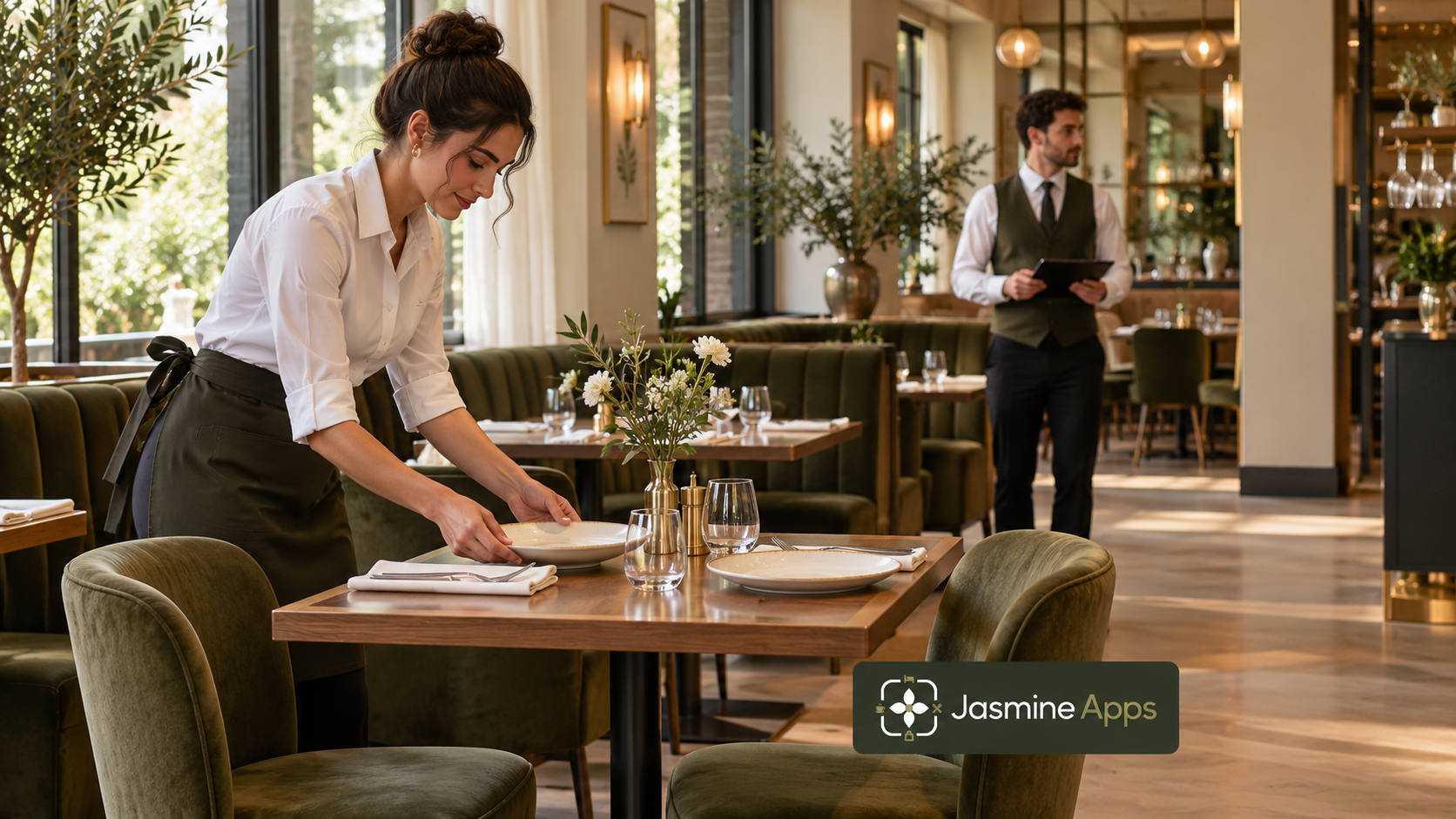
You can shorten a table's unavailable time without shortening the meal. The gap after departure—waiting for someone to notice, clear, reset and confirm availability—can occupy minutes that your guests never enjoyed. Your restaurant table reset time deserves its own review before you reduce a dining allowance that guests value.
Table Jasmine helps your team distinguish seated parties and departures within the booking workflow. Combine that shared record with an observed reset process and a realistic next-booking window. Your opportunity is to make a genuinely ready table available at the right time, while preserving cleaning standards, a comfortable meal and enough flexibility for the service you actually run.
Key Takeaways
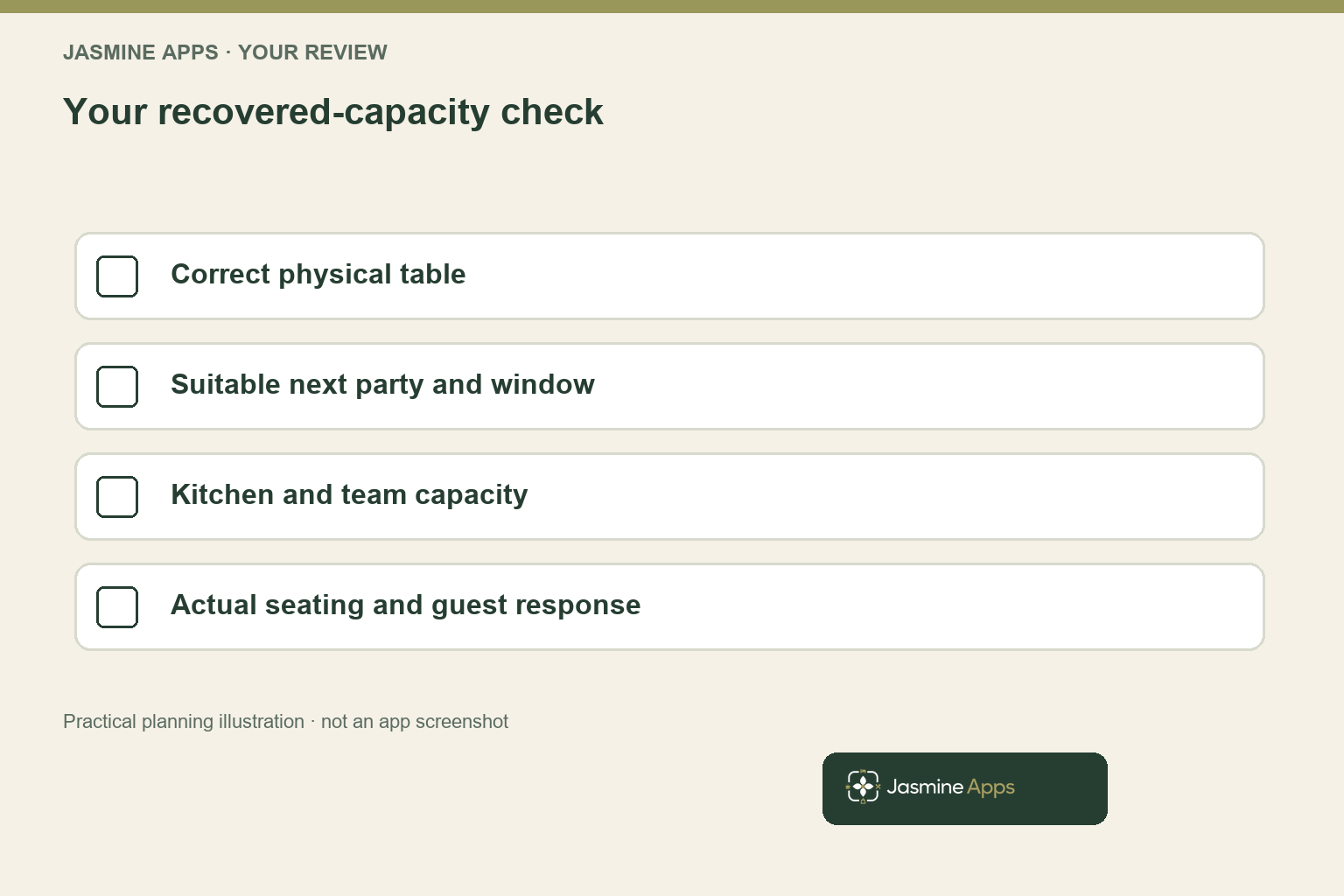
- Separate dining duration from the post-departure reset.
- Measure the ready-for-seating point consistently.
- Check demand before valuing recovered minutes as sales.
- Keep cleaning, accessibility and guest comfort in the plan.
- Test the complete host-to-floor handover.
Define restaurant table reset time separately from the meal
Your table's full occupancy window contains several different stages. Guests arrive, settle, order, dine, pay and leave; the team then clears, cleans, resets and confirms that the next party can be seated. Measuring only the interval between booking times blends those stages and makes it difficult to identify which delay can be reduced without changing the guest experience.
Set a practical start and finish for the reset measure. You might begin when the last guest leaves and finish when the host can safely seat the next party under your venue's standard. Agree what ready means, including cleaning, complete settings and any accessibility requirement. An empty table with used glassware or missing chairs is not yet usable capacity.
Observe the information handover as well as the physical work. A colleague may finish setting the table while the host still believes it is occupied, or the host may offer it before the floor team has completed cleaning. Record the stage at which the shared status changes so your review can separate delayed communication from the work that genuinely needs doing.
Cornell's meal-duration and reservation teaching treats duration and reservations as important elements of restaurant revenue management. Apply that principle carefully to your own service: the useful target is an appropriate total process, not the fastest possible meal regardless of occasion or guest expectations.
Keep the observation anonymous and manageable. Use table references, party size, service period and stage times rather than private guest descriptions. A small sample can identify a handover worth testing, while a dependable booking-policy change requires enough representative evidence to account for ordinary variation. Your first result should explain where minutes go before promising how many bookings they can create.
Measure restaurant table reset time at the stages you can change
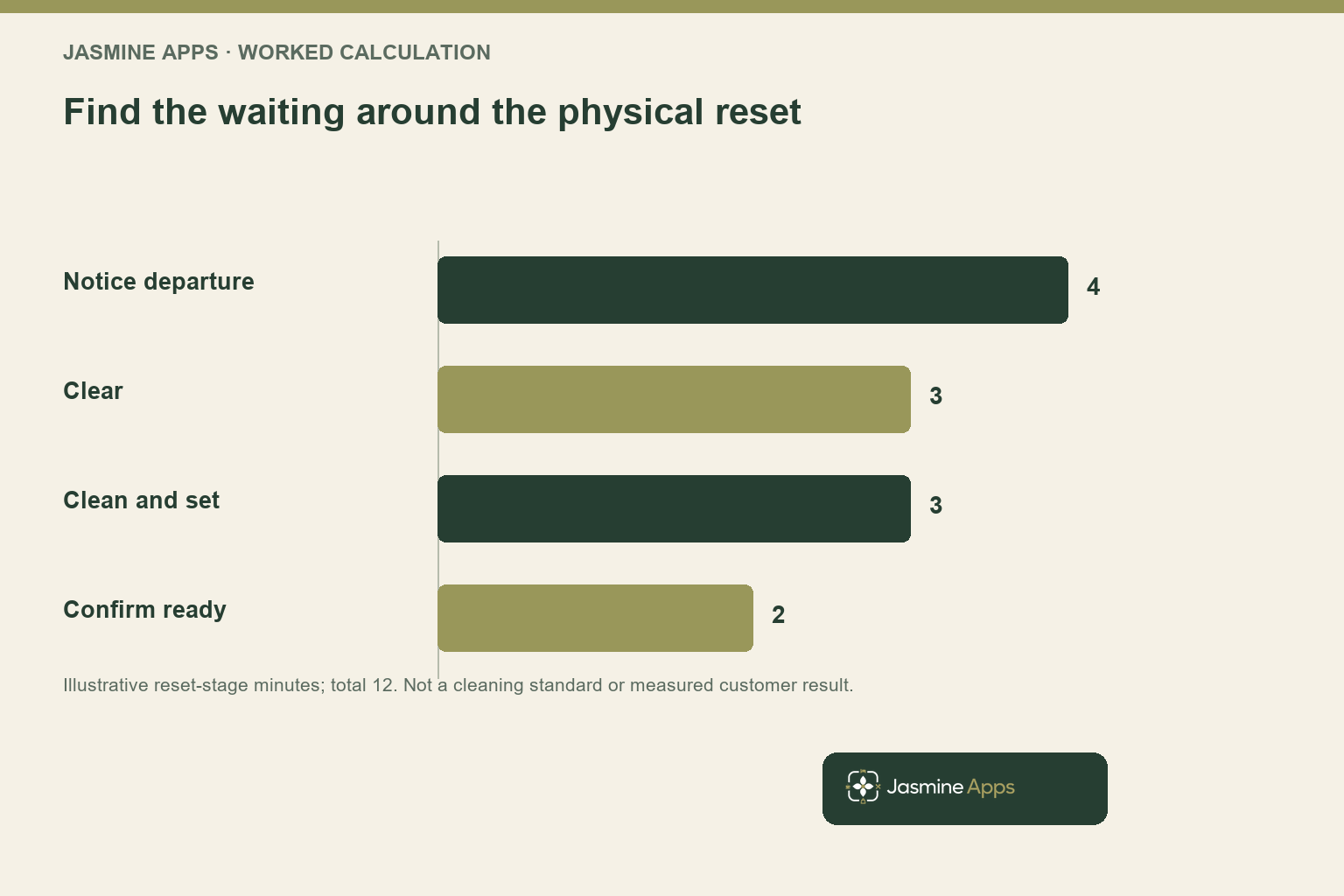
Break the post-departure interval into noticing departure, clearing, cleaning, setting and confirming readiness. The same total can arise from different causes. One table may wait for clearing equipment; another may be ready but unreported. Your improvement should address the stage that holds the process up rather than asking every colleague to move faster throughout service.
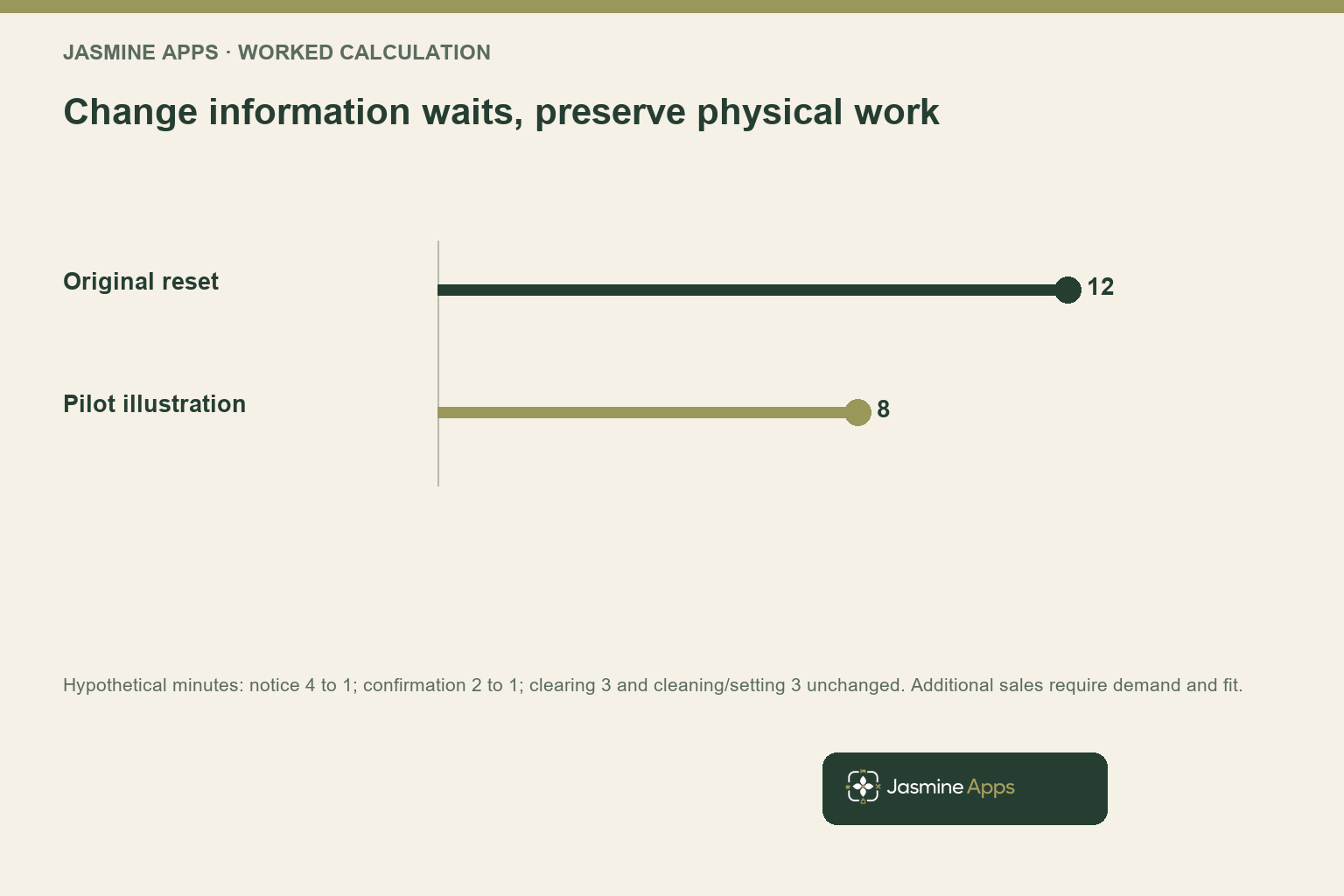
For an illustrative reset, assume four minutes before departure is noticed, three for clearing, three for cleaning and setting, then two before the host receives confirmation. Your total is twelve minutes. Half of that interval sits in the two information waits, which gives your team a different opportunity from trying to compress every cleaning step.
Suppose an agreed handover reduces the first wait to one minute and the final wait to one, while physical work remains unchanged. The modelled reset becomes eight minutes, releasing four minutes per affected table turn. That is a planning example, not a claim about typical hospitality performance or a guaranteed result from changing your booking software.
Check the operating conditions around each observation. A spill, different table configuration or missing equipment may justify a longer reset. Your review should preserve those explanations rather than treating them as inconvenient outliers. Look for recurring avoidable waits, then decide whether the cause is location of supplies, unclear responsibility, status communication or another practical constraint.
Discuss the sample with both the floor team and host. Ask whether the recorded finish really meant the table was ready for the next guest and whether the proposed improvement is workable at peak demand. Your next experiment can then change one handover or equipment arrangement, with a clear measure and the same standard of readiness throughout the comparison.
Turn restaurant table reset time into realistic booking capacity
Recovered minutes matter commercially only when they create usable space in the service plan. Four minutes released from a table whose next booking arrives an hour later may improve readiness without producing another sale. The same minutes at a crowded arrival window might prevent a queue or protect a confirmed booking from starting late.
Look at your table mix and overlapping parties rather than simply adding all released minutes together. Ten tables each ready four minutes earlier do not automatically create one forty-minute booking slot. The minutes belong to different physical tables and time windows, and the next party's size and dining allowance still need to fit your actual layout.
For a separate hypothetical opportunity, suppose the improved process allows one additional two-person party to dine without displacing another booking. If each guest contributes £18 after relevant variable costs, that party adds £36 contribution before any other changed expense. If no additional party can be served, do not count £36 merely because the reset was quicker.
Check the arrival pattern and kitchen capacity. Seating several extra tables together can move the delay from the host stand to ordering and production, leaving guests waiting despite a faster reset. Your booking plan should consider the meal as a complete service, including how many parties the team can welcome and serve well in the same short interval.
Use your restaurant table-capacity guide for the broader layout and overlap discussion. This reset review adds evidence about when a particular table becomes genuinely usable. You can then adjust selected windows where the fit is demonstrated, rather than shortening every booking on the assumption that average minutes translate directly into sellable seats.
Use Table Jasmine to support the host-to-floor handover
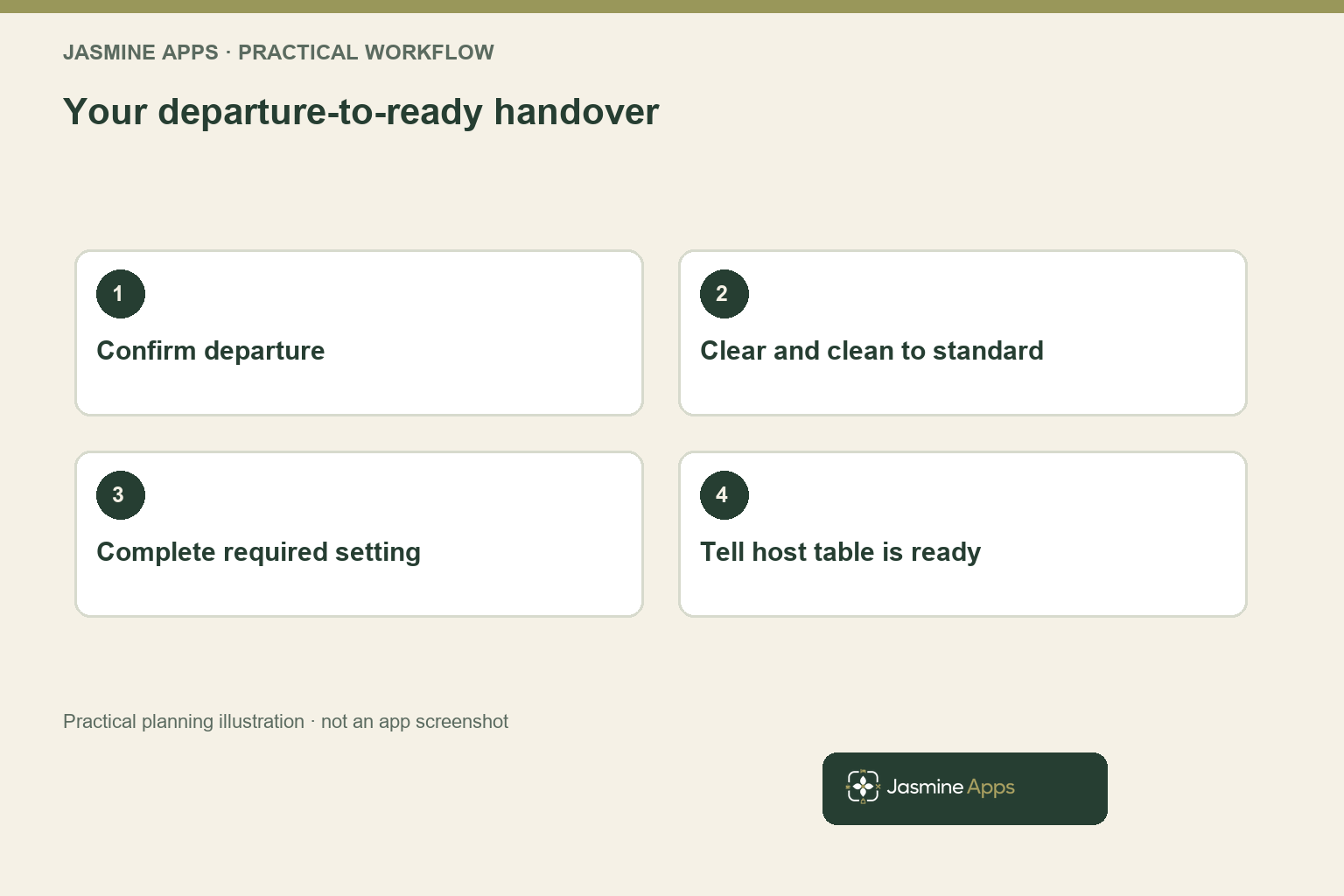
Table Jasmine's booking workflow distinguishes arrived or waiting parties, seated parties and guests who have left, alongside cancellations and no-shows. Agree which colleague updates the relevant status and when. Your departure record should reflect the agreed operating event, so the host and floor team do not use the same label to mean different things.
Demonstrate the exact route from a seated party to the next usable booking in your configuration. Confirm what the host sees, how table assignment is represented and whether your team needs a separate readiness check after departure. Do not assume that marking a party as left automatically certifies cleaning, resets the physical table or completes a workflow that has not been demonstrated.
Test a late departure and an early arrival together. Your host should be able to explain the current position, identify an appropriate waiting or alternative-table decision and communicate with the floor team. A useful system supports that judgement with shared information; it does not remove the need for a realistic policy when two parties want the same table window.
Table Jasmine is currently listed at £69 per venue monthly or £690 annually for its listed unlimited-booking scope. Confirm your full setup, training, extensions, tax and any other applicable charges in the quotation. Your acceptance test should focus on the handover you need, making the subscription comparison relevant to your venue rather than a generic booking count.
Connect the process with your booking lead-time analysis. If useful late demand exists, readiness information may help your host offer suitable capacity; if it does not, the main gain may be smoother arrivals. Your report should describe the actual benefit you observed, with no assumption that every quicker reset becomes an additional reservation.
Protect cleaning standards and the experience of both parties
Your reset target must fit your cleaning and safety procedures. A shorter information wait can improve the process without changing the work required, but removing an essential cleaning step is a different decision. Keep the approved standard visible and involve the responsible manager when reviewing equipment, materials and practical completion conditions.
The government's food-business cleaning guidance provides a relevant food-business reference for effective cleaning arrangements. Apply the requirements appropriate to your operation rather than using a commercial timing target as a reason to cut corners. Your ready-for-seating definition should include the condition the next guest can reasonably expect from the table and surrounding area.
Consider how the outgoing party experiences the change. Clearing obvious finished items can support service, while hovering over guests or resetting neighbouring places prematurely may make them feel hurried. Your team needs a shared understanding of the dining allowance and a tactful route for explaining it before booking or seating, rather than relying on pressure near the end of the meal.
Consider the incoming party as well. An apparently available table is less useful if the route is blocked, the seating configuration does not fit or a requested accessible arrangement has not been prepared. Include those relevant needs in the handover so the host can offer a realistic welcome rather than moving a guest twice because readiness was defined too narrowly.
Review comments and arrival delays alongside reset minutes. Your pilot succeeds when the table becomes appropriately ready sooner and the overall experience improves or remains sound. A faster measure accompanied by more cleaning complaints, incorrect settings or rushed departures indicates that the process has shifted work or discomfort elsewhere, so revise the method before expanding it.
Build a reset review that informs your next service plan
Choose comparable services for a baseline and a small pilot. Record party size, departure time, ready time and the cause of any unusual delay, using consistent definitions. Your manager should see whether the improvement affected the middle of the distribution, only a few extreme waits or a particular table location where supplies were difficult to reach.
Keep the initial intervention specific. You might assign the readiness confirmation to the colleague who completes the setting, move an approved supply point or clarify who notices departure. Avoid changing dining allowances, table layout and staffing simultaneously, because the resulting improvement would be difficult to connect with the reset process you intended to test.
Track the next guest's actual seating time and whether an additional party was served. Those outcomes show whether the released time improved a real arrival window or simply created a larger buffer. Both can be worthwhile, but they should be reported differently. Useful capacity and reduced anxiety at the host stand are not automatically additional cash contribution.
Calculate the complete operating effect where the pilot changes expenses. Include equipment, training time, extra paid hours and any genuinely incremental sales, using a consistent cost basis. If staff use the time for better service elsewhere, describe that as capacity redeployed unless you can demonstrate an expense reduction. This keeps the commercial discussion useful when the manager chooses whether to continue.
Retain the successful readiness rule in your briefing and repeat the check when the layout, menu or arrival pattern changes. Your venue can then improve the table window without treating guests as a stopwatch problem. A clear shared process gives your host dependable information, your floor team an achievable standard and your next party a more confident start to the meal.
Pro Tips
Define ready visibly. Ask the host and floor team to describe a ready table independently. Resolve differences before measuring, otherwise your apparent improvement may simply change the meaning of the finish time.
Keep minutes attached to tables. Review each recovered window against a plausible next party and dining allowance. You cannot combine spare minutes from unrelated tables into a guaranteed extra booking.
Check the next stage. Observe ordering and kitchen demand after earlier seating. A shorter reset is less useful if it creates a wave the rest of the service cannot handle.
Common Mistakes
Shortening the meal first. You risk reducing guest value while leaving post-departure waiting untouched. Separate the stages before changing dining allowances.
Counting all released minutes as sales. You overstate the return when demand, party size or layout prevents another booking. Value only demonstrated incremental capacity.
Equating departure with readiness. You can send guests to an unfinished table. Confirm the physical reset through your agreed handover before seating.
Frequently Asked Questions
How can you reduce restaurant table turnaround without rushing guests?
You can begin with the interval after departure, separating notification, clearing, cleaning, setting and readiness confirmation from the meal itself. Identify recurring waits and test one practical handover improvement while keeping the required standard. Check whether the next party is seated more smoothly and whether service elsewhere becomes overloaded. Your aim is a genuinely usable table window, not simply a shorter recorded meal or an assumed extra booking from every minute released.
What is a good restaurant table reset time?
Your appropriate reset time depends on layout, service style, cleaning requirements, table configuration and available equipment. A universal target can encourage shortcuts or obscure an avoidable information wait. Define the start and ready-for-seating finish, then observe representative services and the stages between them. Use your own baseline to test a realistic improvement, and review guest experience alongside timing so the result remains suitable for the restaurant you operate.
Does a faster table reset always increase restaurant revenue?
You gain revenue only when the released time supports additional demand you can serve without displacing another sale or weakening the experience. A few minutes may instead create a useful buffer or reduce arrival delays. Keep those benefits separate from realised additional contribution. Review the physical table, party size, next booking and kitchen capacity before attaching a financial value, rather than adding minutes across unrelated tables as if they created one sellable slot.
How should you measure table turnover in a restaurant?
You should distinguish the full table window from dining duration and the post-departure reset. Agree consistent stage boundaries and record comparable parties and service periods. Keep table size and layout visible, since a large joined table and a two-top may have different operating conditions. Your report should connect the timing with actual seating and demand outcomes, allowing the manager to decide whether the issue is communication, physical preparation or an unrealistic booking allowance.
Can Table Jasmine automatically tell you that a table is cleaned?
You should demonstrate the exact status and readiness process in your proposed configuration. Table Jasmine includes booking stages such as seated and has left, but a departure label alone does not certify that cleaning and setting are complete. Agree who confirms physical readiness and what the host sees before seating the next party. Your acceptance test should include an early arrival, a late departure and an unfinished reset so the complete handover is understood.
Restaurant table reset time: your next step
Your restaurant table reset time can reveal capacity your guests never needed to lose. Book a Table Jasmine demonstration with your busiest arrival window and one table's departure-to-ready process. You can test the shared status handover and build a realistic plan for smoother seating without rushing the meal.