

Restaurant Booking Conversion: Why More Website Clicks Can Mean Fewer Useful Bookings
· Jasmine Apps
Your booking button can attract more clicks while your restaurant receives fewer usable reservations. If the extra visitors reach an unavailable service, an unclear party-size limit or a form they cannot finish, your headline traffic improves while your operation does not. Your restaurant booking conversion review needs to follow the guest beyond that first click.
You should measure a defined journey and inspect the stage where it fails. This guide helps you connect your website, Table Jasmine setup and reservation records without claiming that a button press is the same thing as a confirmed table.
Key Takeaways
- Define whether you measure visitors, booking starts or confirmed reservations.
- Keep unavailable searches separate from form-completion problems.
- Check the actual guest journey on a phone.
- Verify analytics events against the real reservation outcome.
- Improve one failing stage before judging the whole conversion rate.
Define restaurant booking conversion before calculating it
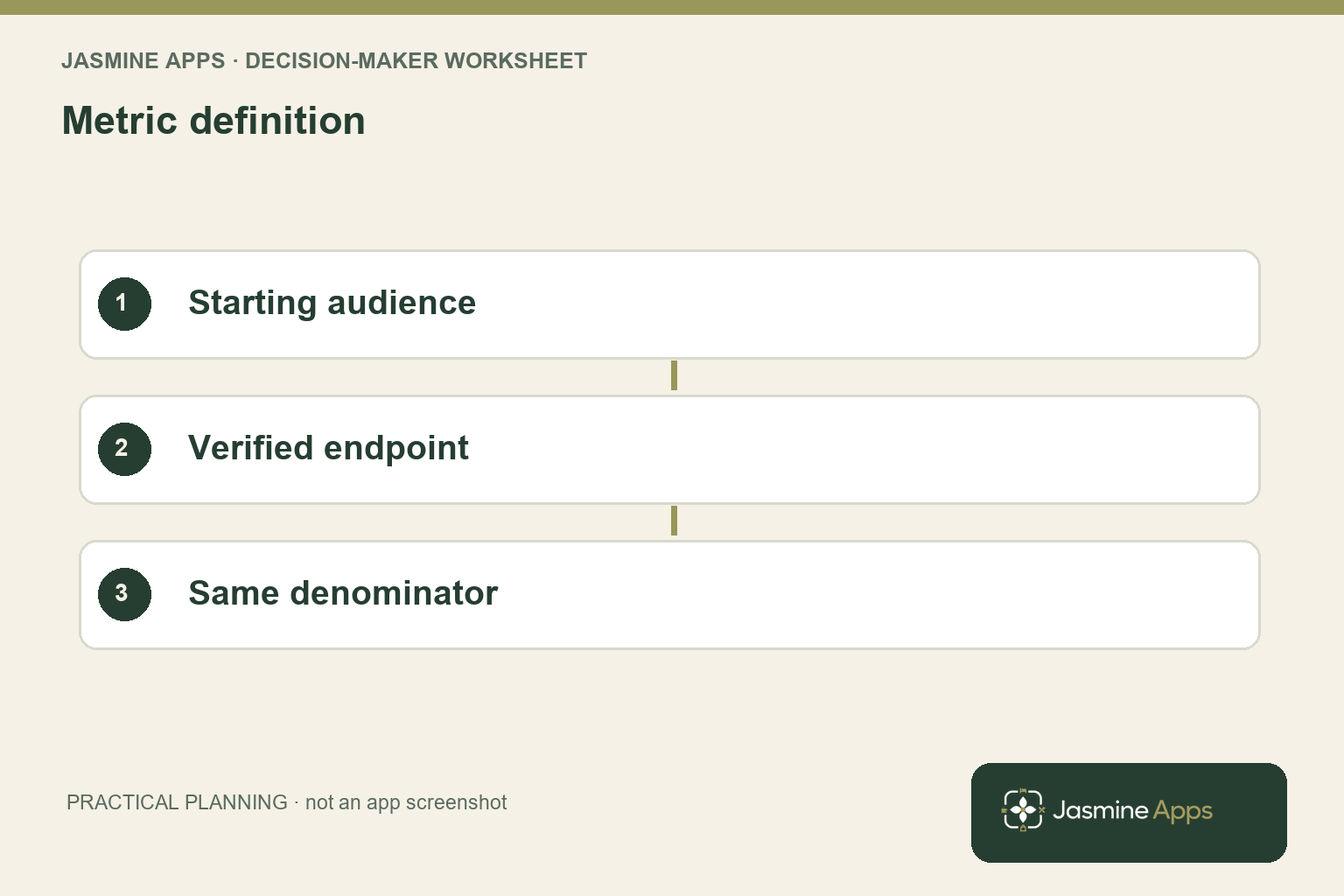
Choose your starting point. Visitor-to-booking conversion uses the relevant website audience as its denominator, while start-to-completion conversion uses people who begin the booking journey. Those calculations answer different questions and should have different labels. If you change the denominator between reports, the resulting increase or decrease can reflect your measurement rather than a change in guest behaviour.
Define your endpoint just as carefully. A booking-button click, a form submission and a confirmed reservation are distinct events. Identify which status your operational team treats as an accepted booking, and check how the measurement connects to that record. Your analytics setup should not count an unsuccessful attempt as a completed reservation because the guest reached a visually impressive final page.
Google Analytics distinguishes events you designate as important outcomes through its key-event documentation. Use that terminology accurately when discussing the setup with your website specialist. It does not establish that your booking widget already sends the required event. Ask your specialist and supplier to verify the available integration before promising a fully measured funnel.
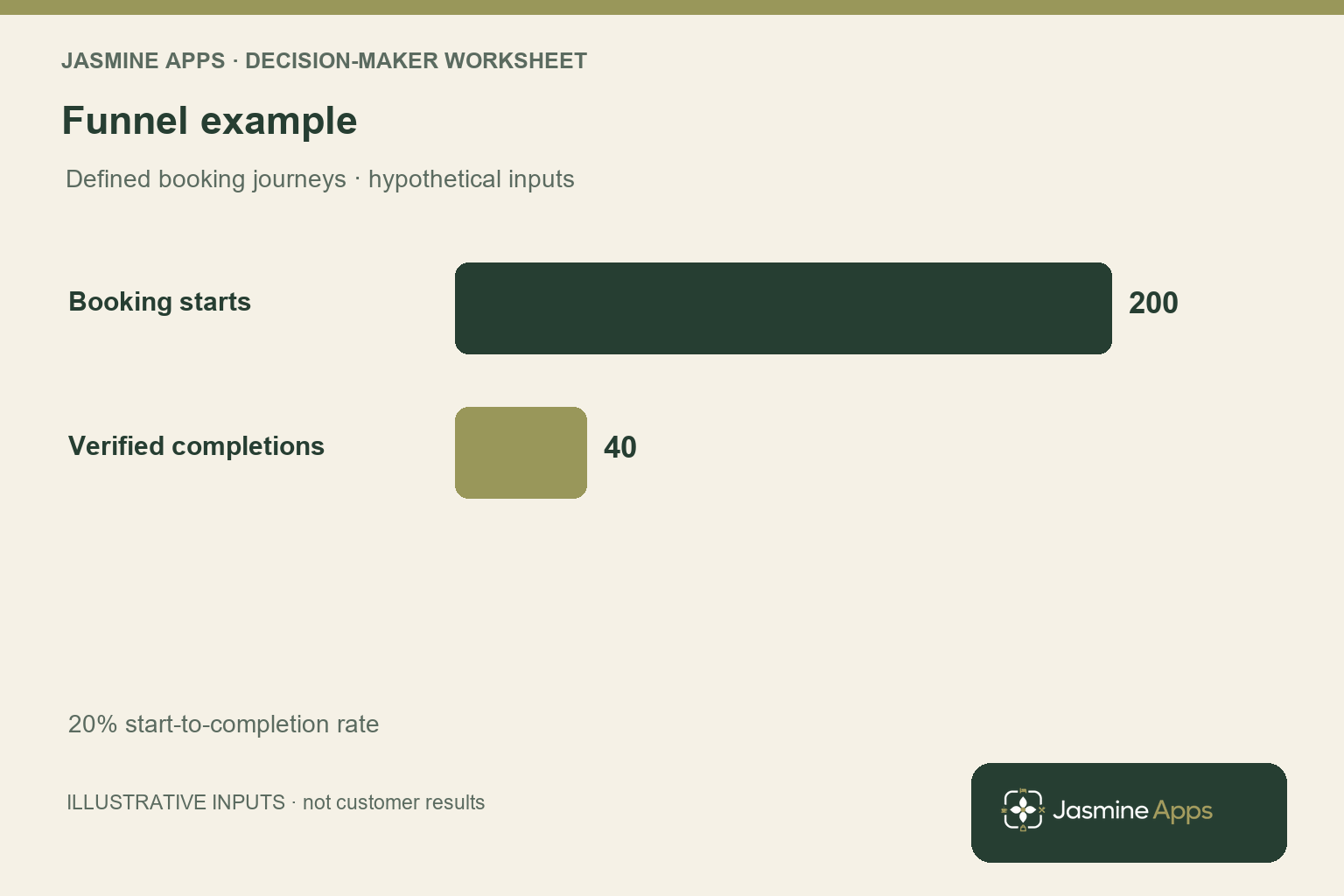
Use an illustrative calculation only to explain the method. If 200 defined booking starts produce 40 verified completed reservations, your start-to-completion rate is 20%. Those hypothetical inputs are not an industry benchmark or a Table Jasmine result. Your useful comparison is the same metric measured consistently across comparable conditions, with the unavailable searches and technical issues kept visible to the person deciding what to change.
Ask your website specialist to identify the exact event being counted and demonstrate how an unsuccessful attempt is excluded from that outcome.
Diagnose restaurant booking conversion through the guest journey
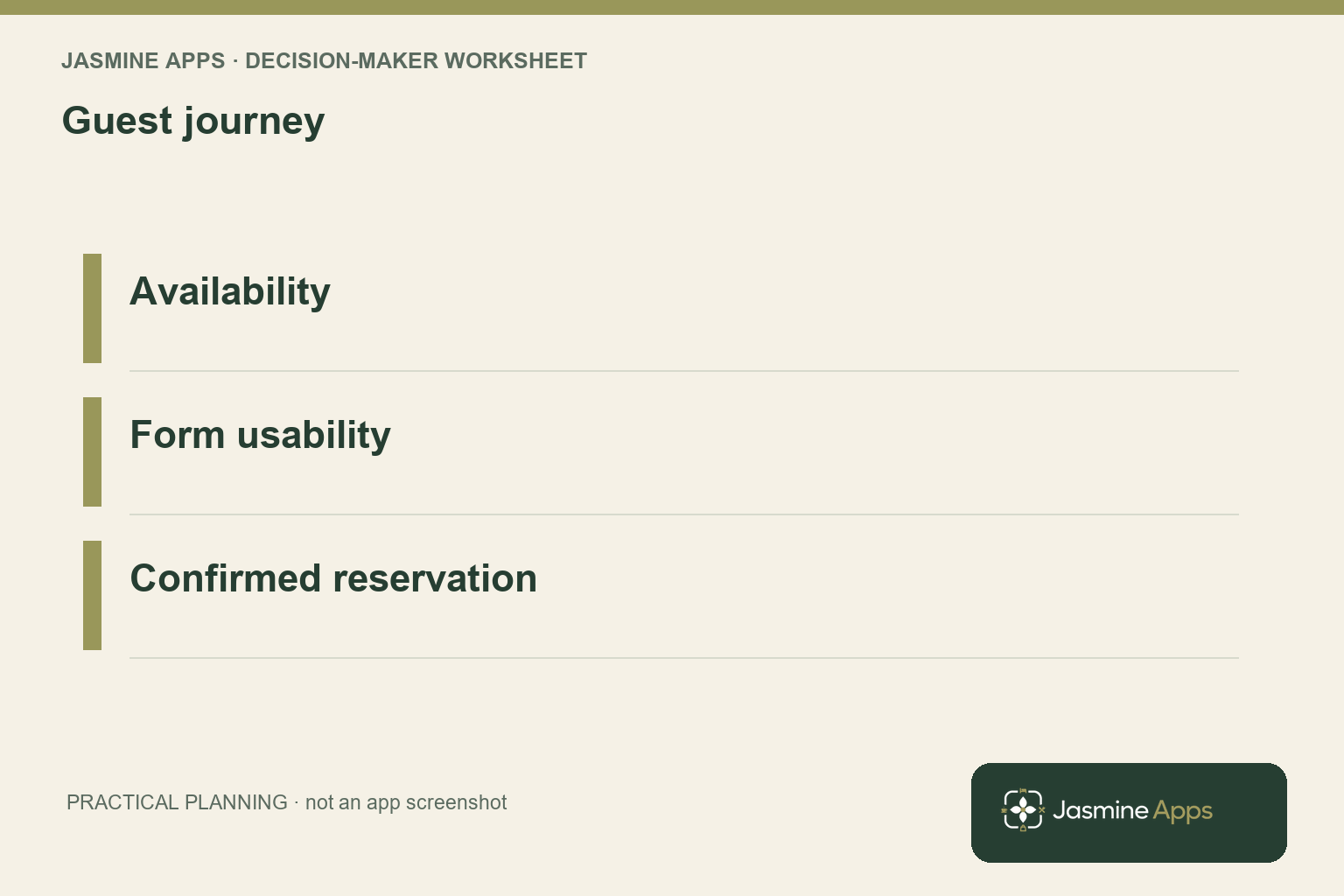
Open your venue website on an ordinary phone and begin with a realistic party size, service date and time. Check whether the booking route is easy to identify, whether the form fits the screen and whether its next step is understandable. Use your authorised test procedure rather than placing unwanted live reservations. In the actual Table Jasmine widget settings, the preview warns that submitted bookings are real.
Separate lack of availability from technical failure. Your guest can complete every step correctly and still find no suitable table because the configured service is full or the party size exceeds the online limit. That outcome belongs in your capacity and enquiry review. It should not automatically be treated as a broken form or solved by increasing limits without checking your service plan.
The actual widget settings distinguish Max guests per slot, which caps overlapping guests, from Max tables per slot, which limits reservation starts in a bucket. They also include a maximum online party size and a reservation gap. Review those controls against the experience your guest sees. A setting that looks generous in isolation can still interact with another rule to exclude the requested service.
Inspect the embed on the website as well as the preview inside the app. The current setup guidance requires the correct full HTTPS widget source and venue context. Your website editor should check the installed embed rather than assume a working admin preview proves the public page works. Link the opening-hours guide into your operational review so the approved service times and the online promise stay aligned.
Improve restaurant booking conversion with controlled changes
Choose one change that addresses the stage you observed. You might clarify the large-party enquiry route, move the booking button to a useful page position or correct an embed problem. Keep the other main conditions steady where practical. If you redesign the page, change the offer and alter availability together, you make it harder to identify which change helped the journey.
Record the operational outcome after the booking. A reservation that completes online but is then cancelled because the offer was misunderstood is not a durable success. Review guest questions, unsuitable party requests and the final reservation state alongside your completion rate. Your aim is a booking your venue can honour, with a guest who understands the service they selected.
Test your analytics against an authorised known outcome. Your specialist should check whether the relevant event occurs once, whether failed attempts are excluded and whether returning visits change the denominator. Where the widget is on another domain or runs inside an embedded frame, confirm what your analytics can actually observe. Keep any unmeasured stage labelled rather than filling the gap with an inferred conversion figure.
Set a review cadence that includes ordinary service variation. Compare the same definitions and similar booking conditions, noting sold-out dates, promotions and website changes. Use Table Jasmine’s feature page to discuss the supported guest journey, not as proof of a conversion uplift. Your best improvement is the one supported by a clearer path and verified reservations, with fewer questions left unresolved for the host team.
Pro Tips and Common Mistakes
Pro Tips
Record availability at the point of failure. A guest unable to find a table needs a different response from one unable to submit the form. Keep those causes separate before asking your website editor to redesign the page.
Use a confirmation definition agreed with operations. Your analytics specialist and host manager should mean the same thing by a completed booking. Verify the event against the accepted reservation record rather than agreeing only on a button label.
Review the enquiry alternative. Your online limit can be correct while your large-party route remains unclear. Give those guests a useful next step instead of encouraging them to split one party into several unsuitable reservations.
Common Mistakes
Counting booking-button clicks as reservations fails because the guest can still abandon or find no availability. Measure the endpoint that your operation actually receives.
Raising capacity to improve conversion fails when the venue cannot serve the resulting bookings. Check the real seating, kitchen and service plan before changing availability rules.
Changing the denominator mid-report fails because visitor conversion and booking-start conversion describe different journeys. Name the measure and keep its definition consistent.
Use your conversion review to improve a guest decision, not merely to produce a higher percentage. Your website, settings and host procedure should all support the same service promise before you attribute success to a design change.
Ask your website owner to keep a short change log covering embed edits, event definitions and landing-page revisions during the review period, with the relevant dates. You can then identify whether a movement follows a better guest journey or a measurement change before attributing the result to your booking design.
Frequently asked questions
How do you calculate restaurant booking conversion?
Divide verified completed reservations by your defined starting audience, then multiply by 100. Your denominator might be relevant website visitors or booking starts, so label it explicitly and use it consistently. Define the completed outcome with your operations team and verify the analytics event against the real reservation record. Your calculation should exclude unsupported assumptions about what happens inside the widget.
A percentage becomes useful only when another person can reproduce its scope and understand the journey it measures.
What is a good restaurant booking conversion rate?
You should start with your own consistently measured baseline rather than adopt an unrelated benchmark. Your rate depends on the denominator, audience, availability, service format and measurement setup. A visitor-to-booking figure cannot be compared fairly with a start-to-completion figure. Review where guests fail and whether the resulting reservations suit your operation.
Use comparable periods and disclose material differences, so your target encourages a better booking journey rather than a change in reporting definition.
Why do guests abandon an online restaurant booking?
Your guest may find no suitable time, exceed the online party limit, misunderstand the offer or struggle with a technical or usability problem. You need evidence from the actual journey to distinguish those causes. Test realistic requests on a phone and review the relevant capacity and service rules. Where measurement is available, inspect the failing stage.
Do not assume every incomplete booking reflects a poor form, because an accurately unavailable service can produce the same apparent drop-off.
Can Google Analytics track a restaurant booking widget?
It depends on the widget, domain arrangement and supported integration. Ask your website specialist to verify which events your setup exposes and how a completed outcome is identified. A booking-button click may be visible while the embedded form’s later stages are not. Check cross-domain or frame limitations and the treatment of repeated events.
You should report the stage you can verify, with any measurement gap stated clearly, rather than assume installing Analytics provides a complete reservation funnel automatically.
Should you remove booking restrictions to get more reservations?
Only change restrictions after checking the operational reason for them. Your party-size limit, overlapping guest cap and reservation gap can protect the service your team can deliver. Removing them to raise a completion figure can produce unsuitable reservations or conflicts. Review whether the guest needs clearer wording or a useful enquiry alternative instead.
Your goal is an accepted booking you can honour, so measure service fit and subsequent outcomes alongside the number of completed online forms.
Make restaurant booking conversion mean a better guest journey
Your restaurant booking conversion review should identify a specific obstacle and a reservation outcome you can verify. Bring your website address, intended service and one guest journey to Contact Us. Request a Table Jasmine demonstration around your opening hours, party limits and enquiry route, so you can make online booking clearer without promising capacity your venue cannot deliver.