

Restaurant Menu Profitability: Your Bestseller May Not Win
· Jasmine Apps

Your most ordered main course can contribute less money than a dish that sells far fewer portions. You see the difference only when you put demand beside the contribution each sale leaves behind. Your restaurant menu profitability should therefore start with two questions: what do guests choose, and what does that choice contribute?
With Till Jasmine, you can examine product mix alongside the product prices and cost fields in your admin. Your purchasing case should focus on better decisions from reliable inputs, rather than assuming a report makes every dish profitable.
Key Takeaways
- Compare portions sold and contribution per portion separately.
- Use a consistent tax and cost basis before ranking dishes.
- Include total contribution, preparation constraints and guest demand.
- Test one change before removing a dish guests rely on.
- Use your own recipe and sales records to validate the decision.
Measure restaurant menu profitability beyond portions sold
Your sales ranking answers a useful but incomplete question. It tells you which products guests buy during the selected period, but it does not explain how much each sale contributes after the variable costs you include. A popular dish with an expensive recipe can produce less total contribution than a lower-volume alternative.
Menu engineering has an established research basis. The International Journal of Hospitality Management study on menu engineering examines the use of popularity and contribution in restaurant menu analysis. You can use that framework as a decision method without treating a study of other restaurants as proof of your venue’s likely return.
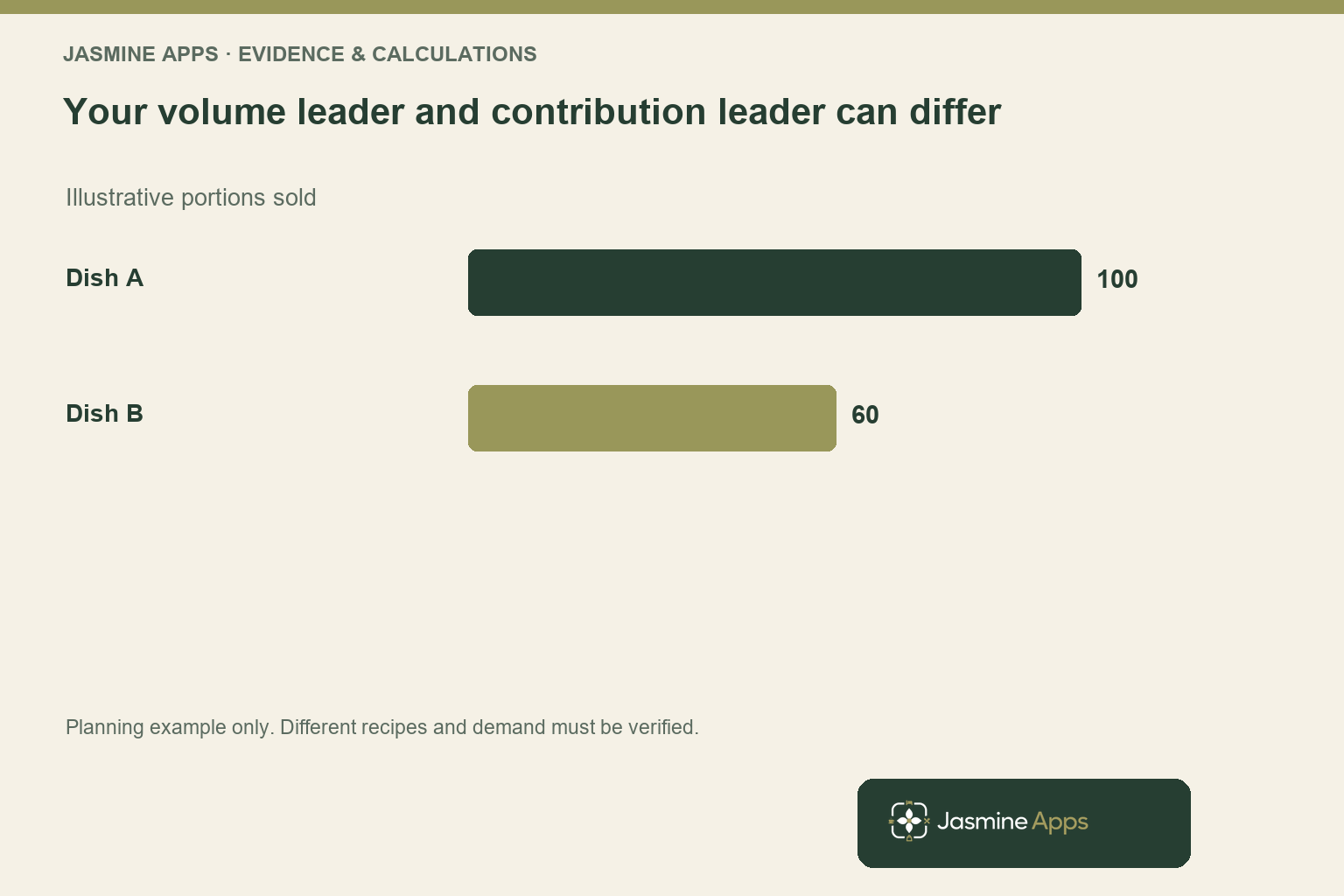
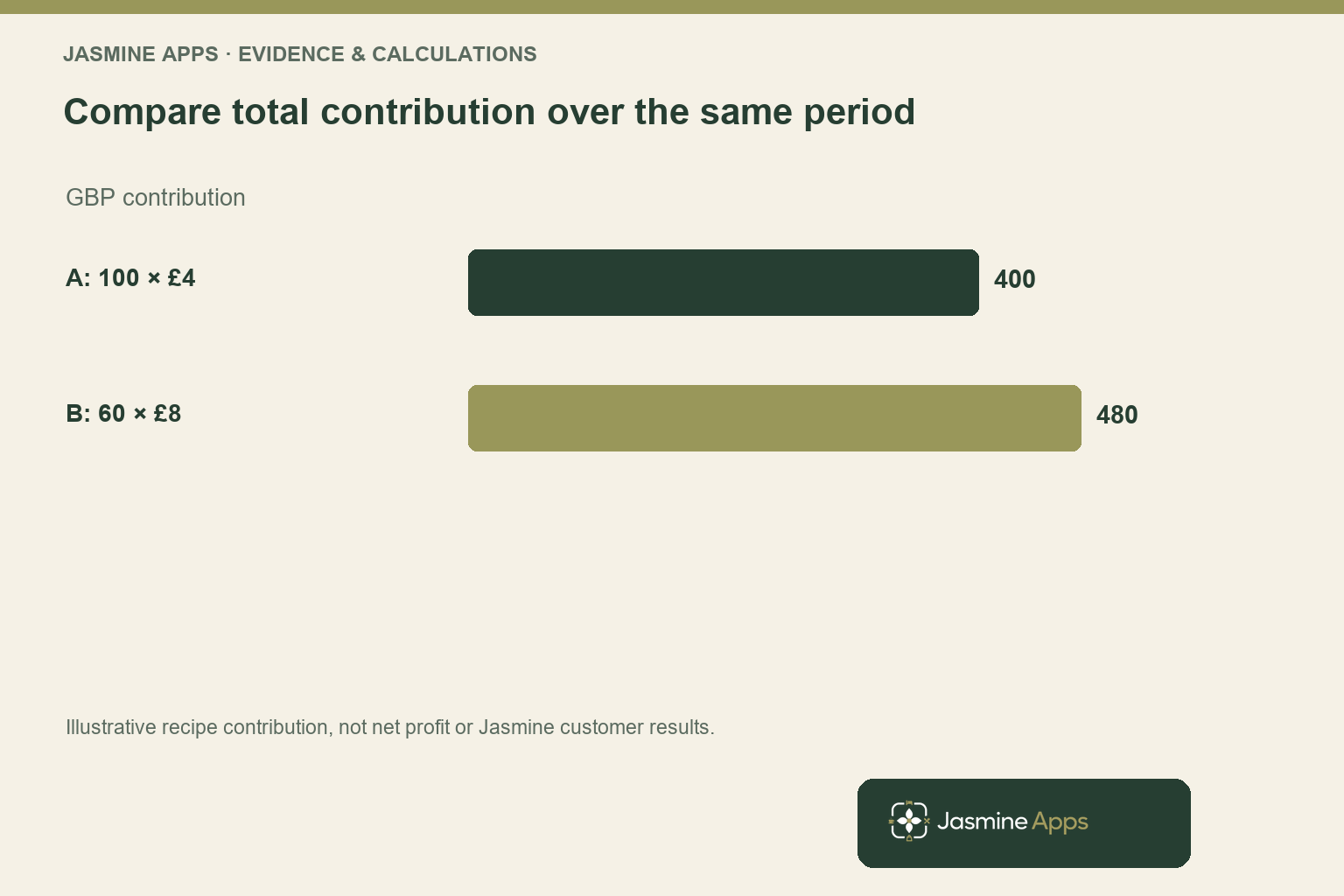
Consider two illustrative dishes. Your first sells one hundred portions and leaves £4 contribution per portion, giving £400 in the defined period. Your second sells sixty portions and leaves £8 per portion, giving £480. The first wins the volume ranking, while the second wins the total-contribution comparison.
These are deliberately simple planning values, not real sales from the Jasmine dashboard. You should replace them with your own records, use the same period and decide which variable costs belong in the calculation. A recipe ingredient margin is not the same as fully allocated net profit.
You also need to separate what the guest pays from the revenue basis you use internally. If your selling price includes tax but your recipe costs use a different basis, a subtraction can produce a misleading margin. Ask your accountant or finance lead to approve a consistent calculation rather than relying on the display label alone.
Your aim is to identify a decision worth investigating. A lower contribution does not automatically mean a dish should disappear; it may attract guests who buy other items or satisfy an important dietary preference.
Build restaurant menu profitability on dependable product inputs
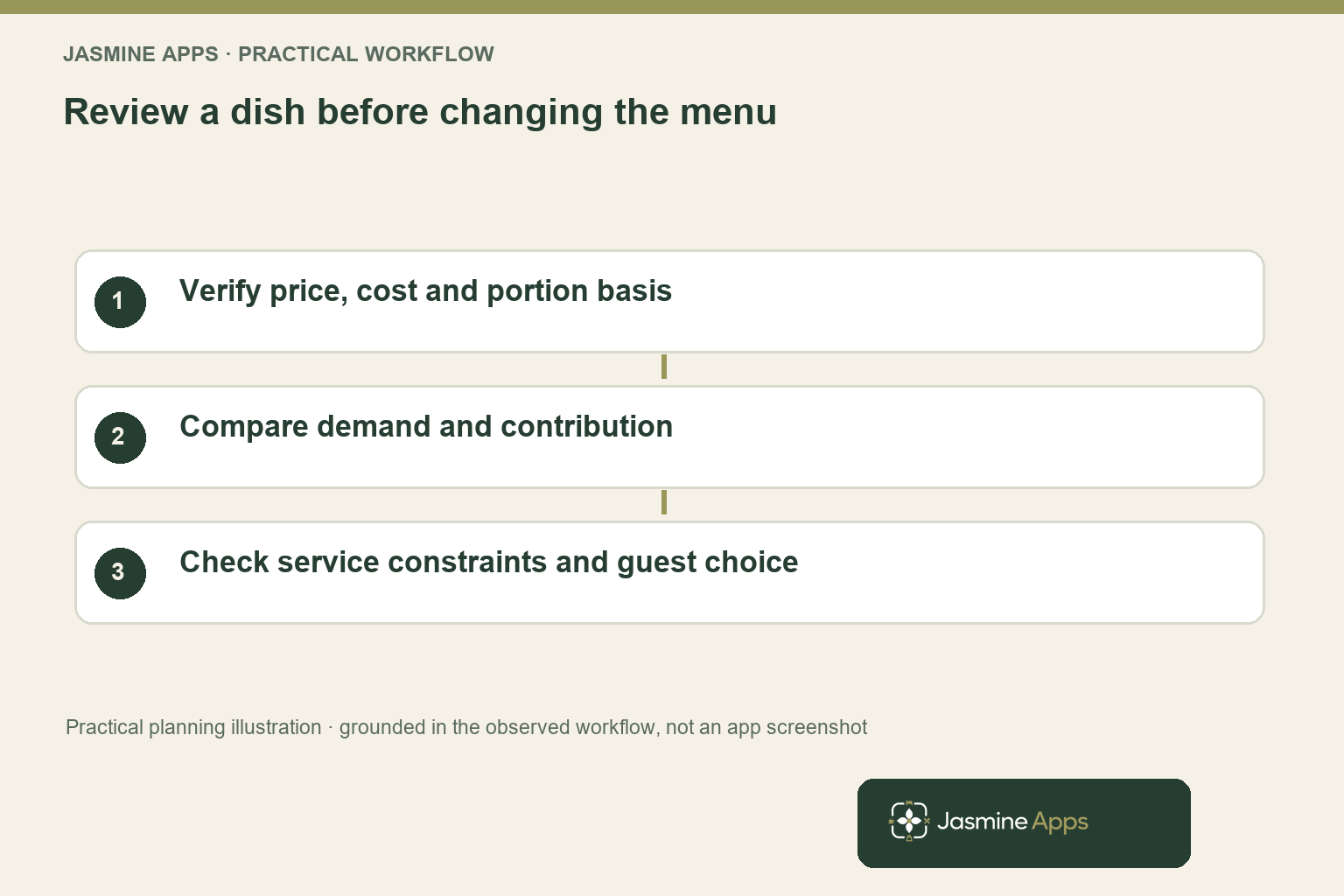
Your actual product admin includes a price labelled as including tax, a cost field, category, sale type and course information. Those fields provide structure, but their presence does not establish that your recipes are complete or current. You should verify the values before interpreting the sales mix as a profitability report.
Start with a short list of mains that account for a meaningful share of sales. Confirm portion size, recipe cost and the price actually charged during your comparison period. Record promotional prices and discounts separately if they change what the sale contributes.
Do not interpret a blank or zero cost as evidence that an item is free to provide. It may indicate an incomplete setup, a cost stored somewhere else or a recipe that has not been reviewed. Your team should know who updates the input and what the field represents.
The dashboard’s product mix, categories and payment views help you examine trading patterns. Your selected reporting period matters, especially if you compare lunch with dinner or a weekday with a busy event. Check how your trading day is configured instead of assuming every venue’s midnight boundary matches the operational service.
Your comparison can then combine verified unit contribution with the number of portions sold. In the illustrative example, moving ten sales from the £4 dish to the £8 dish adds £40 contribution only if total demand and the cost assumptions remain unchanged. That condition is central: your guests may not switch, and your kitchen may have different capacity requirements.
Use the EPOS demo checklist to ask how your actual product records, discounts and sales reports would support this calculation. A useful demonstration should expose uncertain inputs rather than disguise them with a polished total.
Use restaurant menu profitability to choose a controlled change
Your first action does not need to be a price increase. You might improve a dish description, review portion consistency, change an expensive ingredient with the chef’s approval or adjust a menu position. Choose the intervention that addresses the reason the item performs poorly.
Separate a demand problem from a cost problem. If guests rarely choose a dish with strong unit contribution, investigate whether the description, position or relevance prevents selection. If a popular item contributes little, investigate recipe yield, purchasing cost and pricing before trying to sell more of it.
Your kitchen’s working constraints belong in the discussion. A profitable-looking dish can slow a service if it depends on a heavily used station or requires scarce preparation capacity. Contribution per portion is one measure; reliable delivery and contribution per constrained resource may change your decision.
Avoid comparing services where you changed several variables at once. If you introduce a new recipe, rewrite the description and discount the item during a local event, you cannot confidently identify the cause of a change in sales. A smaller test makes your next decision more defensible.
Choose a period long enough to observe relevant demand while keeping the test manageable. Record portions sold, contribution assumptions, waste concerns and feedback from the kitchen and service team. Keep neighbouring dishes in the review so you can see whether an apparent gain merely displaced another valuable sale.
You should retain a clear approval route for price and product changes. Your admin’s product and till structure needs to reflect the agreed menu, but a report does not decide your commercial policy. Use the system to support the decision your chef, manager and finance lead have reviewed together.
Turn a menu review into a useful EPOS purchase case
The CRM lists the standalone EPOS subscription at £59 per venue per month or £590 per year. Your quote should specify the till scope, tax basis, setup and any hardware or additional services. Do not allocate the whole software cost to one menu test if the same system also supports the rest of your trading operation.
For an existing customer, the relevant question may be whether your team is using the information well enough. For a new buyer, you should compare the complete proposed solution with your current arrangements. Your menu analysis is one source of value within that wider decision.
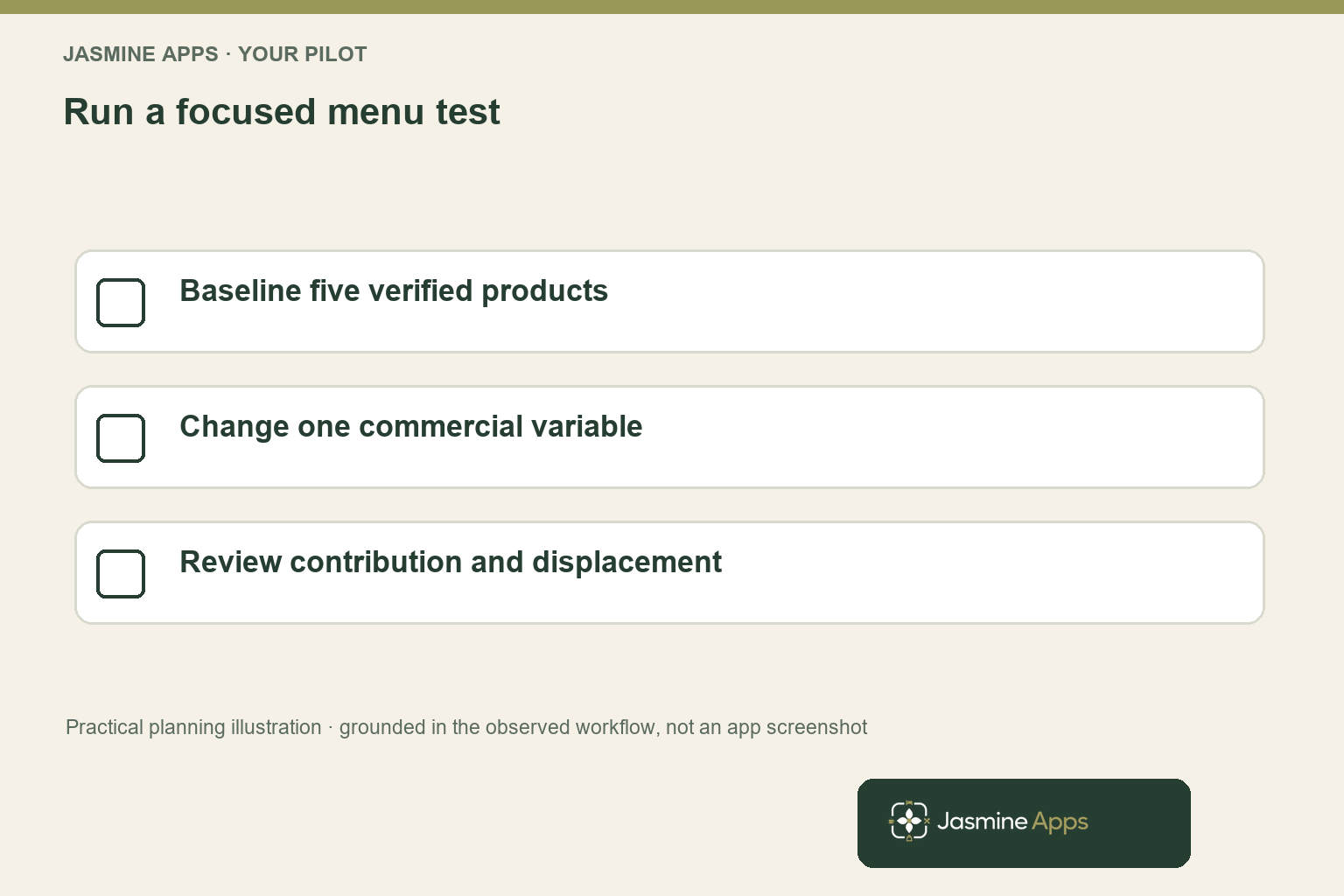
You can build a pilot around a handful of products rather than rebuilding the entire menu. Establish verified costs, capture a baseline sales mix and select one intervention. Then review the result alongside service capacity and guest response before expanding the method.
Treat an improvement in contribution as a calculation that depends on reliable inputs. Your overall profit also reflects labour, rent, utilities and other expenses beyond a simple recipe margin. You should describe the outcome precisely instead of calling every additional pound of contribution a pound of net profit.
Keep a record of the decision even when the test does not improve the result. Learning that a popular dish attracts valuable accompanying orders can prevent an unhelpful removal. A useful EPOS review can protect a good decision as well as reveal an opportunity to change something.
Read the multi-venue EPOS reporting guide if you compare locations. Your recipes, portions and tax treatment need a consistent basis before a higher-margin-looking venue becomes the model for every other site.
Pro Tips
Rank two ways. Keep portions sold beside total contribution. You can see when a bestseller and a contribution leader are different products.
Audit the largest uncertainty first. If your recipe yield is unreliable, improve that input before debating a small menu-price change. A precise-looking answer built on a guessed portion cost is still a guess.
Watch neighbouring sales. Track the dishes and extras your changed item might displace. Your item-level improvement can conceal a lower total basket contribution.
Common Mistakes
Calling recipe margin net profit. Your calculation may exclude labour and fixed expenses. That label exaggerates what the result establishes.
Using inconsistent price and cost bases. Tax-inclusive prices and differently recorded costs can make rankings misleading. Agree the calculation basis before comparing products.
Removing every low-contribution item. You can lose guest choice, accompanying sales or demand the dish attracts. Investigate its role before making the final menu decision.
Frequently Asked Questions
How do you calculate restaurant menu profitability?
You can start by subtracting your defined variable cost per portion from a consistent sales-revenue figure, then multiply the resulting contribution by portions sold. You should document the cost and tax basis before using the result. Add preparation constraints, guest demand and accompanying sales to the review. Your recipe contribution helps evaluate a dish, but it does not establish the restaurant’s net profit after every operating expense.
Is your bestselling menu item always the most profitable?
Your bestseller leads the portion-count ranking, but another dish may leave more contribution per sale or more total contribution during the same period. You should compare both measures before making changes. A popular item can still have strategic value through guest demand or accompanying purchases, so a lower contribution is a prompt to investigate. You should not remove it solely because another line has a higher unit margin.
What is contribution margin in a restaurant?
Your contribution is the revenue remaining after the variable costs you include in the calculation. You need to state whether you have included ingredients alone or additional variable expenses such as packaging. Use a consistent revenue and tax basis.
That amount contributes towards your other operating costs and profit, but it is not automatically your net profit. A clear definition lets your chef, manager and finance lead compare the same measure.
Can EPOS reports help you improve menu margins?
Your EPOS reports can help you understand what guests buy and when, provided the products and reporting periods are configured correctly. You then need dependable recipe costs and a consistent calculation to interpret the mix commercially. You should ask for a demonstration with your own product examples rather than assuming every cost field is complete. The useful outcome is a better-informed decision, followed by a measured test of the change.
Should you increase prices or remove low-margin dishes?
You should first identify whether the issue comes from recipe cost, portion yield, price, demand or preparation capacity. A price increase may help one problem while reducing demand; removal may damage guest choice or accompanying sales. Test a focused change and compare the whole relevant basket before deciding. Your kitchen and service teams should review the operational effects, while your finance lead confirms the calculation and the commercial threshold.
Restaurant menu profitability: your next step
Your restaurant menu profitability becomes useful when it changes a decision you can explain and measure. Book a Till Jasmine demonstration with five products, your recipe-cost definitions and a sample sales period. You can then see how Till Jasmine supports a practical review of demand, contribution and the menu your kitchen can deliver.