

Hotel Maintenance Software ROI: What £79 Needs to Save
· Jasmine Apps

Repairing a room does not automatically recover its room rate. If you had no buyer for that night, the direct revenue gain may be zero; if you were sold out, the same repair can protect a valuable booking. Your hotel maintenance software ROI therefore depends on demand as well as how quickly your team resolves faults.
You can assess Jasmine Maintenance against room availability, repeat issues and handover quality. The public site currently labels it coming soon, so your purchasing conversation should confirm rollout access before you plan an operational deployment.
Key Takeaways
- The CRM lists £79 per venue per month, or £790 annually.
- The public coming-soon label means availability must be confirmed.
- A recovered night is worth its contribution multiplied by the chance of selling it.
- Room flags and maintenance notes do not create bookings or refunds.
- Measure time unavailable, repeat faults and verified repair costs.
Hotel maintenance software ROI begins with the room you can sell
Your maintenance log should help your team decide what a room can safely and reliably offer. A vague note saying the problem is being handled leaves reception guessing, housekeeping waiting and a guest potentially experiencing an unresolved fault. Clear ownership and room status can be valuable even before you attach a revenue figure.
You can describe the economic problem in three parts: time unavailable, likelihood of selling the room during that time, and contribution from a sale you would otherwise lose. A high room rate alone does not establish the return. Your booking pace, season and alternatives within the hotel matter when you value a recovered night.
Reputation adds context, but it needs careful interpretation. A Cornell study published in November 2012 used matched reputation and hotel-performance data and found associations between reputation scores and revenue performance. It was not a maintenance-software experiment, and you should not convert its findings into a guaranteed return from fixing a fault.
Your actionable evidence is closer to the operation. Track how long a room remains unavailable after a fault is reported, when reception learns about the change and whether the same issue returns. A repeated shower complaint might reveal incomplete diagnosis; a delay in releasing a repaired room might reveal an unclear handover rather than a slow technician.
Before buying software, identify which part you expect to improve. You might reduce forgotten tasks, make status changes visible or build a clearer record of recurring faults. Give the improvement an owner and a definition, so your system supports an operational decision instead of becoming an archive of unresolved notes.
Calculate hotel maintenance software ROI with demand and contribution
The CRM lists Jasmine Maintenance at £79 per venue per month, or £790 annually, for assets, rooms and repeating checks. The public product page still says coming soon, so confirm actual access, delivered scope and deployment timing in your enquiry. A listed price is not proof that your installation is ready for immediate rollout.
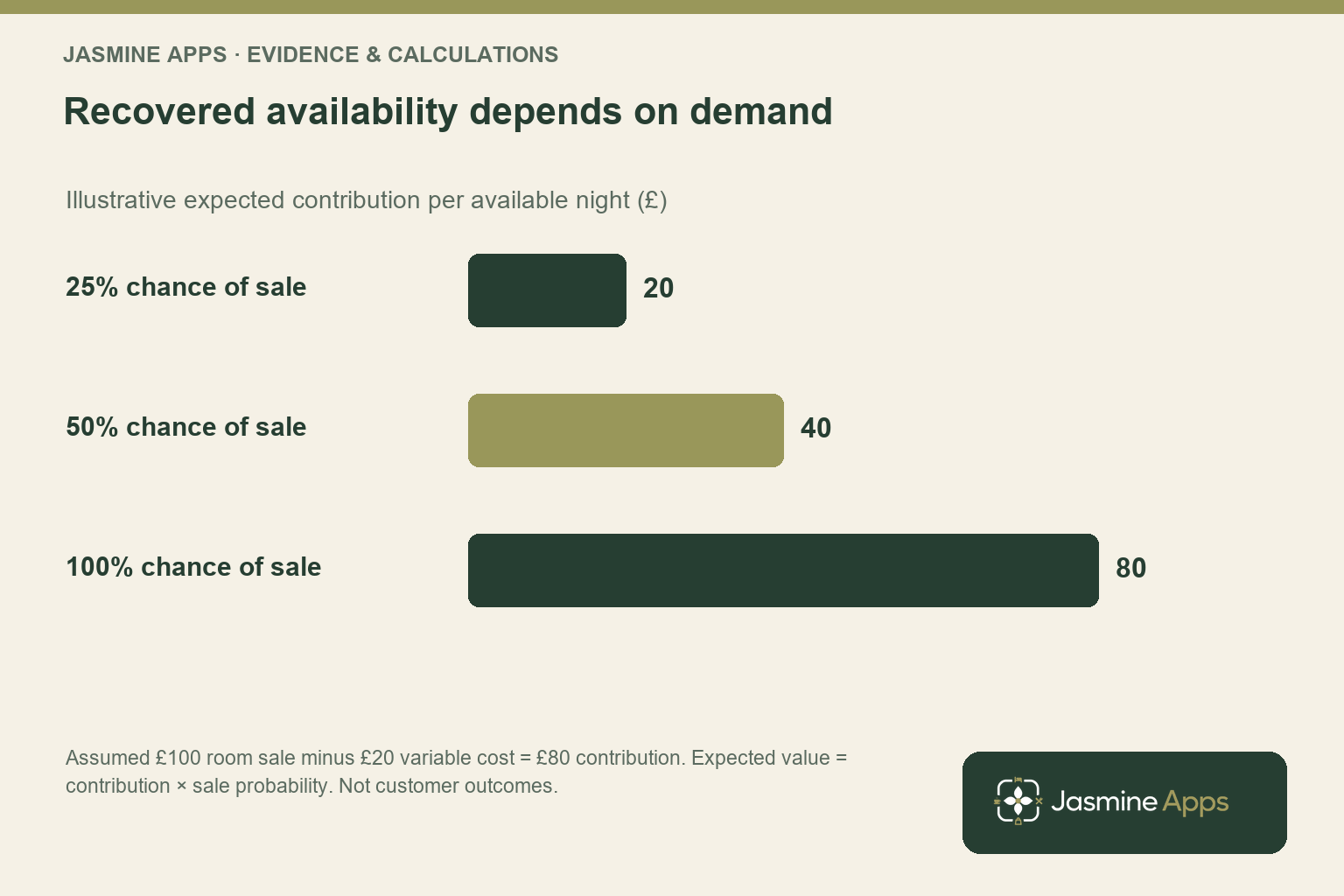
For an illustrative room model, assume an additional sale brings £100 of revenue and £20 of variable servicing cost. That leaves £80 contribution. If your hotel has a buyer for the recovered room, one additional occupied night contributes enough to cover the £79 software fee by £1, before setup and other operating costs.
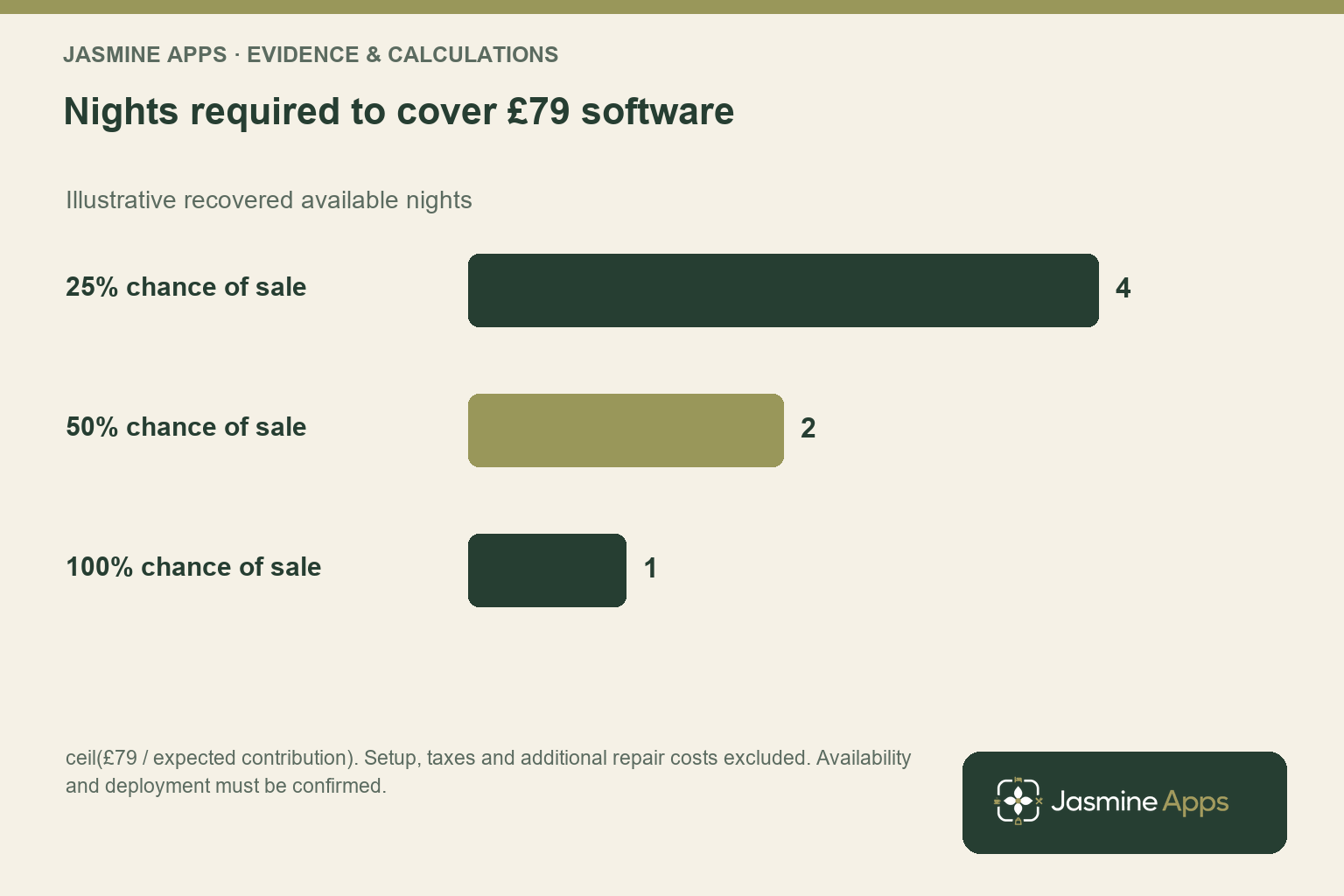
Now introduce demand uncertainty. If your estimated chance of selling that recovered night is 50%, its expected contribution is £40, so you need two recovered available nights to exceed £79 in expected value. At 25%, each is worth £20 and you need four; at 75%, each is worth £60 and you need two. These assumptions are a planning model, not observed Jasmine Maintenance outcomes.
You must also avoid counting a guest moved from another empty room as a new sale. If your hotel could already accommodate the booking elsewhere, the repair may improve choice or reduce inconvenience without adding room revenue. Record the actual displaced demand before calling the availability change a financial recovery.
Include quoted setup, training and any additional operating work in your complete comparison. The public terms leave fees and taxes to your order, so confirm their treatment. Keep avoided repeat repair cost separate from recovered room contribution, and only count it when the repeated expenditure genuinely falls rather than moving to a different budget line.
Connect hotel maintenance software ROI to the actual room workflow
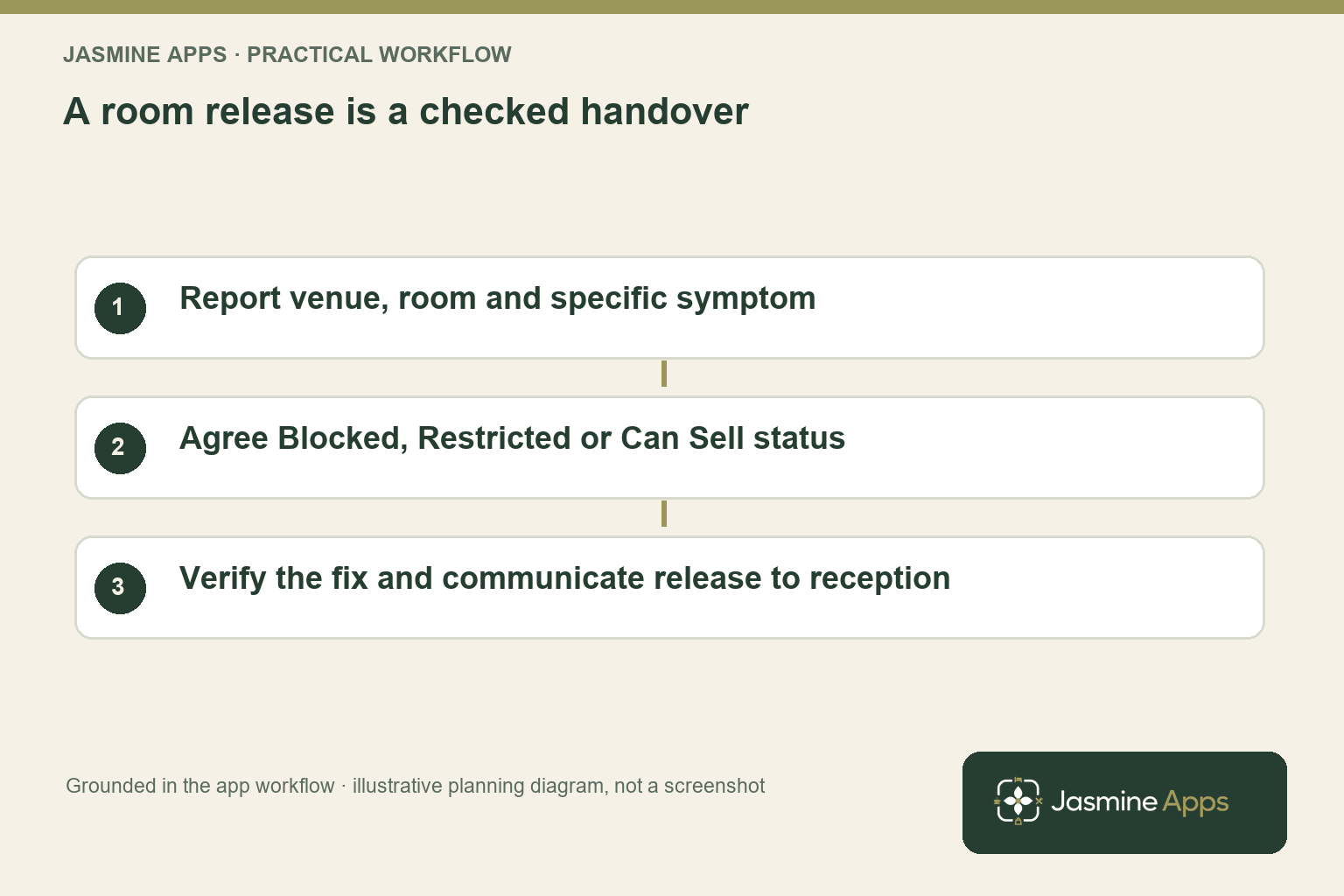
The administration preview asks you to choose a venue and room, describe the symptom and consider availability. The visible flags include Blocked, Restricted and Can Sell. That distinction matters: an operational issue can require a complete room block, a defined restriction or a repair that does not prevent a suitable sale.
Your team should agree who has authority to change those flags and how reception learns about the change. A maintenance note should not imply that a room is ready merely because someone has started a task. Your release decision needs the appropriate check for the fault and a clear handover to the people selling and preparing the room.
Use a representative example in the demonstration, such as a non-sensitive sample door fault or heating complaint. Follow the report, the assigned work, the resolution steps and the availability decision. Ask to see how Open and Resolved views help a supervisor find what still requires attention without creating a live issue unnecessarily.
The CRM description includes assets and repeating checks, so ask to demonstrate the exact recurrence and asset workflow you need before you include it in a buying commitment. Your internal preview and the public availability label are different signals; your quotation should state what is delivered, what needs configuration and what is scheduled for later.
The public terms also clarify that room notes and availability flags do not themselves create a guest booking or refund. You should therefore confirm how the maintenance decision reaches your existing reservations and guest-service process. Your value comes from a reliable operational handover, not an assumption that marking a room automatically changes every connected system.
Build a room-availability pilot your operations team can trust
Choose a defined group of rooms and a short list of recurring fault types for your first evaluation. You need enough activity to observe the reporting and release process without making the pilot so broad that nobody reviews the records. Confirm product access and the agreed deployment arrangement before involving live operations.
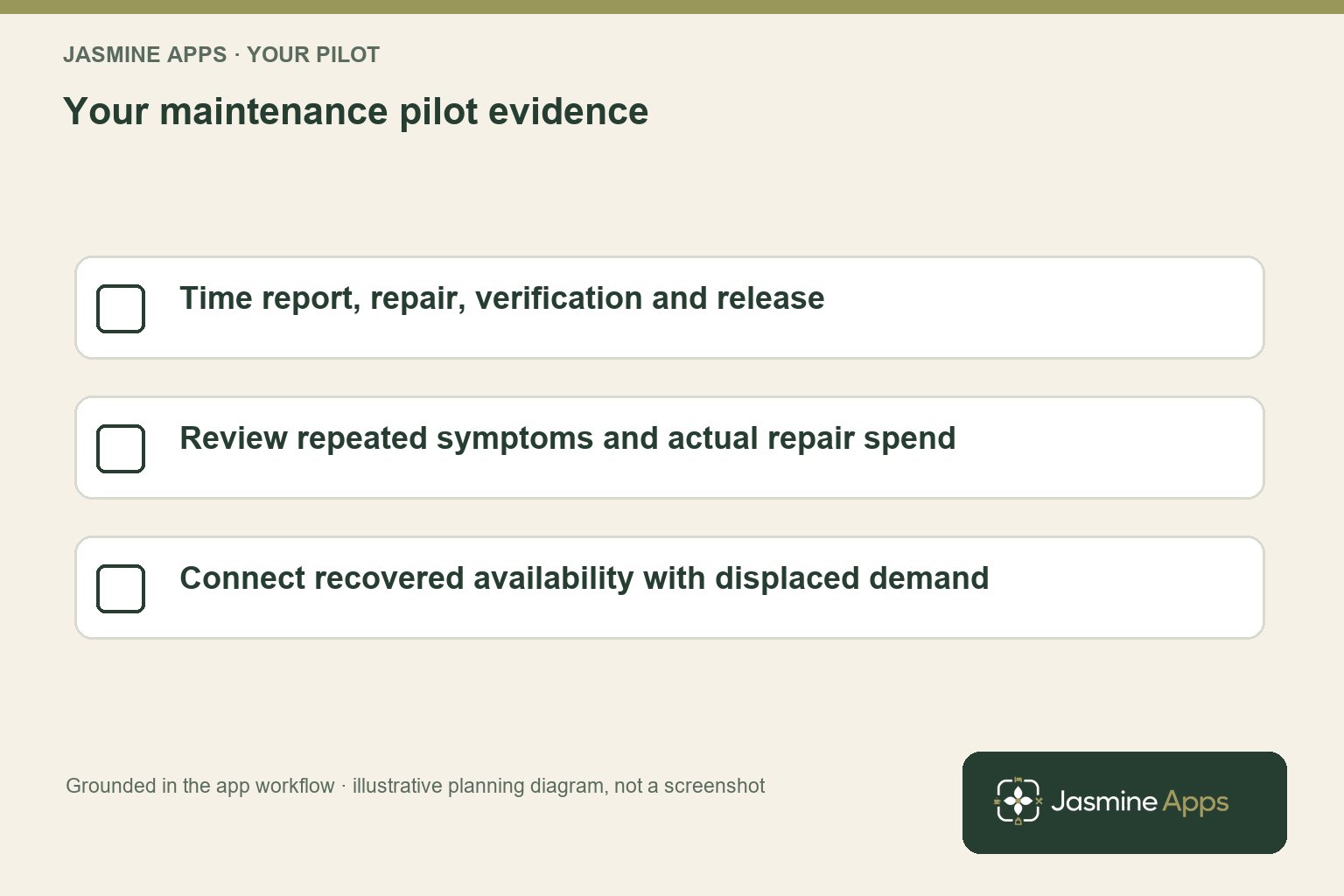
For each issue, record the report time, the time work begins, the time the fix is checked and the time reception is told the room can be sold. Those stages reveal where delay occurs. A quick repair followed by an overnight communication delay needs a different fix from a long wait for parts.
Review repeat faults by room and symptom. If a problem returns shortly after resolution, check whether the original cause was addressed and whether the resolution note explains the work. Your objective is to reduce preventable recurrence, not to close tickets quickly enough to improve a dashboard statistic.
For financial review, connect unavailable periods with real demand evidence from your existing booking process. Record bookings refused or displaced because the room could not be used, then value only the contribution you could reasonably have recovered. Keep a conservative case where the night remains unsold, so your decision is not dependent on perfect occupancy.
Your pilot should finish with a better handover and a clearer cost picture. If staff can identify room status confidently, repeat work declines and recoverable availability improves, you have a strong operational case to discuss. If the main delay is an external parts shortage, software may improve visibility while the purchasing or supplier process still needs separate attention.
For the related operating detail, read your guide to recurring maintenance faults before the demonstration.
Pro Tips
Measure each handover stage. Separate repair time from the delay before reception knows the room is ready. Your easiest improvement may be communication rather than a faster technical fix.
Value displaced demand. Use actual booking pressure when you estimate a recovered night. A repaired room without a buyer does not generate its advertised rate.
Review reopened symptoms. Group repeat faults by room and cause. You can target an incomplete repair or recurring asset issue rather than rewarding fast ticket closure alone.
Common Mistakes
Treating every release as a new sale. A room becoming available is not proof of an additional booking. Check demand and alternative rooms before counting revenue.
Ignoring the availability label. The public site says coming soon. Confirm delivered scope and access before planning a live rollout.
Closing without a checked handover. Your note needs to support the room decision. An unchecked resolution can create a repeat guest problem and an unreliable availability record.
Frequently Asked Questions
How much does hotel maintenance software cost?
The CRM currently lists Jasmine Maintenance at £79 per venue per month, or £790 annually. The public product page labels it coming soon, so you should confirm availability, deployment timing and the delivered scope before budgeting a live rollout. Include setup, training and any extra operating requirements in the complete quote. Your financial comparison should use recoverable room contribution and verified repair savings rather than multiplying every fault by the headline room rate.
Can maintenance software reduce out-of-order rooms?
You can improve reporting, ownership and the handover needed to return rooms to use. Your result still depends on diagnosis, available parts, qualified work and appropriate checks. Measure the time between reporting, repair, verification and release so you know where the delay occurs. Software visibility alone cannot make a repair safe or create missing parts, but it can help your team identify and address an avoidable operational delay more consistently.
How do you calculate the value of a recovered room night?
You start with the contribution from an additional occupied night after variable servicing costs, then consider the likelihood that the recovered availability produces a sale. Check whether another room could already have accommodated the guest. Your planning estimate can use a conservative probability, while your realised result should use actual additional bookings. Keep avoided refunds, repeat repair costs and recovered room contribution separate so the same incident is not counted more than once.
Does a maintenance room flag change your bookings automatically?
You should not assume that it does. The public terms describe maintenance notes and availability flags as operational records that do not themselves create a booking or refund. Ask how your agreed installation communicates a room decision to reception and your reservations process. Test the complete handover with a representative example, including who can release the room and what verification is needed, before depending on the workflow during live service.
Is Jasmine Maintenance available to use now?
The CRM lists a price and on-sale status, while the public page still labels the product coming soon. You should confirm your actual access and deployment timing through an enquiry rather than relying on either label alone. Ask to see the room, asset and repeating-check workflows relevant to your hotel, and request written scope for what is delivered. Your rollout plan should follow the confirmed installation arrangement and the checks your operations team requires.
Hotel maintenance software ROI: your next decision
Your hotel maintenance software ROI should protect usable rooms and reduce repeat work without exaggerating demand. Ask about Jasmine Maintenance availability and a room-workflow demonstration, bringing one recurring fault and your current handover process. You can leave with confirmed scope and a conservative model for the availability your hotel can actually sell.