

Hotel Late Checkout Promotion: Sell Useful Time Without Overloading Housekeeping
· Yiannis Yiasemis
The room is not spare simply because the next guest has not arrived yet. Your housekeeping team may need that interval to inspect, clean, replenish and release it, with little room for a delay. Your hotel late checkout promotion should sell a feasible extension of the guest's stay, rather than turn the team's preparation buffer into an unplanned promise.
Jasmine TV can place clear hotel information and an appropriate request route in the room. The commercial opportunity depends on what happens afterwards: reception checks the current operating position, the responsible team approves the extension and the guest receives an understandable confirmation. Build that handover first, then promote useful extra time with a price and availability process your venue can actually support.
Key Takeaways
- Confirm room readiness capacity before approving an extension.
- Keep a request separate from a confirmed entitlement.
- Price the extra service against genuinely changed costs.
- Give reception and housekeeping one current decision.
- Measure fulfilled extensions and displaced work, not enquiries alone.
Start hotel late checkout promotion with the room-ready deadline
Identify when the room must be suitable for its next use, then work backwards through the required preparation. The next arrival's likely time is not your only constraint: your venue may have a standard check-in commitment, inspections, maintenance or a housekeeping sequence that depends on access earlier in the day. The responsible manager needs that complete picture before approving an extension.
Review the actual room and day. A quiet weekday with flexible staffing may offer a different opportunity from a full turnover day with an early arrival. Your policy can define the ordinary approval route, but the live decision should reflect relevant conditions rather than assume the same number of rooms can always be extended because yesterday's offer worked well.
Use an anonymous timeline to make the dependency visible. For an illustrative room, ordinary departure at eleven leaves time before a fourteen-hundred readiness commitment. If a proposed thirteen-hundred departure leaves thirty minutes for required preparation and thirty for the remaining buffer, check whether that sequence is realistic for the actual room and team rather than treating the arithmetic as approval.
Keep safety, cleaning quality and the incoming guest's commitment within the decision. A paid extension should not depend on the team skipping a required step or hoping the next guest arrives later than promised. Your return-to-service framework provides the wider readiness handover, which still matters when the room is delayed by a sale rather than a fault.
Give reception a practical yes, no or needs-review route with a responsible person. The purpose is not to make every request complicated; it is to decide quickly from the relevant operating facts. Your promotion becomes more credible when the team knows what can be offered and the guest can understand when an enquiry has become a confirmed extension.
Connect hotel late checkout promotion with housekeeping capacity
Ask housekeeping how the proposed extensions affect the complete workload, not only one room. Several later departures can cluster preparation into the same short interval, while ordinary departures leave staff waiting earlier. Your venue may have enough total labour minutes but insufficient capacity at the moment the rooms become available, so review the shape of the day as well as the total.
For a hypothetical workload, assume six rooms each require thirty minutes of relevant preparation, totalling one hundred and eighty minutes. A four-hour available work window contains two hundred and forty minutes before other duties and constraints. That apparent sixty-minute difference is not automatically enough for extensions, because access timing, inspections and other tasks determine when the work can actually be completed.
Map which rooms become available at each stage and who can release them. If three extended rooms all depart shortly before the same readiness deadline, their ninety minutes of preparation may not fit one person's remaining window. Your manager can adjust the offered time, limit the count or decline the request, using the actual staffing and room sequence rather than a universal upsell target.
Keep the housekeeping instruction current after approval. The team needs the room, approved departure time and the appropriate access or priority arrangement through the supported process. A guest's receipt or a note on the television does not by itself establish that the cleaning schedule changed. Confirm the handover and the person responsible when the decision is amended or cancelled.
Use the HSE workload and work-pattern guidance as a relevant reference for considering demands on people. Your operating plan should protect a realistic workload rather than assume that a paid extra gives staff unlimited capacity. A feasible offer can improve guest choice while respecting the preparation work required for everyone arriving later.
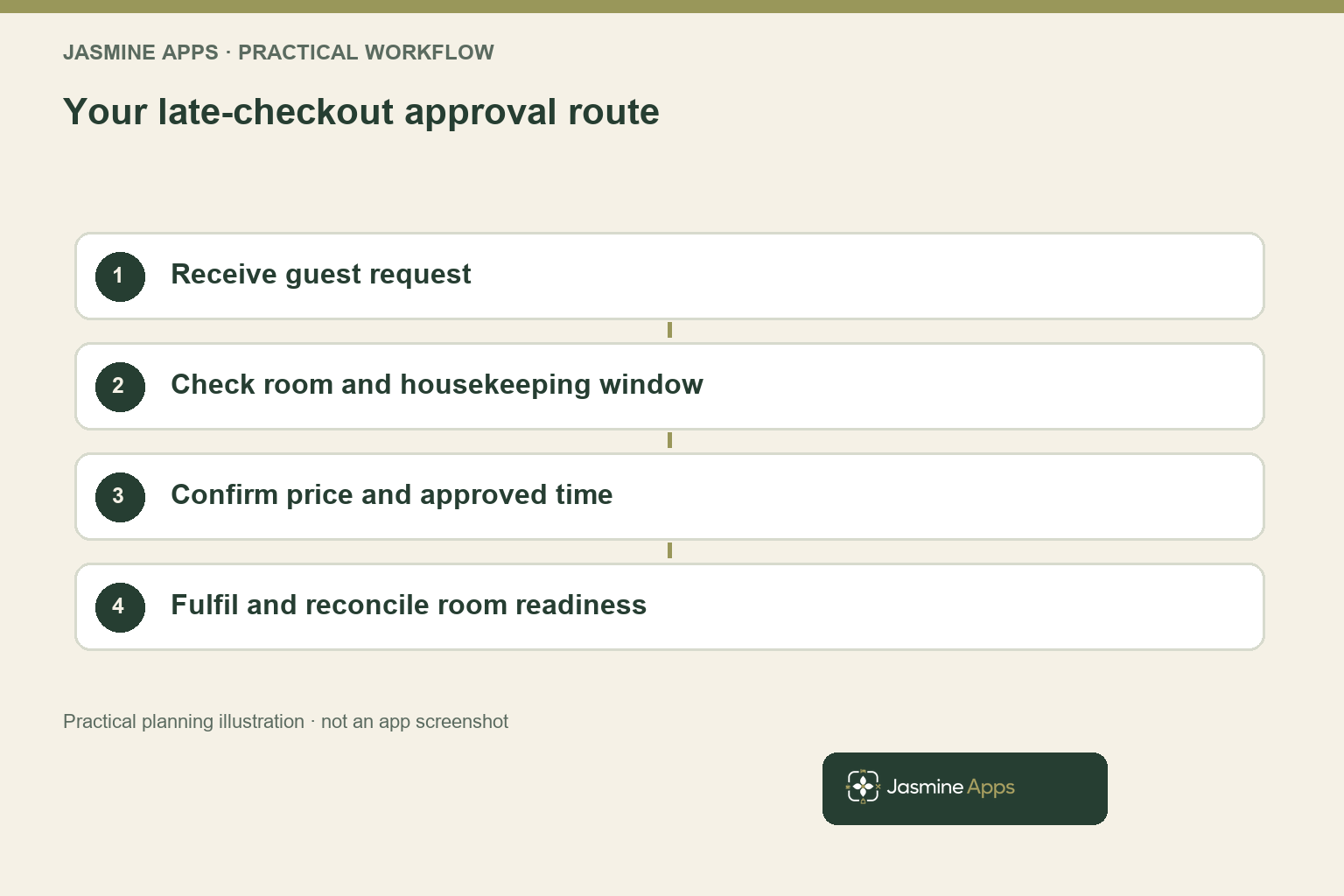
Write hotel late checkout promotion as a clear request and confirmation
Your room-screen message should say what the guest can ask for and how to make the request. Keep it brief, with the relevant time, price information and availability condition presented clearly through the appropriate process. The guest should understand whether they are enquiring or receiving a confirmed extension, particularly if the television itself does not complete an availability check or purchase.
Jasmine TV's public description covers a branded welcome screen, venue-set hotel information, local sights and supported streaming apps. That gives you a useful place to explain the service, but it does not establish automatic late-checkout booking or entitlement recognition. Demonstrate any additional function you require and obtain its scope in writing before promising it in the blog or the guest-facing offer.
For a practical illustrative message, your hotel might invite guests to ask reception about a two-hour extension, subject to confirmation. Your actual wording should reflect the service, total applicable price and conditions your venue has approved. Avoid phrasing that makes every room appear eligible or implies that viewing the offer has reserved the extension on the guest's behalf.
The CMA price-transparency guidance provides the relevant consumer-information reference when displaying charges. Give the guest the required clear information at the appropriate stage and use a process that records the agreed service. A promotion should make a buying decision easier, not defer an unavoidable charge or important restriction until after the guest has relied on the offer.
Review the message with reception and housekeeping before displaying it. Both teams should recognise the approval route and the time being proposed, while the guest should encounter a compatible explanation when they ask. Your TV stay-stage content plan places the message within departure information without assuming that the software automatically selects or personalises it for every room.
Calculate contribution from an extension without ignoring displaced service
Start with the complete relevant sale on a consistent tax basis, then subtract costs genuinely caused by the extension. Your accounting treatment should distinguish the ordinary room preparation that would happen anyway from additional paid work, consumables or other variable expense resulting from the change. Do not count the entire fee as profit simply because the room has already been sold for the night.
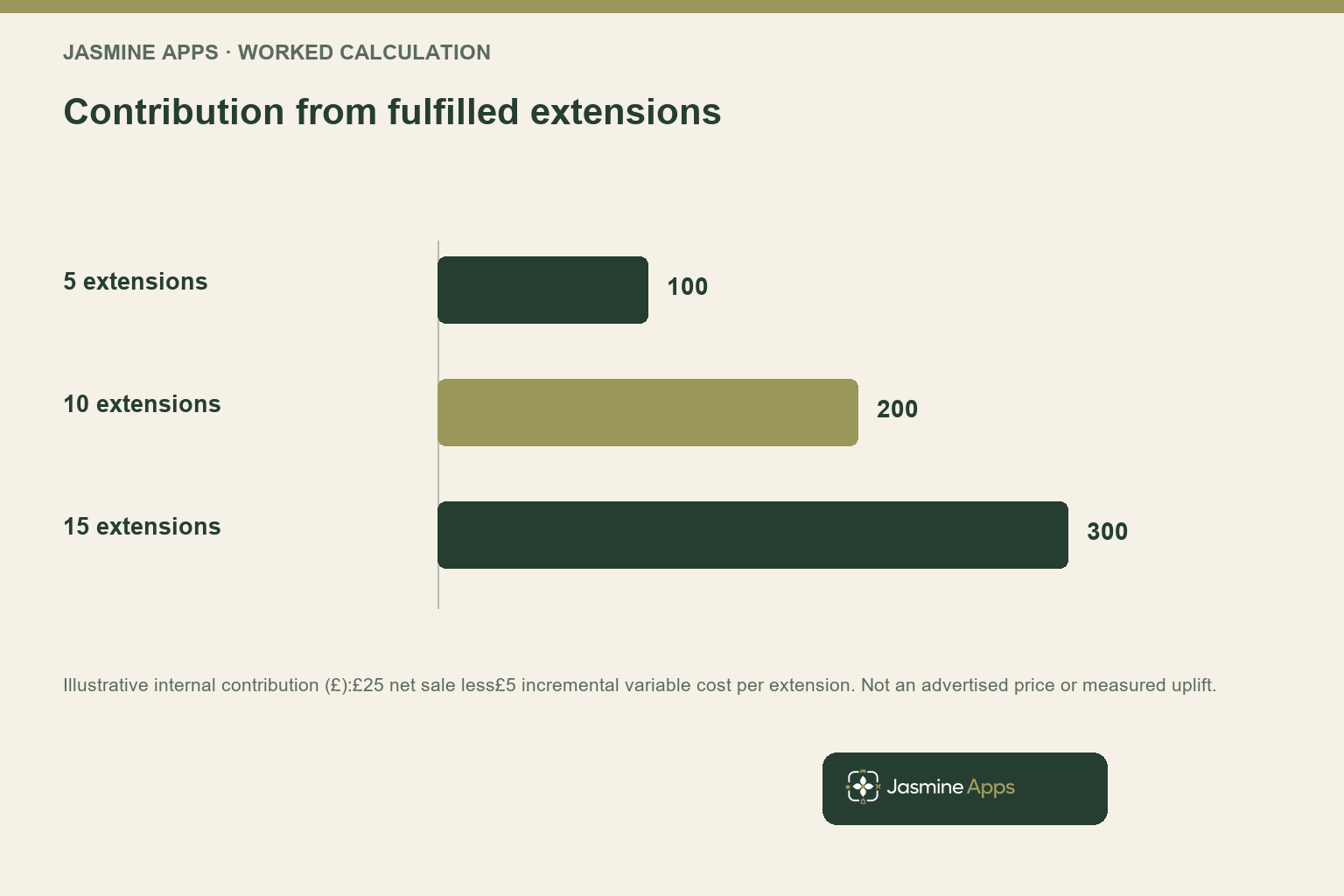
For an illustrative internal model, assume an extension yields £25 net sales and creates £5 of incremental variable cost. Each fulfilled extension contributes £20 before other relevant changed expenses. Five such sales contribute £100; ten contribute £200; fifteen contribute £300. These are hypothetical calculations, not a recommended guest price, tax-inclusive advertised offer or measured Jasmine customer result.
Check whether the extension displaces another useful service. A delayed room could affect an incoming guest, an early-check-in sale or the ability to complete other work during the available shift. Your decision should include the realistic incremental consequences, with operational quality and commitments considered alongside the financial model rather than reduced to an optimistic fee-minus-consumables calculation.
If approval requires extra paid housekeeping time, show that separately. Ten example extensions at £20 contribution give £200 before an assumed £60 extra labour cost, leaving £140. If the labour requirement or delay grows, the result changes. Your manager should see the dependency and the feasible count before deciding that a room-screen promotion is worth expanding across the hotel.
Keep promotional influence distinct from fulfilment. Some guests may have asked for late checkout anyway, so a request following a TV message does not establish that the content created the entire purchase. Record the source where your supported process allows it and use an appropriate comparison before claiming additional revenue caused by the screen, while still learning whether the handover works smoothly.
Run a small approval and delivery pilot before widening the offer
Choose a manageable service window and define who can approve extensions. Brief reception on the current criteria and housekeeping on the agreed handover, then test a fictional request before involving guests. Include a room that cannot be extended, because a useful process should provide a clear alternative or decline as well as demonstrate the successful sale.
Record requests, approvals, fulfilled extensions and reasons for declining under an appropriate minimal-data process. Keep the time and room reference needed for operations, without placing unnecessary guest details in general reporting. The sequence helps your manager distinguish weak demand from limited capacity and reveals whether an approval is being recorded before the relevant team has actually confirmed feasibility.
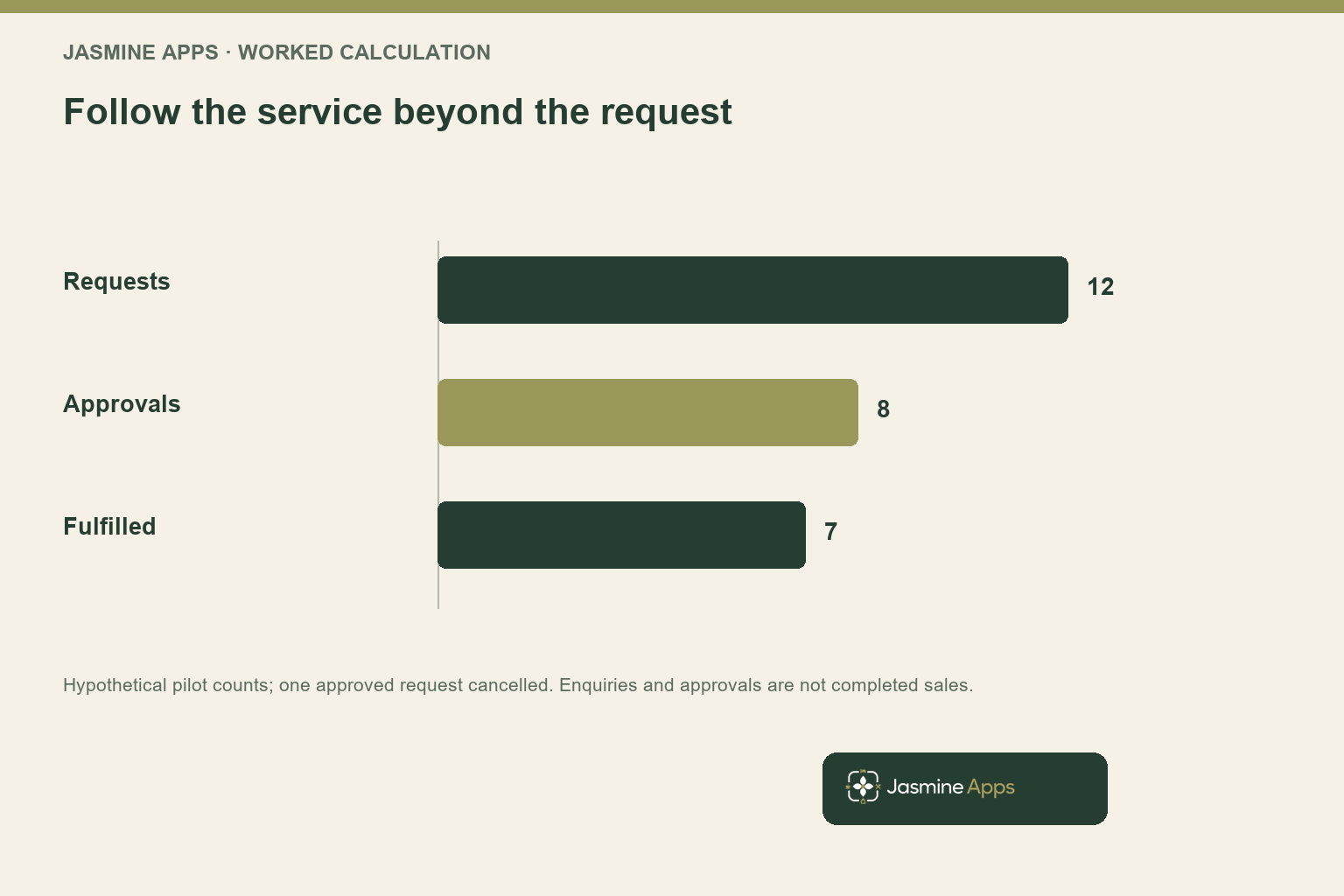
For a hypothetical pilot, twelve requests might lead to eight approvals and seven fulfilled extensions, with one approved request later cancelled. Those counts should remain separate. Twelve enquiries are not twelve sales, and eight approvals are not proof that the service was delivered; your review needs the completed outcome and any relevant payment or refund treatment.
Track incoming-room readiness and additional work alongside the sales. A successful pilot should preserve the service standard for the next guest and make the staff handover more dependable. Ask reception and housekeeping which decision took too long or arrived through the wrong route, then improve that step before increasing the number of room-screen messages or broadening eligibility.
Jasmine TV is currently listed at £5 per room monthly with a £40 monthly minimum, and £50 per room annually. Confirm hardware, setup, annual terms, tax and required services in your quotation. Your pilot can inform a complete buying case, but the subscription should not be justified solely by assuming every approved extension is additional revenue generated by the television.
Keep the offer useful when occupancy and staffing change
Give the content owner a clear update trigger when the operating position changes. A busy turnover day, changed arrival commitment or reduced housekeeping capacity may alter what reception can approve. Your team should know who communicates that change and how the guest-facing message is revised through the supported process, rather than relying on reception to correct an outdated promise repeatedly.
Demonstrate any scheduling or live-availability connection you intend to use. Do not assume that a booking, housekeeping record or room status automatically changes the TV content because the products share a brand. Where a manual handover remains, assign it explicitly and choose wording that stays accurate while reception checks the current position, keeping the promotion aligned with the actual approval process.
Review whether a different service would help guests you cannot extend. Your venue might offer an appropriate luggage or public-area arrangement where available, with clear conditions and no unsupported promise. A useful response can preserve the experience even when the room must be prepared for its next arrival, rather than treating every decline as a failed sales conversation.
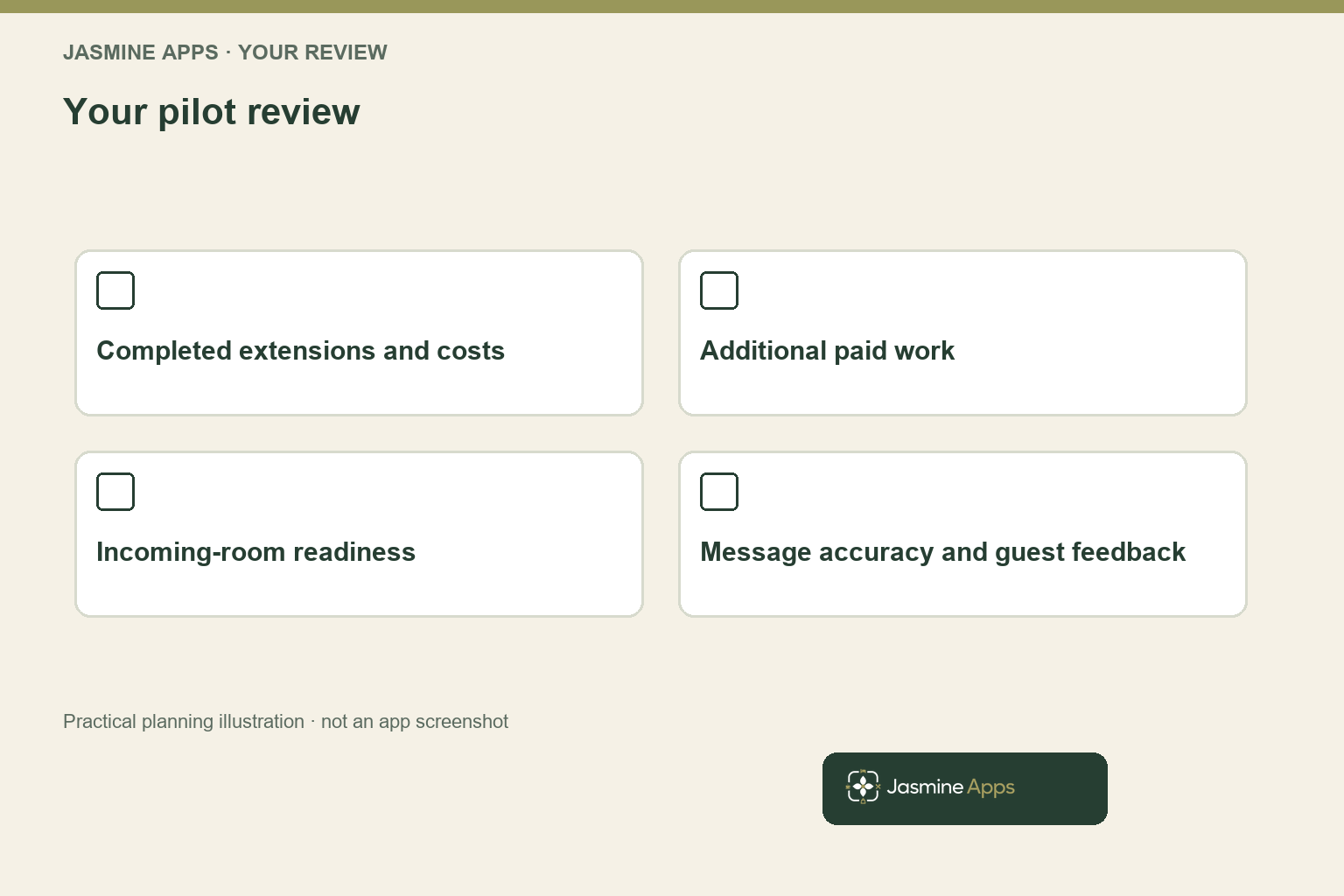
At the monthly review, compare completed extensions, additional paid work, readiness outcomes and relevant feedback. Keep time released, staff effort and financial contribution distinct. Your hotel TV ROI article provides a broader subscription framework; this pilot supplies one specific operating example with evidence and assumptions visible instead of an automatic payback claim.
Retain the time slots and approval rules that work under the relevant conditions, and revise them when the hotel's workload changes. Your strongest offer sells something the guest genuinely values and the team can fulfil confidently. A clear room-screen message then becomes the front of a dependable service, helping reception discuss an option rather than manage the consequences of a promise made before capacity was checked.
Pro Tips
Plot the access wave. Review when extended rooms become available together, not just total cleaning minutes. Enough daily labour does not guarantee enough capacity before one shared deadline.
Count fulfilment. Keep requests, approvals and completed extensions separate. Your revenue review needs the service actually delivered and the relevant payment treatment.
Prepare the decline. Give reception a clear explanation and any feasible alternative. A respectful no can protect the guest experience and the next arrival more effectively than an unworkable paid promise.
Common Mistakes
Selling the preparation buffer twice. You may leave insufficient time for the next guest. Check the complete room-ready sequence before approval.
Treating TV content as entitlement confirmation. You can create a promise the system has not checked. Distinguish the request route from an approved extension.
Ignoring additional staffing. You overstate contribution if the offer needs more paid work. Include genuinely changed costs in the model.
Frequently Asked Questions
How can a hotel promote late checkout without upsetting housekeeping?
You should agree a room-specific approval process with housekeeping and reception before advertising the option. Work back from the next readiness commitment, including preparation, inspection and other relevant duties. Review when extended rooms become available together rather than rely only on total daily labour minutes. Keep the guest message clear that the request requires confirmation, and record the approved time through the supported handover so the team can plan the work realistically.
How should you price a hotel late checkout offer?
You should assess the relevant net sale, genuinely incremental costs, capacity constraints and possible displaced service, using a consistent accounting basis. Your guest-facing price must also follow the applicable clear consumer-information requirements. A worked internal contribution model can help compare options but is not a universal recommended fee. Test the actual delivery process and additional staffing requirement, then review fulfilled sales and guest response before expanding the offer across more rooms or dates.
Does every occupied hotel room have late checkout capacity?
You should check the individual room, next readiness commitment and housekeeping sequence. A later expected arrival does not automatically release the preparation interval, particularly when inspections, maintenance or simultaneous room access constrain the team. Your policy can make approval straightforward, but it still needs the current operational facts. Offer only the extension the venue can fulfil without weakening cleaning, safety or the commitment to the next guest, with a clear confirmation before the departing guest relies on it.
Can Jasmine TV sell late checkout directly from the screen?
You should demonstrate that exact purchasing and availability function before relying on it. Jasmine TV's public description includes the welcome screen, hotel information, local sights and supported streaming apps, which do not alone establish automatic service confirmation or charging. Your content can explain the approved enquiry route, with reception confirming feasibility through the relevant process. Keep any additional integration, hardware and commercial scope explicit in the quotation and test the complete request-to-fulfilment handover.
How do you measure the success of a late checkout promotion?
You should count requests, approvals and fulfilled extensions separately, then assess relevant contribution, additional paid work and the readiness outcome for incoming guests. Record the source where supported, but do not assume every purchase after a message was caused by it. A small pilot can reveal capacity and handover problems without proving a universal uplift. Your manager should see whether the service was worthwhile and dependable, with any additional-demand claim supported by an appropriate comparison.
Hotel late checkout promotion: your next step
Your hotel late checkout promotion should sell useful time the hotel can confidently deliver. Request a Jasmine TV demonstration with your proposed message, approval route and housekeeping window. You can test the guest enquiry and team handover, then build an offer that adds worthwhile contribution while protecting the next arrival.