

Hotel Breakfast Upselling: Make the Decision Easier Before Morning
· Jasmine Apps
Your breakfast can be excellent and still lose a sale because your guest does not know whether it is included, when it starts or how much it costs. You do not necessarily need a bigger discount; you may need to remove one unanswered question. Your hotel breakfast upselling should make the decision easy before a guest has already chosen somewhere else to eat.
With Jasmine TV, you can put practical breakfast information on the bedroom screen. The commercial opportunity is a clearer choice that your kitchen and reception team can deliver consistently.
Key Takeaways
- Separate guests with breakfast included from guests eligible to buy it.
- Explain the price, service window, location and next step together.
- Measure additional breakfast contribution rather than all breakfast revenue.
- Keep offers aligned with kitchen capacity and guest expectations.
- Use a defined pilot to test whether the message changes a decision.
Start hotel breakfast upselling with the guest’s unanswered question
Your guest may arrive after the breakfast team has gone home. Reception can give a short explanation, but a tired traveller may forget it by the time they reach the room. A clear screen message gives them another opportunity to understand the offer without requiring a second conversation.
Begin with the questions that prevent a purchase. Is breakfast already included in this booking, or is it an optional extra? What is available, when can the guest eat, and what happens if they need to leave early? Those questions influence the decision more directly than an attractive photograph of a service the guest cannot confidently plan around.
You should distinguish a general hotel-information page from a personalised entitlement statement. Do not tell every room that breakfast is included unless that is true for every relevant booking. If your installation does not display confirmed package entitlements, direct the guest to check with reception rather than creating an apparently authoritative answer that may be wrong.
Dietary questions also need a reliable route. The Food Standards Agency’s allergen guidance provides the relevant operating context for food businesses. Your promotional screen should help guests reach your approved food-information process; a decorative menu image should not substitute for the information your team needs to provide.
Ask reception which breakfast questions guests repeat and ask the kitchen which promises cause difficulties. You can then create a short message that joins those two views. Your goal is to help the guest choose a breakfast they can actually receive, not to put every possible benefit and exception onto one crowded screen.
Price hotel breakfast upselling around contribution and entitlement
Your first financial measure should be breakfast attachment among eligible guests. If you include guests whose package already contains breakfast in the denominator, you can make an optional-sales opportunity look smaller or larger than it is. Keep the eligible group and your counting rule clear before comparing messages.
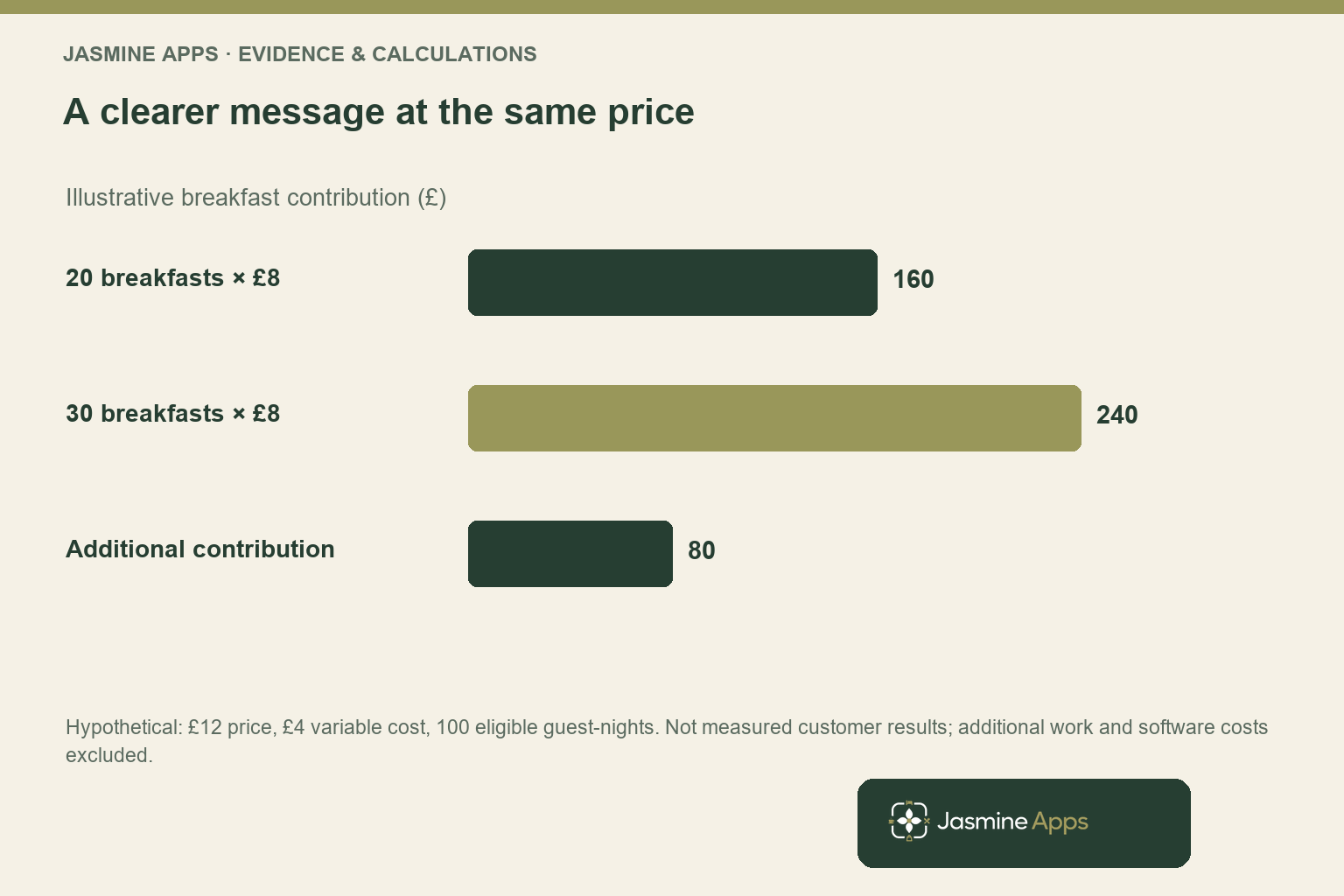
For an illustrative example, suppose 100 eligible guest-nights produce 20 paid breakfasts at a £12 selling price. At an assumed £4 variable cost per breakfast, your contribution is £8 each, or £160 altogether. If a clearer message produces 30 paid breakfasts under comparable conditions, the ten additional purchases contribute £80 before the cost of making and maintaining the offer.
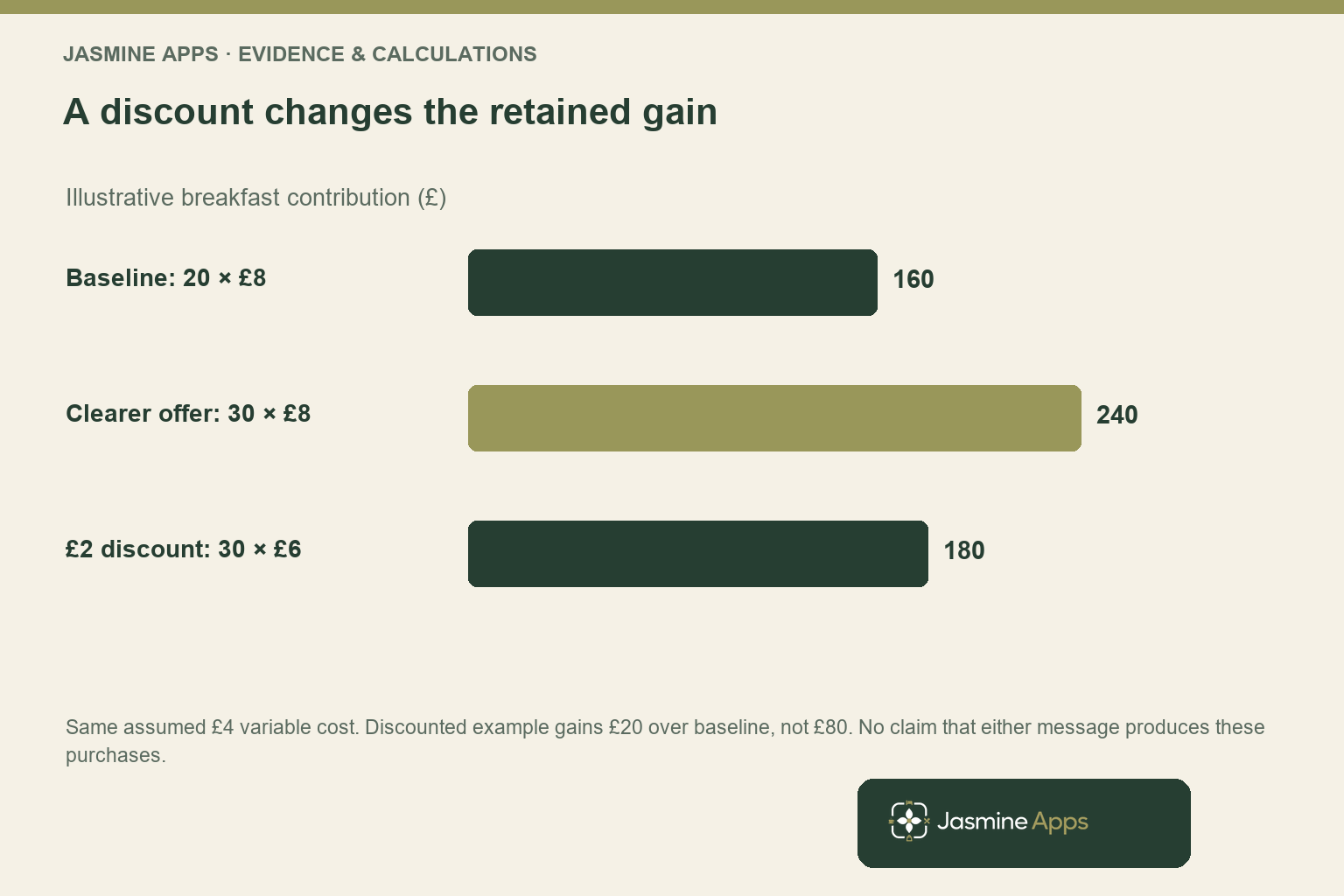
Now compare a different intervention. Suppose a £2 discount encourages those same 30 purchases, with variable cost unchanged at £4. Your contribution falls to £6 each, giving £180 rather than £240. Against the original £160 baseline, your gain is £20: the higher attachment rate is commercially useful, but much less valuable than the undiscounted scenario.
These are hypothetical inputs, not a Jasmine TV customer result or a prediction of guest behaviour. Your own food cost, staffing implications and available capacity can change the comparison. Calculate using a consistent tax basis and account for any extra work needed when breakfast covers rise.
Jasmine TV’s current listed monthly software is £5 per room with a £40 minimum. If you already use it, evaluate this content change incrementally rather than assigning the whole system cost to every offer. For a new installation, include the complete room-based quotation, equipment and content work; your order confirms fees, taxes and annual minimum treatment.
Make hotel breakfast upselling usable on the actual screen
The actual Jasmine TV administration separates welcome content from hotel-information sections. You can use a section title and text to make breakfast easy to find without forcing all the detail into the first greeting. Keep the first view welcoming, then give the guest a recognisable route to the practical answer.
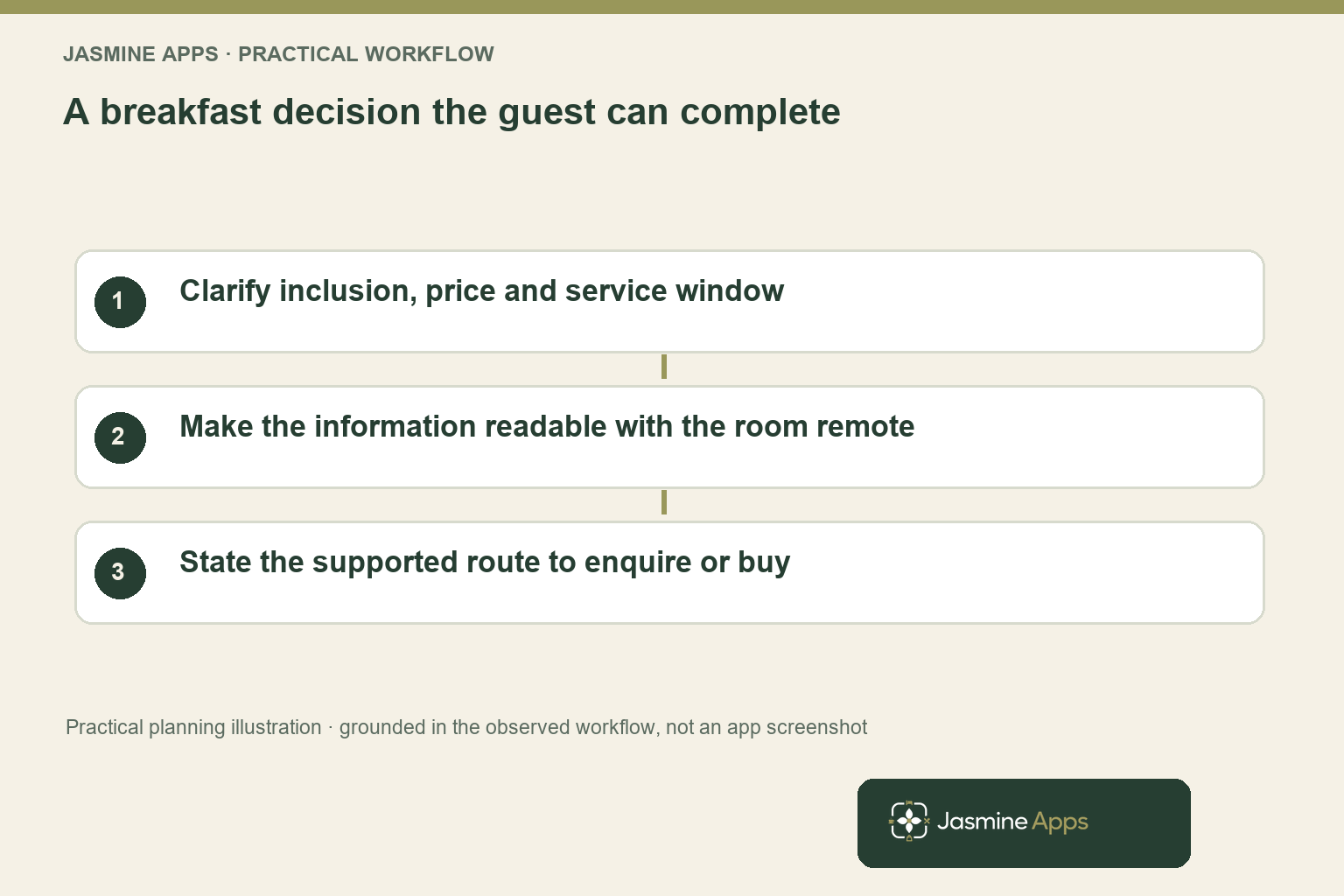
Write the core message in a compact sequence: what you offer, when it is served, what the relevant price covers and how to enquire or book. Avoid a vague invitation such as asking guests to discover your delicious breakfast when the important service details are still missing. Your guest should understand the next step without interpreting a marketing slogan.
Test the information with the remote control on a supported room device. Ask someone who did not write it to find the breakfast time and purchase route from the normal starting screen. Readability from the bed matters, and a section that looks tidy on an office monitor may need shorter text when viewed across a bedroom.
Confirm the transaction route separately. The observed information editor does not prove that your guest can purchase breakfast directly on the television or that a room package is automatically recognised. You can show information while reception or your existing booking process handles the sale, provided the message describes that route accurately.
Give one operational colleague ownership of breakfast times and another clear responsibility for updating the display. If your weekend service starts later, or an early-departure option changes, the screen needs to agree with the team. Your hotel guest information article explains the wider fact-ownership problem; this breakfast campaign puts it to work on one specific purchasing decision.
Test the message before you widen the breakfast offer
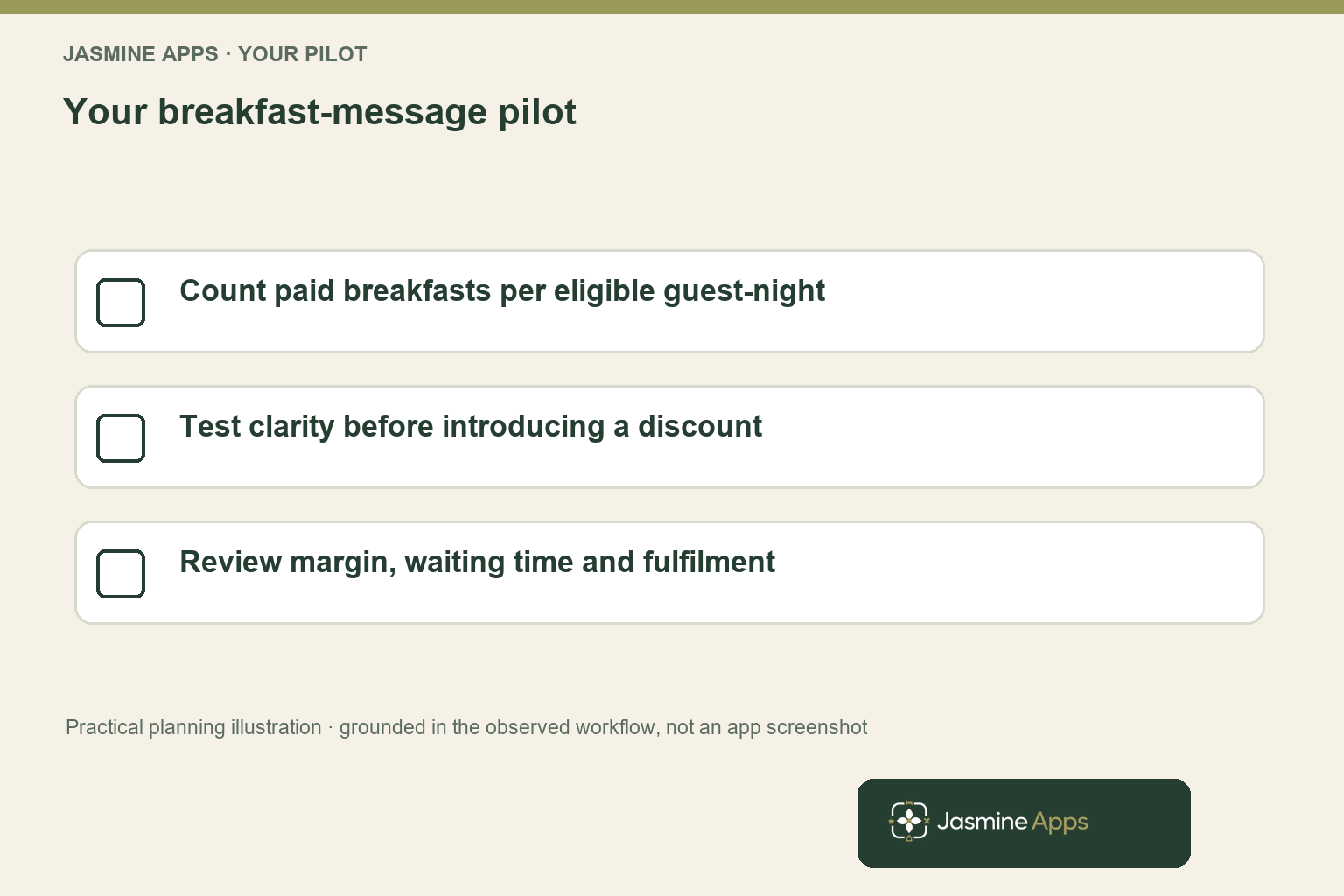
Choose a representative group of rooms or a defined period for your pilot, using an agreed configuration that your installation supports. Record eligible guest-nights, paid breakfasts, contribution assumptions and any breakfast complaints. You need a denominator that remains comparable when occupancy or package mix changes.
Start with a clearer message at the existing price. That lets you investigate whether information was the obstacle before you pay for a discount. If you change the price, menu and screen wording together, you can assess the combined offer but cannot confidently identify which element influenced the result.
Ask your reception team to record the recurring questions that remain. A guest may still be unsure about package inclusion or need an earlier service than you provide. Those observations help you distinguish a wording problem from a product that does not fit the guest’s morning; the appropriate response is different in each case.
Review fulfilment as well as sales. Additional covers can affect seating, preparation and wait times, especially when guests arrive in a short window before meetings or checkout. Your trial should record whether the kitchen can absorb the demand without reducing the experience for guests who already paid for breakfast in their room package.
At the end, compare contribution per eligible guest-night and the practical workload created. Retain the message if it helps guests choose and your team fulfil the promise. You can then test a second angle, such as clearer early-departure information, without turning the screen into a succession of discounts that gradually erode the breakfast margin you wanted to improve.
Pro Tips
Segment the denominator. Separate included breakfasts from optional purchases before measuring attachment. Your message may influence only one part of the guest population, and that is the group your comparison should follow.
Test clarity before price. Begin with the existing offer and remove missing information. You can learn whether the obstacle is uncertainty before funding an incentive for guests who would have bought anyway.
Value the constrained sitting. Review the busiest breakfast window separately. Extra purchases at a quiet time can be useful, while the same demand at full capacity may require additional servicing effort.
Common Mistakes
Promising inclusion to every room. A general information section may not know each booking’s entitlement. An incorrect inclusion message creates a dispute rather than a useful sales opportunity.
Celebrating attachment without margin. A discount can increase breakfast purchases while adding little contribution. Compare what you retain after fulfilment and the incentive, not just the number of covers.
Leaving the booking route vague. Your guest can understand the breakfast and still abandon the purchase if the next step is unclear. State the supported enquiry or booking route beside the offer.
Frequently Asked Questions
How can you increase hotel breakfast sales?
You should first identify why eligible guests do not buy breakfast. Check whether inclusion, price, timing and the purchase route are clear before adding a discount. Use a defined message pilot and compare paid breakfasts per eligible guest-night under similar conditions. Review contribution and service capacity alongside sales, because more covers only improve your result when your team can fulfil the offer at an acceptable incremental cost.
What should a hotel breakfast offer include?
You should show the relevant service window, location, price basis, what the offer includes and the next step to enquire or book. Distinguish general hotel information from a statement about an individual booking’s entitlement. Give dietary questions a reliable route to your approved food-information process. Your guest should be able to decide whether the offer fits their morning without needing to infer important details from a photograph or a vague promotional line.
Should you discount breakfast to encourage purchases?
You should calculate the contribution change before deciding. A discount applies to purchases you may have received at full price as well as genuinely additional sales. Test clearer information first where uncertainty is the likely obstacle, then compare any incentive with a consistent baseline.
Include variable food and servicing costs, and check your busiest sitting. Your best offer may improve understanding rather than reduce the price of a breakfast guests already value.
Can you sell breakfast directly through Jasmine TV?
You should confirm the exact purchase journey in your demonstration. The observed administration supports welcome content and hotel-information sections, but that does not establish direct television ordering or automatic package entitlement checks. Your screen can explain an offer while reception or an existing booking route completes the transaction. Ask to see that complete journey on your intended room devices before describing a direct-purchase feature to guests.
How do you measure hotel breakfast upselling?
You compare optional paid breakfasts and their contribution against eligible guest-nights, using a stable counting rule. Keep included packages separate and note changes in occupancy, guest mix, price and service. Record complaints and additional fulfilment work so your result includes the operational effect. Treat any example attachment-rate increase as a test hypothesis until your own records support it, rather than assigning the screen credit for every breakfast purchased during the pilot.
Hotel breakfast upselling: your next step
Your hotel breakfast upselling should help guests make a confident choice and protect the contribution your kitchen earns. Request a Jasmine TV breakfast-content demonstration with your service times, entitlement questions and purchase route. You can leave with a practical screen message and a pilot that measures the decision your guests actually change.