

Event Agreement Change Control: Keep Dates, Numbers and Prices Aligned
· Yiannis Yiasemis

Your guest can have the correct signing link and your kitchen can still be preparing the wrong event. If the date, numbers or menu changes after agreement, a signed PDF and an updated service note may describe different commitments. Your event agreement change control needs to join the commercial decision with the document and the operational handover.
Sign Jasmine supports PDF-based signing workflows and recipient status tracking. Your process should decide what the proposed change means, who can approve it and which document or confirmation is appropriate before anything is sent. You can then give the organiser one clear current position and your team a service plan that matches it, reducing confusion without assuming every change has the same legal treatment.
Key Takeaways
- Separate a requested change from an accepted commitment.
- Review availability, price and delivery before approval.
- Use the appropriate document and execution formalities.
- Preserve the relationship between original and changed terms.
- Brief every affected team from the agreed current version.
Define event agreement change control before an organiser asks
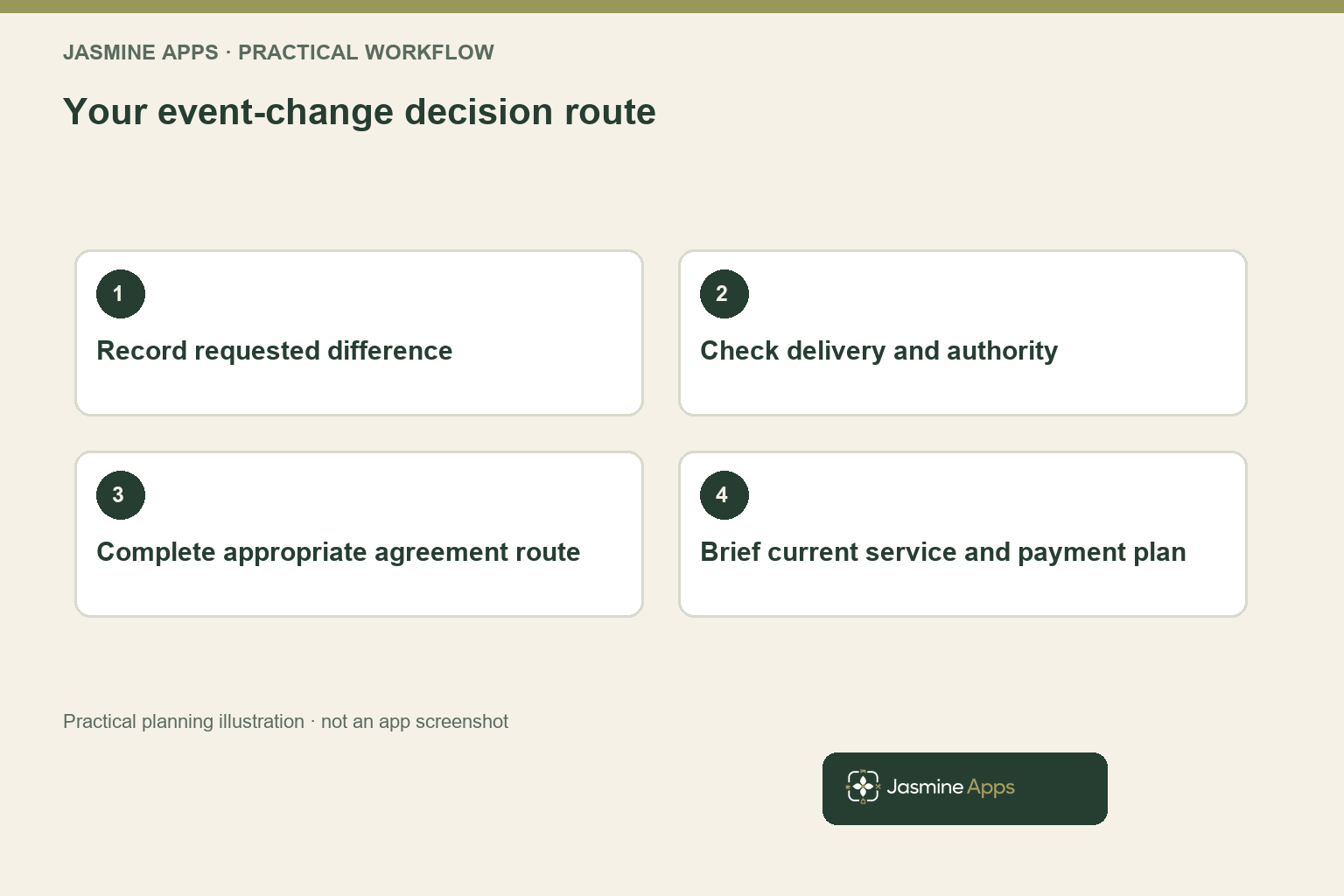
Your policy should identify the details that can alter the event your venue has agreed to deliver. Dates, start and finish times, guest numbers, menu, room, equipment and payment arrangements can each affect availability and cost. A request may sound small in conversation while changing several operational assumptions, so give staff a consistent route for recording and assessing it.
Decide who can acknowledge the request and who can approve the commitment. Your events colleague may collect the details without authority to promise a new date or waive a charge. Make that distinction clear in the team briefing and the organiser's communication, preventing a helpful initial response from being mistaken for confirmation before the relevant manager has reviewed the effect.
Keep your current agreement and service plan identifiable. Record the relevant version, event reference and approved operational summary through your secure supported process. The aim is to locate the existing position quickly, not send staff searching through multiple similarly named PDFs while the organiser waits for a simple answer about changing twenty guests to twenty-four.
Use your existing document version-control article for the broader discipline of sending the right file. Change control adds the decision before that file exists: what has been requested, what the venue can deliver and what form of confirmation is appropriate. Your process should preserve those questions instead of treating every new attachment as an approved replacement.
Explain the route before the event becomes busy. The organiser should know where to send changes, when relevant deadlines apply and how acceptance is confirmed. Your staff can then respond promptly without improvising a different policy for every caller, making the service more reassuring while keeping availability and commercial authority with the people responsible for them.
Assess event agreement change control across capacity and contribution
Review a requested date or count against the actual space, staffing and service window. A larger party may fit the room but overload production at the agreed time; a new date may be free in one diary while another team has a conflicting commitment. Your approval needs the relevant operational confirmations before the organiser receives an unqualified yes.
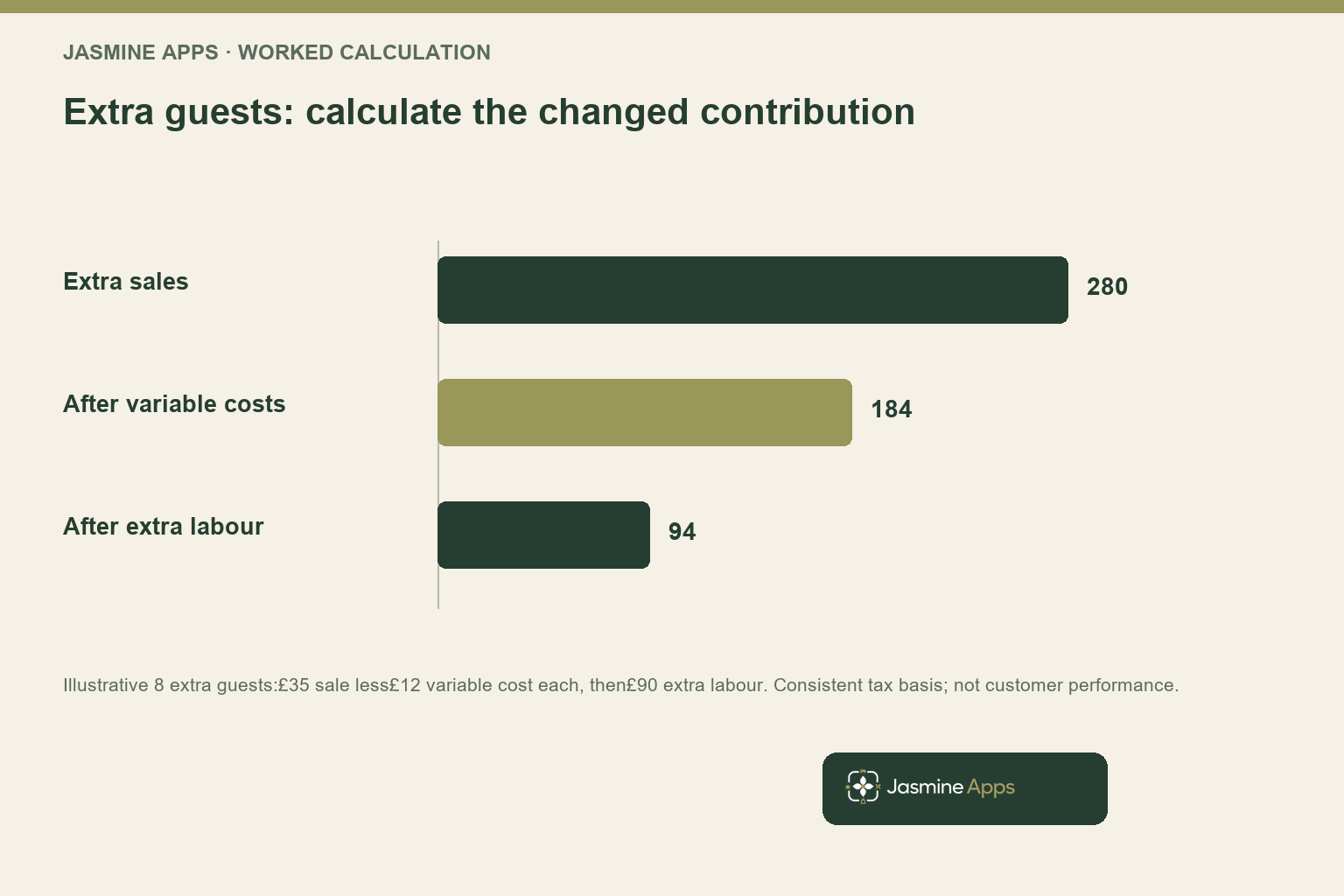
Calculate the commercial difference on a consistent basis. For a hypothetical event, increasing from forty to forty-eight guests at £35 each adds £280 sales. If incremental variable cost is £12 per added guest, the eight additional guests add £184 contribution before other changed expense. A required £90 extra staffing allocation would reduce that example difference to £94.
Now test the physical and contractual assumptions. The extra guests may require another room layout, equipment hire or menu arrangement, and the original agreement may define how changes are handled. Your calculation should include the relevant incremental effects rather than treating the additional bill value as pure profit or assuming that an existing per-person figure covers every possible expansion.
For a date move, consider the realistic alternative use of both windows. Releasing a high-demand date may have a different effect from moving an event that would otherwise leave the room empty. Keep uncertainty visible and apply the relevant agreed terms and professional advice, rather than inventing a charge from a theoretical maximum revenue you cannot support.
Use the group service-planning framework alongside the existing event records where appropriate. That plan helps you turn the proposed change into an operational wave, not just a revised number. Your manager can then approve a feasible option with a clear contribution calculation and explain any alternative the organiser needs to consider before deciding.
Choose the document route for event agreement change control
Once the venue has assessed the request, determine the appropriate way to record any agreement. Depending on the terms and circumstances, your process may require a formal variation, replacement agreement or another reviewed confirmation route. Do not assume that sending a fresh signing link automatically cancels or legally replaces the original document without the necessary agreement and formalities.
The Law Commission's electronic-execution work explains that an electronic signature can authenticate a document where the necessary intention and execution formalities are satisfied. Use appropriate legal advice for your document and jurisdiction, particularly when changing an existing commitment. A completed software status is an operational record, not a universal legal conclusion about every possible event contract.
Make the proposed change understandable to the organiser. Identify what changes, what remains applicable and the effective arrangement, using the wording approved for your circumstances. Avoid a long replacement PDF that silently alters unrelated terms or a short note whose relationship to the original agreement nobody can explain when another colleague later reviews the booking.
Check who needs to approve or sign the change and in which capacity. Your organiser's day-to-day contact may not be the person authorised to alter a corporate booking, and your venue's countersignature requirements may differ by document. Sign Jasmine includes recipient roles and ordering; demonstrate the route required for the reviewed document rather than assuming a viewer role proves approval.
Retain the relationship between the original document, the approved change and the current operational plan through your authorised record process. Your next colleague should be able to establish the current position without guessing which email superseded another. A clear document route protects the organiser's understanding and gives the venue a more dependable basis for delivering the event as agreed.
Send the approved version through a controlled signing workflow
Prepare the document only after the necessary internal decisions are complete. Check the event reference, parties, dates, times, guest numbers, pricing basis and the reviewed description of the change. Your colleague should compare those details with the approved request rather than assume that a correctly formatted PDF contains the right commercial information.
In Sign Jasmine, follow the supported PDF, title, message and recipient workflow in an approved environment. Use a fictional example to confirm the signer or countersigner roles and order your venue needs. The demonstration should show how the organiser understands what they are receiving and how your team distinguishes draft, sent, in-progress, completed or voided status in the actual setup.
Include the case where an error is found after sending. Ask how your team stops relying on the incorrect document, informs the organiser appropriately and issues the corrected version through the reviewed process. Do not assume a technical void or a new file alone settles the legal effect of something already signed; your operational response must follow the appropriate advice and agreement requirements.
Use the existing signer and countersigner guide for the role-order discussion. Here, keep the focus on the change being approved and the current version. A signing route works best when the person receiving it can see the actual decision they are asked to make, rather than a familiar link attached to an unexplained replacement file.
Record the final outcome and any remaining condition before handing the event back to operations. Your team should know whether the change is accepted, still awaiting completion or not proceeding, with the relevant evidence accessible to authorised colleagues. That prevents a draft variation from entering the service briefing as if the organiser and venue had already completed the necessary agreement.
Translate the agreed change into the service and payment plan
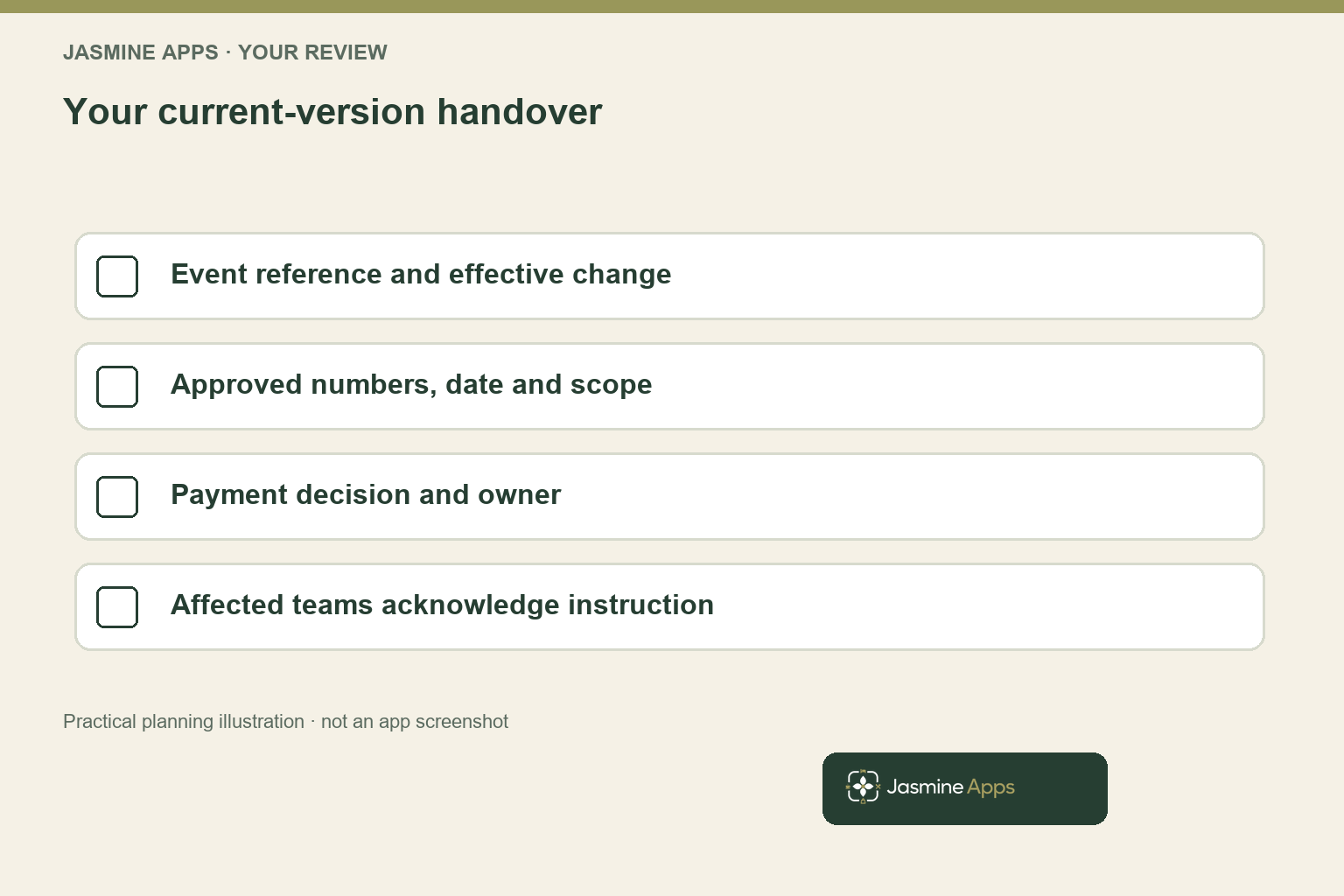
A completed document needs an operational handover to become a delivered event. Identify the teams affected by the change: reception, reservations, kitchen, floor, housekeeping, accounts or an external supplier where applicable. Each needs the current detail relevant to their work, with unnecessary private or commercial information restricted through your normal access arrangements.
Give the handover a clear effective position. If the event moves from forty to forty-eight guests, the kitchen should know the current approved count and menu decisions, while accounts should know the resulting payment arrangement. A message saying updated agreement signed leaves both teams to find and interpret the difference themselves, increasing the chance that one continues using the earlier plan.
Check the deposit and final-account treatment through the supported payment process. Your signing workflow does not itself establish that money was collected, refunded or allocated correctly in another system. Confirm the relevant payment record and responsible owner separately, especially when a change alters the due amount, date or relationship between an existing deposit and the final bill.
For consumer-facing terms, the CMA fair-contract guidance is a relevant reference for clear and fair arrangements. Apply the requirements appropriate to your circumstances with professional review where needed. Your organiser should understand the agreed change and its cost, rather than discover another mandatory condition when the revised event is already being prepared.
Use a short acknowledgement from the affected operational leads to confirm they have the current instruction. Keep that confirmation distinct from legal acceptance of the contract itself. Your purpose is to close the delivery loop: the organiser and venue have agreed the appropriate change, and the people responsible for the actual service now know what they must prepare.
Measure change-control work and improve the recurring handover
Review a manageable sample of changed events and identify where the process waited. Your stages might include request, availability check, price decision, document preparation, organiser response and operational handover. Keep elapsed time distinct from active staff work, because a three-day wait for a decision is not the same as three days spent administering the file.
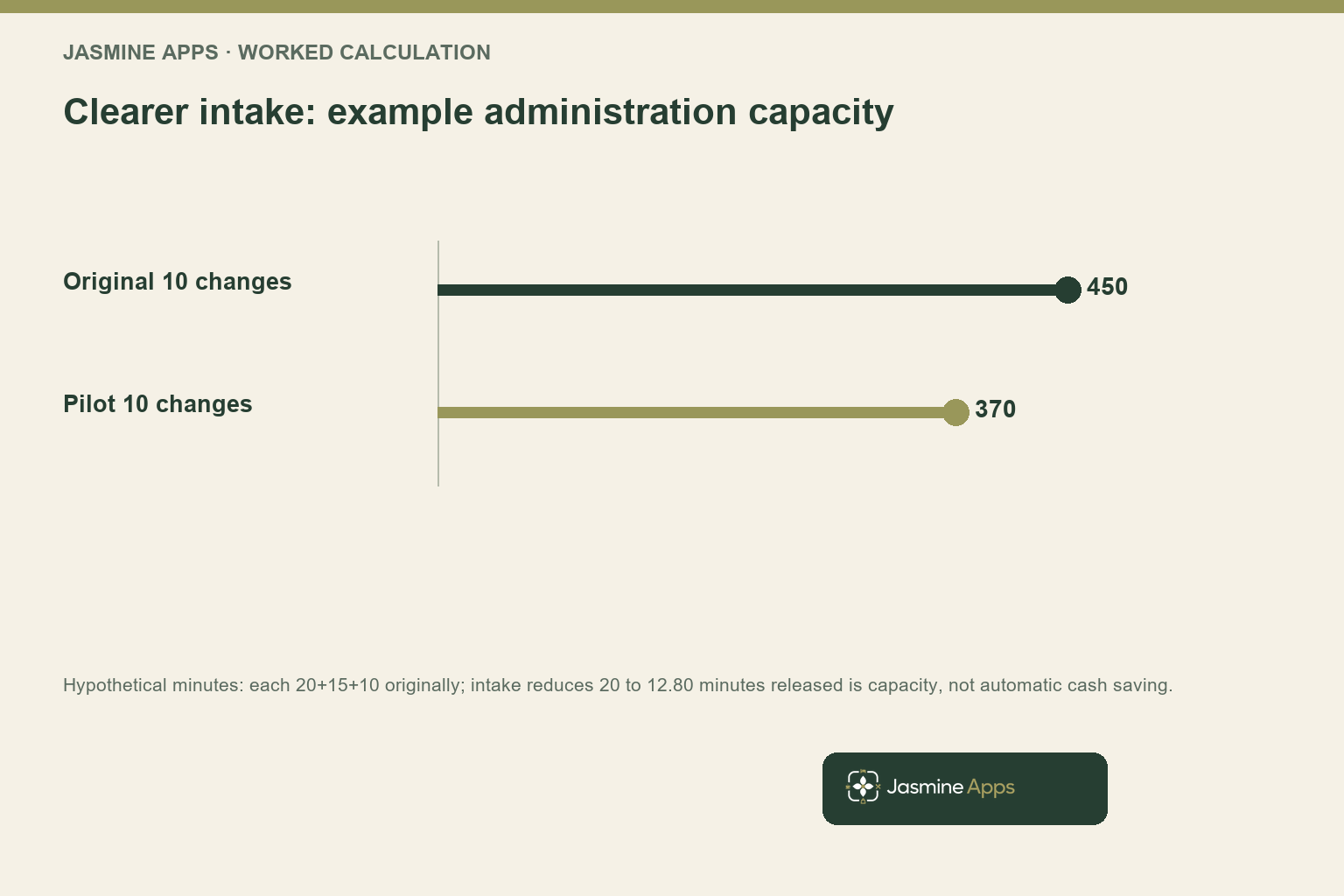
For a hypothetical set of ten changes, assume the team spends twenty minutes each gathering facts, fifteen preparing the approved document and ten confirming the operational handover. That totals four hundred and fifty minutes, or seven and a half hours. The example helps you budget the process; it is not a measured benchmark or an automatic saving available from e-signature software.
If clearer intake and a current summary reduce gathering time from twenty to twelve minutes in a later comparable sample, the model releases eighty minutes across ten changes. Check whether errors, queries and downstream corrections also changed before calling the process better. Released time is useful capacity unless an actual expense reduction is separately established in your staffing and accounting records.
Sign Jasmine is currently listed at £15 per venue monthly or £150 annually, with unlimited documents in the listed scope. Confirm your full terms, setup, required roles, evidence retention and tax basis in the quotation. Your buying decision should assess the complete change workflow, including the professional document review and operational communication that remain outside a subscription price.
Finish each review with one practical improvement: a clearer request form, an earlier capacity check or a better current-version handover. Your venue can then respond to changes with more confidence and fewer contradictions, while the organiser receives an understandable decision. The value comes from keeping agreement and delivery aligned, supported by the right document and a process your team can repeat.
Pro Tips
Name the pending decision. Show whether you are waiting for availability, price authority, document review or organiser acceptance. A generic awaiting update status hides who can move the change forward.
Reconcile before replacing. Establish the relationship between the proposed document and the existing agreement through appropriate review. A new file name is not enough to explain the current commitment.
Brief the difference. Tell each operational lead what changed and the effective current instruction. Do not make every team reconstruct the revision from two PDFs.
Common Mistakes
Promising before checking delivery. You can agree a date or count the venue cannot serve. Complete the relevant capacity and authority review first.
Treating a new signing link as automatic replacement. You may misunderstand the existing agreement and formalities. Use the appropriate reviewed variation or confirmation route.
Stopping when signing finishes. You leave the kitchen or accounts on the old plan. Confirm the affected operational handover separately.
Frequently Asked Questions
How should you handle a change to an event booking agreement?
You should record the request, review availability and commercial effects, obtain the appropriate authority and decide the reviewed document or confirmation route. Keep a requested change separate from an accepted commitment. Identify the relationship with the existing agreement and satisfy the relevant execution requirements, using professional advice where needed. After agreement, brief every affected team from the current plan so the service and payment arrangements match what the organiser and venue have actually agreed.
Do changes to guest numbers always need a new contract?
You should check the existing terms, the nature of the change and the appropriate advice for your circumstances rather than apply one universal rule. Some changes may fit an agreed confirmation process, while others may need a formal variation or replacement document. Your operational team still needs the current count, price and preparation decisions. A signing platform can support the chosen document route, but its completed status alone does not determine the legal treatment of every change.
Can you edit an event agreement after it has been signed?
You should preserve the relevant original record and use an appropriate reviewed process for any agreed change. Do not silently alter a signed document and assume the change has been accepted. Confirm authority, wording, the relationship between documents and any required execution formalities, with legal advice where appropriate. Your organiser should understand the proposed difference, and your team should know when the current operational plan can be updated from a request to an accepted arrangement.
What should an event change request include?
You should identify the event, the current agreed position, the requested difference and the date or service consequence involved. Capture the organiser's authorised contact and the operational questions that affect availability, price, preparation or payment. Keep unnecessary private information out of a broad team note. Your reviewer should be able to assess the request and identify the next decision without searching a long message thread or assuming that an informal suggestion has already been approved.
What should you demonstrate in Sign Jasmine for event changes?
You should follow a fictional reviewed change through PDF preparation, title and message, appropriate recipients, signing order and status tracking. Include an error discovered after sending and the route for preserving the relationship with the existing agreement. Confirm evidence retention and the handover after completion. Your demonstration should support the document process appropriate to your venue, while legal suitability, payment reconciliation and operational acceptance remain explicit parts of the wider workflow.
Event agreement change control: your next step
Your event agreement change control should keep the organiser's decision and your team's delivery plan in step. Arrange a Sign Jasmine demonstration with a fictional change of date or guest count and your reviewed document route. You can test the signing and handover process before relying on it for a real event.