

Restaurant Large-party Service Plan: Keep Group Dining Under Control
· Yiannis Yiasemis
A twenty-person booking can behave like one reservation on your diary and several different services on your floor. Guests arrive in waves, choose at different speeds and may expect to pay separately. Your restaurant large-party service plan needs to resolve those differences before the party reaches a kitchen already serving the rest of the room.
Table Jasmine gives your team booking, table and function workflows to organise the relevant details. Your service plan should turn those records into decisions: who confirms the final party, when the kitchen needs information and how changes reach the person responsible. You can then sell group dining with a clear view of the capacity and contribution it requires, rather than treating a large cover count as automatically valuable business.
Key Takeaways
- Plan the arrival and production wave, not only total covers.
- Agree one authorised organiser and a change deadline.
- Keep guest dietary needs within your approved process.
- Settle payment expectations before the event.
- Review group contribution alongside the capacity displaced.
Build your restaurant large-party service plan around the service wave
Begin with the type of occasion your venue is accepting. A working lunch with a fixed departure time needs a different service plan from a relaxed birthday dinner. Ask the organiser about arrival, seating, speeches or activities and the time guests need to leave, then check whether the requested experience fits your team and kitchen at that service.
Translate the total cover count into the demand it creates over time. Twenty main courses ordered together can be more demanding than twenty covers arriving across an hour, even though the booking count is identical. Your kitchen lead should assess the proposed menu, production stations and dispatch sequence alongside ordinary reservations that will remain in the room.
Review the physical layout without assuming that every spare seat can be joined into the requested arrangement. Your table configuration, access routes and relevant accessibility needs determine what is practical. Give the organiser a clear description of the offered arrangement and any meaningful limit before they invite guests on the assumption that a different space will be available.
Use Table Jasmine's booking and table workflow to demonstrate how the party and its overlap with other reservations appear to the host. Confirm the actual configuration rather than assuming the software automatically models kitchen production capacity. Your service plan should preserve the distinction between recorded guest numbers and the operational judgement about how many simultaneous orders can be handled well.
Connect the proposal with your table-capacity planning article. That gives the wider seating context; your large-party plan adds the arrival and production wave. You can then accept, stagger or reshape the request with a reason the organiser understands, protecting the experience of both the group and the rest of your dining room.
Make the restaurant large-party service plan usable for the organiser
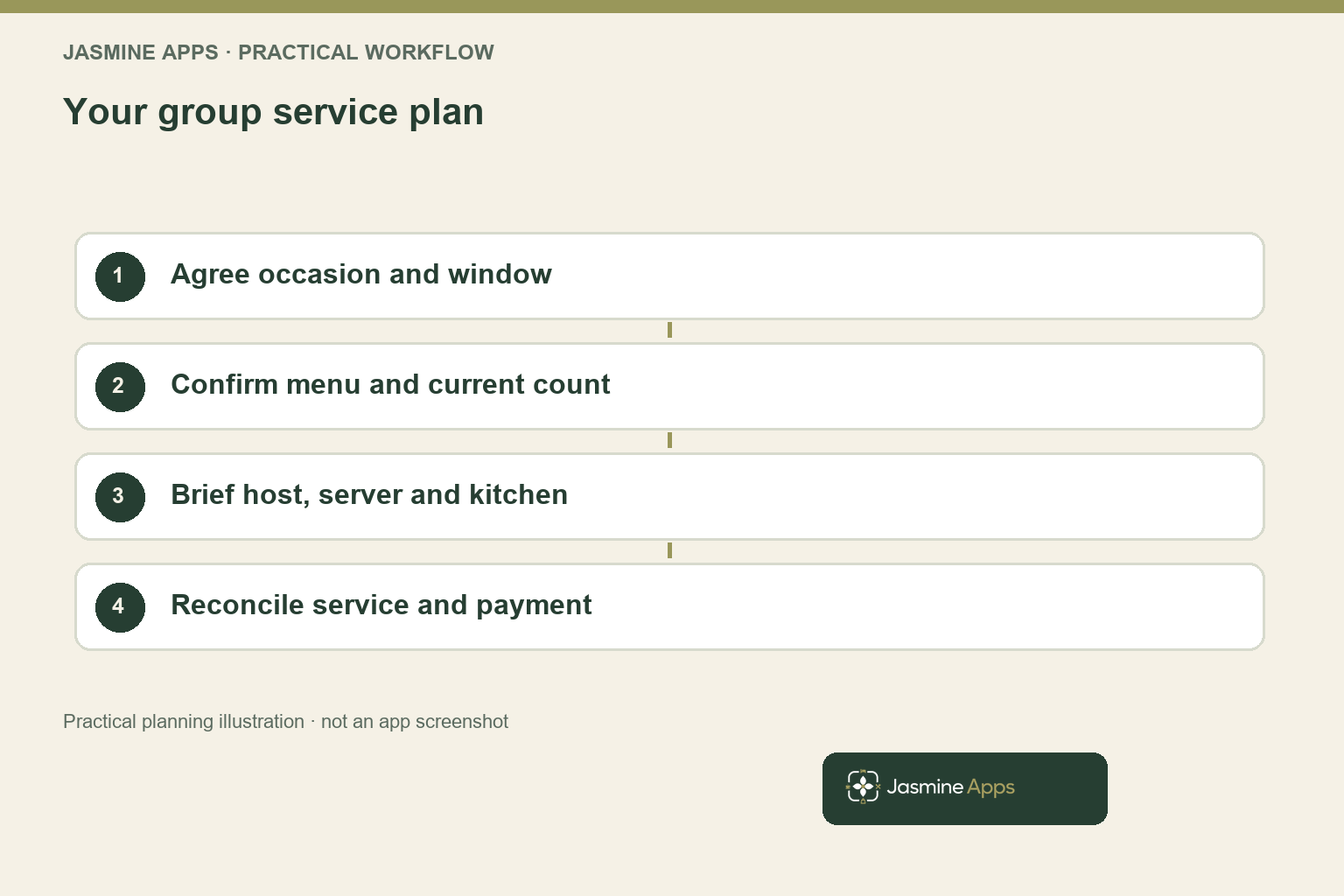
Agree who can confirm the final details and how your venue will identify the current instruction. Several guests may contact different colleagues with well-meant changes, but your kitchen needs one dependable version. Ask the organiser to nominate the responsible contact and describe how guest requests are collected, reviewed and confirmed through the route your team can maintain.
Set deadlines backwards from preparation and service, rather than choosing an arbitrary number of days. Your kitchen may need a purchasing commitment, your events team may need a final layout and your host may need an accurate arrival count. Explain each deadline in terms of the decision it supports, making it easier for the organiser to understand why a late change needs approval.
Separate information that is confirmed from information still requested. Your briefing should show the current party size, menu or pre-order status, timing, payment arrangement and any unresolved question with an owner. A long message thread can contain all those details without making the latest decision obvious, so give staff a concise operational summary they can actually use.
The GOV.UK service-design guidance is a useful reference for designing a process around the task a user needs to complete. Apply that idea to your organiser's job: state what you need, by when and what happens next. Do not assume a guest understands your internal distinction between an enquiry, provisional space and a confirmed booking.
Review the summary with the organiser before the final handover. Ask them to check the details that affect their guests, and record how later changes will be handled. Your venue can then welcome the party from an agreed plan rather than reopening basic questions during arrival, reducing confusion without making promises about requests the kitchen has not yet approved.
Connect your restaurant large-party service plan with pre-orders safely
Your pre-order process should support preparation without pretending that a dish choice settles every guest requirement. Confirm the menu version, portions and the information needed for your service format. Keep the organiser's administrative role separate from the trained food-business decisions your venue must make about ingredients, allergens and whether a particular request can be accommodated.
Table Jasmine's function workflow includes menu and pre-order choice records, with the pre-orders extension currently listed at £9 per venue monthly or £90 annually. Demonstrate how your proposed group is represented, how an outstanding choice is identified and how a changed response reaches the kitchen. Confirm the complete required configuration and any additional function or messaging scope in your quotation.
Keep allergen information current and use your approved communication procedure. The Food Standards Agency's allergen guidance provides the relevant food-business context. A guest's earlier pre-order does not remove the need to respond appropriately if ingredients, preparation conditions or the guest's request change before service.
Decide how the kitchen handles an incomplete or late choice. Your organiser should know the available options and the approval route, while the team should know which version is in production. Avoid silently substituting a dish or assuming a previous dietary note covers a new request. Where a decision affects suitability, involve the responsible trained colleague and communicate the outcome clearly.
Use your existing group pre-order guide for the detailed choice-collection process. This article's service plan connects those choices with arrival, production and dispatch. Your final briefing should tell the team which information is reliable, which requests need confirmation and what action to take when the party differs from the agreed plan.
Check group contribution against the space and demand you displace
A large group is commercially attractive when its expected contribution justifies the capacity and work it requires. Begin with the agreed menu and realistic guest count, then subtract the relevant variable costs. Include any additional staffing, special preparation or service expense caused by the booking rather than assuming that the whole bill is available to cover your fixed costs.
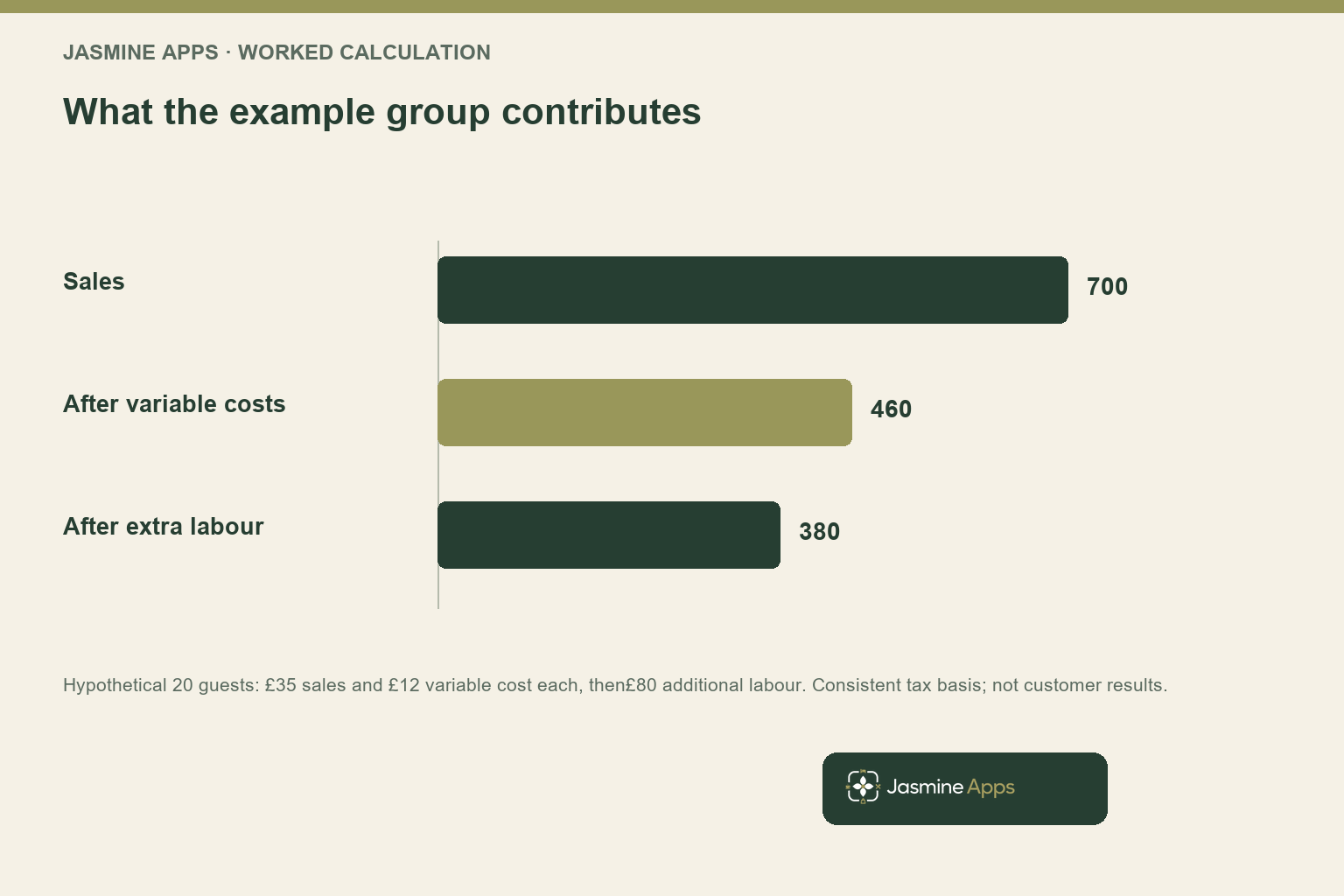
For a hypothetical party of twenty, assume net sales of £35 per guest and £12 variable cost per guest on a consistent tax basis. Sales total £700 and variable costs £240, leaving £460 contribution before additional event-specific expense. If the plan requires £80 of extra paid labour, the comparison becomes £380 before other relevant changed costs.
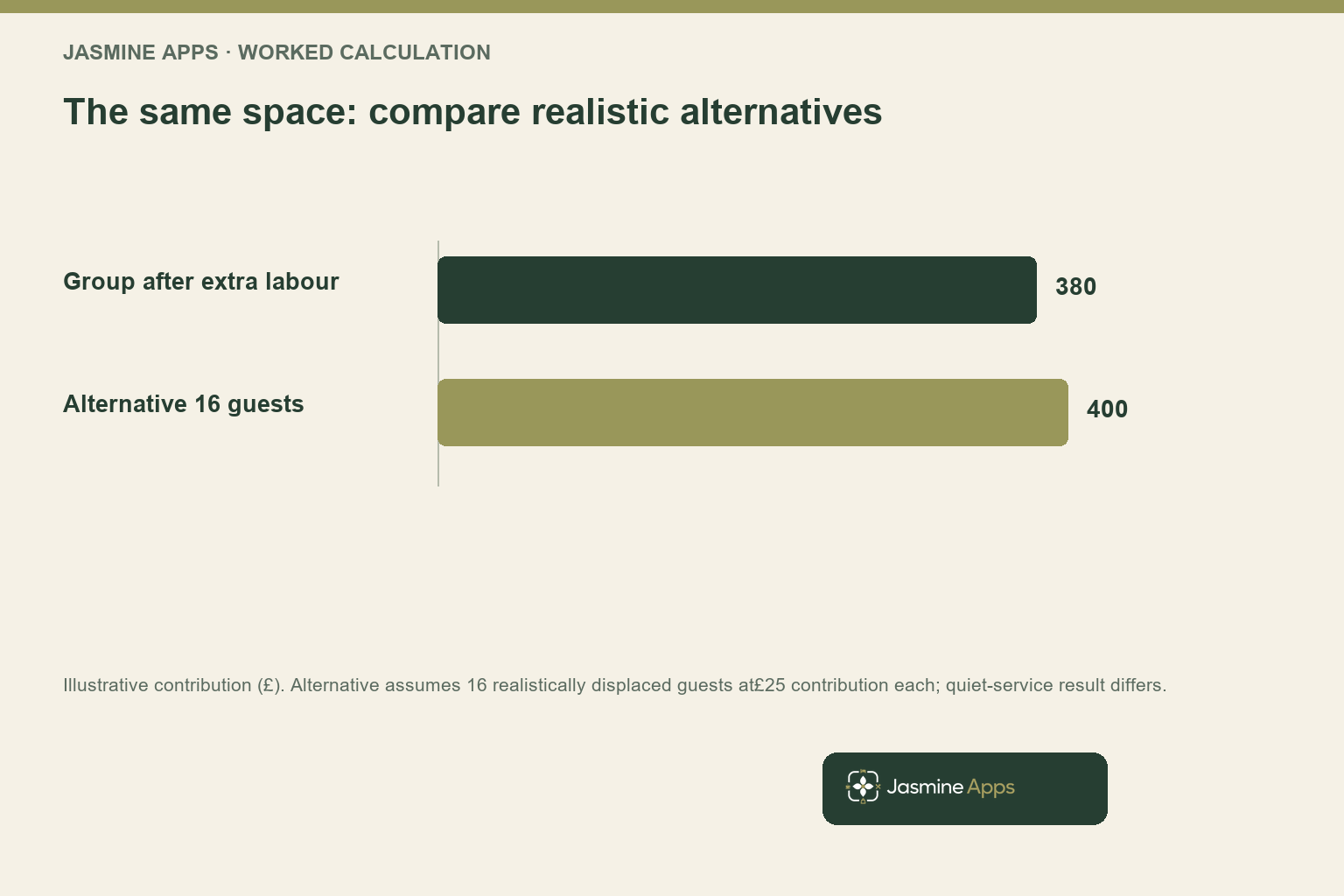
Now examine the alternative use of the space. Suppose the same table window could realistically have served sixteen other guests contributing £25 each, or £400 in total. Under those assumptions, the group leaves £20 less contribution than the alternative after its extra labour. On a quiet service with no comparable displaced demand, the same group may be a useful opportunity.
Keep the displacement assumption evidence-based. An optimistic belief that every seat would otherwise sell can make you reject worthwhile business, while ignoring an already strong booking pattern can make a large party look better than it is. Use comparable demand, lead time and the actual physical window rather than the maximum theoretical capacity of your dining room.
Present the result as a decision model, not a fixed verdict on group bookings. You can adjust timing, menu complexity, minimum commitment or staffing to improve the fit, with clear guest-facing terms. Your manager should see which assumption drives the outcome and what the organiser would need to agree for the proposal to work for both sides.
Set payment and change expectations before the arrival rush
Ask the organiser how the group expects to pay, then confirm what your venue can support in the intended configuration. A host-funded meal, individual payments and a shared deposit credited to the final bill create different reconciliation tasks. Settle the arrangement early so your server does not discover the expectation while twenty guests are preparing to leave.
Write the agreed price basis and included items clearly. Your service team should know how drinks, extras, service charges and last-minute additions will be handled, with the appropriate consumer information and terms reviewed for your circumstances. Do not leave the organiser to infer that a quoted menu figure includes every possible charge or guarantees unlimited changes.
If deposits or card-on-file arrangements form part of the proposal, demonstrate the collection, change, refund and reconciliation route you intend to use. The card-deposits extension is currently listed at £9 monthly or £90 annually, but that entry price does not establish payment-processing fees or every operational condition. Your written quotation should confirm the actual required scope.
Use your booking deposit policy article for the broader discussion of fair, understandable terms and realistic loss. Here, ensure the service team has the agreed operational position: final expected numbers, approved changes and how payments should be recognised. Payment clarity helps the meal finish smoothly without asking a server to improvise a contractual decision.
Keep a named escalation route for a mismatch on the day. Your colleague should know who can approve an exception, how the current decision is recorded and what should be explained to the organiser. That process protects the guest relationship and the accuracy of the final account, making the payment handover part of the planned experience rather than an afterthought.
Brief, run and review the group as one connected service
Before arrival, give the host, server and kitchen a short common briefing. Include the current count, seating arrangement, timing, menu version, approved requirements and payment plan. Highlight unresolved questions and the person responsible for them, because a neat document is not a finished plan if the kitchen still needs a decision nobody owns.
Prepare for variation without promising unlimited flexibility. Decide what the team should do if guests arrive late, the party grows or a speech delays the main course. Your manager should balance the group's request with food quality, staff capacity and other bookings, then communicate a feasible option through the agreed organiser rather than giving different answers to several guests.
During service, keep the changes that affect the next team visible. A host may know the final arrivals while the kitchen is still preparing for the original number; a server may approve extra drinks without understanding the payment arrangement. Use the supported record route and the practical verbal handover needed for time-sensitive decisions, confirming the current instruction when it matters.
Afterwards, review contribution and delivery together. Compare the agreed plan with actual covers, extra paid work, waste, payment corrections and the experience of nearby tables. A busy evening can look successful while creating hidden preparation or reconciliation work, so ask each team which missing decision caused effort that could have been avoided before the party arrived.
Use the review to refine your next proposal rather than creating a larger form for every booking. Retain the few decisions that changed preparation and service, and simplify questions that did not help. Your group offer becomes easier to sell because your team understands what it can deliver, with a clearer commercial basis and fewer surprises for the organiser.
Pro Tips
Plan by arrival wave. Review what the kitchen receives in the same short interval, not just total covers for the evening. Staggering a feasible arrival can matter more than adding another table.
Use one current summary. Give the organiser and service leads the latest agreed plan with an effective date. Keep unanswered requests visibly separate from confirmed instructions.
Compare the alternative. Value the group against realistic displaced demand for that physical window. A quiet lunch and a sold-out Saturday require different commercial judgements.
Common Mistakes
Accepting covers without a production check. You can fill the diary while overloading one station. Ask the kitchen to review the actual menu and timing.
Treating every guest message as an approved change. You create conflicting instructions. Route changes through the agreed contact and responsible decision-maker.
Leaving payment until departure. You create avoidable confusion and reconciliation work. Confirm the supported arrangement before the group arrives.
Frequently Asked Questions
How do you organise a large restaurant booking?
You should agree the occasion, arrival pattern, timing, seating, menu decisions and payment expectations before service. Nominate an organiser and set deadlines around the operational decisions your team needs to make. Check the kitchen's production wave alongside other bookings, then provide a concise current summary to the host, server and kitchen. Keep late changes subject to a clear approval route so the venue can offer feasible options without conflicting promises.
Should every large restaurant party pre-order?
Your best approach depends on menu complexity, preparation needs, party size and timing. A pre-order can help the kitchen plan, but it must fit the experience you are offering and your ability to handle changes safely. Explain what the organiser needs to collect and by when, with the appropriate allergen communication process. Demonstrate the proposed choice-tracking route rather than assuming the same rule is necessary or suitable for every group.
How do you calculate whether a group booking is profitable?
You estimate realistic sales, subtract relevant variable costs and additional booking-specific expenses, then compare the contribution with the alternative use of that space and service window. Keep the tax basis consistent and use plausible displaced demand rather than maximum theoretical capacity. Your decision can then consider menu complexity, staffing, guest experience and timing. A large bill alone does not establish that the party is the best commercial use of a busy restaurant.
How should you handle last-minute group booking changes?
You need an agreed contact, an approval route and a clear way to update the current service plan. Check the effect on purchasing, food suitability, production, layout and payment before confirming the change. Your staff should distinguish a request from an accepted instruction, especially when several guests contact different colleagues. Offer the feasible options promptly and record what was agreed so the host, server and kitchen work from the same version.
Which Table Jasmine features should you demonstrate for group dining?
You should follow a fictional party through booking, table allocation, function details and the pre-order route your proposal requires. Include an incomplete choice, changed count and the payment process you intend to use. Confirm extensions, supported reporting and the full setup in writing, because an entry subscription does not establish every add-on or payment fee. Your kitchen and host should both explain how the demonstrated record supports their next practical decision.
Restaurant large-party service plan: your next step
Your restaurant large-party service plan should make a promising booking deliverable for every team involved. Request a Table Jasmine demonstration with a sample group, menu and arrival window. You can test the booking-to-service handover and shape an offer that earns worthwhile contribution while giving your organiser a clearer, calmer experience.