

PIN Clock-in Versus Paper Timesheets: Follow the Whole Shift
· Yiannis Yiasemis

A quick clock-in can still lead to a slow timesheet review. Your supervisor may spend longer finding missed breaks or correcting forgotten departures than your employees spend recording the shift. Your PIN clock-in versus paper timesheets comparison should follow the whole day, from arrival to an approved record.
Clock Jasmine Kiosk is a shared workplace tablet extension for personal-PIN clock-in, clock-out and breaks. Used with Clock Jasmine, it gives you a defined attendance route to test. Your buying decision becomes clearer when you compare the complete review process, including exceptions, rather than only the seconds taken to tap a button.
Key Takeaways
- Compare arrival-to-approval work, including corrections.
- Keep PINs personal and demonstrate the exception route.
- Review break records alongside actual working patterns.
- Include Clock, Kiosk and device costs in the quote.
- Measure supervisor work after the team learns the process.
Start PIN clock-in versus paper timesheets with the full record
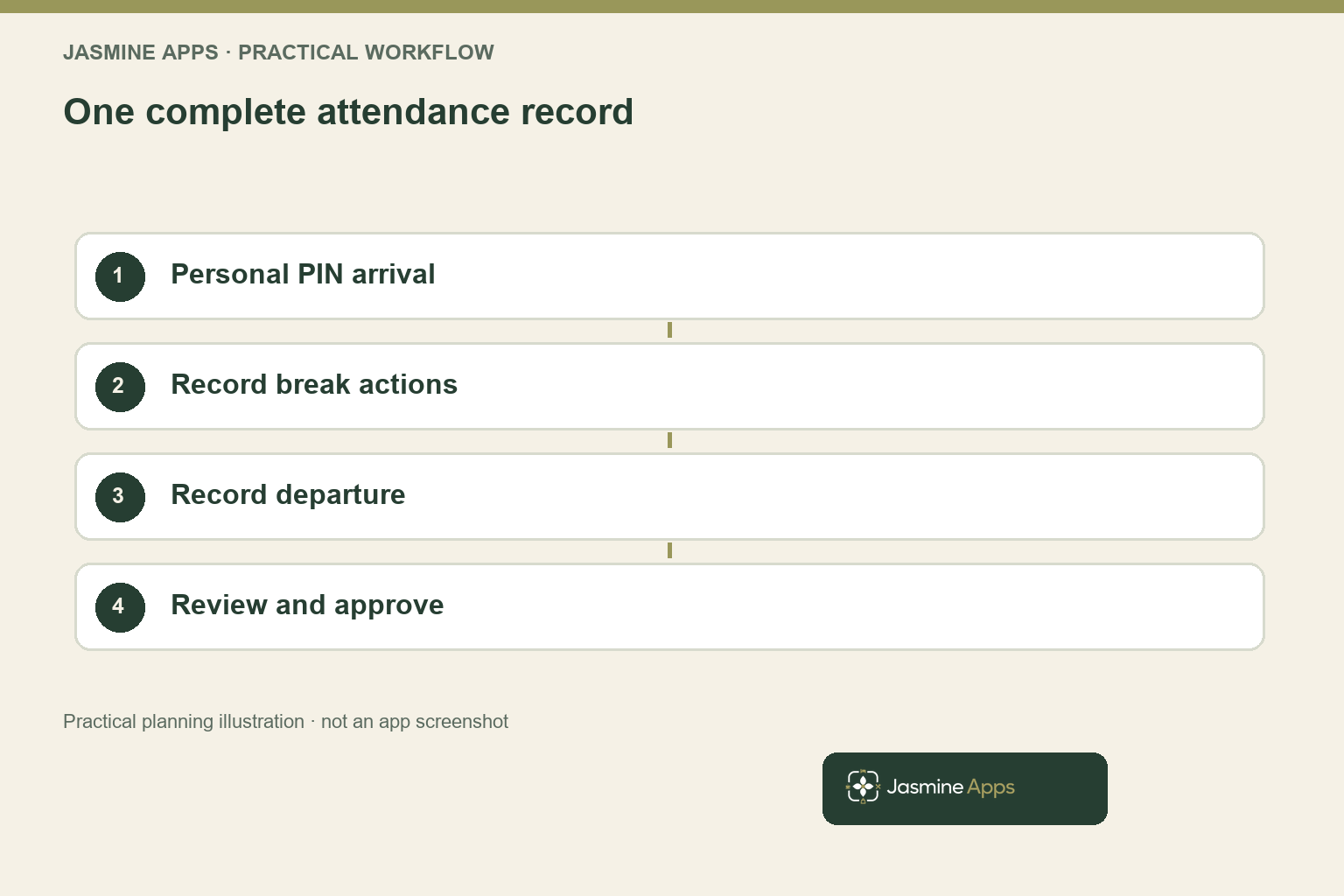
Your paper process may look simple at the staff entrance. An employee writes a start time, adds a break later and records a departure before leaving. The manager then needs to read the entry, check missing information and transfer the approved result into the attendance or payroll preparation process your venue uses.
List those steps before comparing a kiosk. Include illegible entries, late recollections, corrections and the colleague responsible for approval. You can then see where a clearer record may help and where the same managerial decision will remain, because a digital entry still needs review when the circumstances are uncertain.
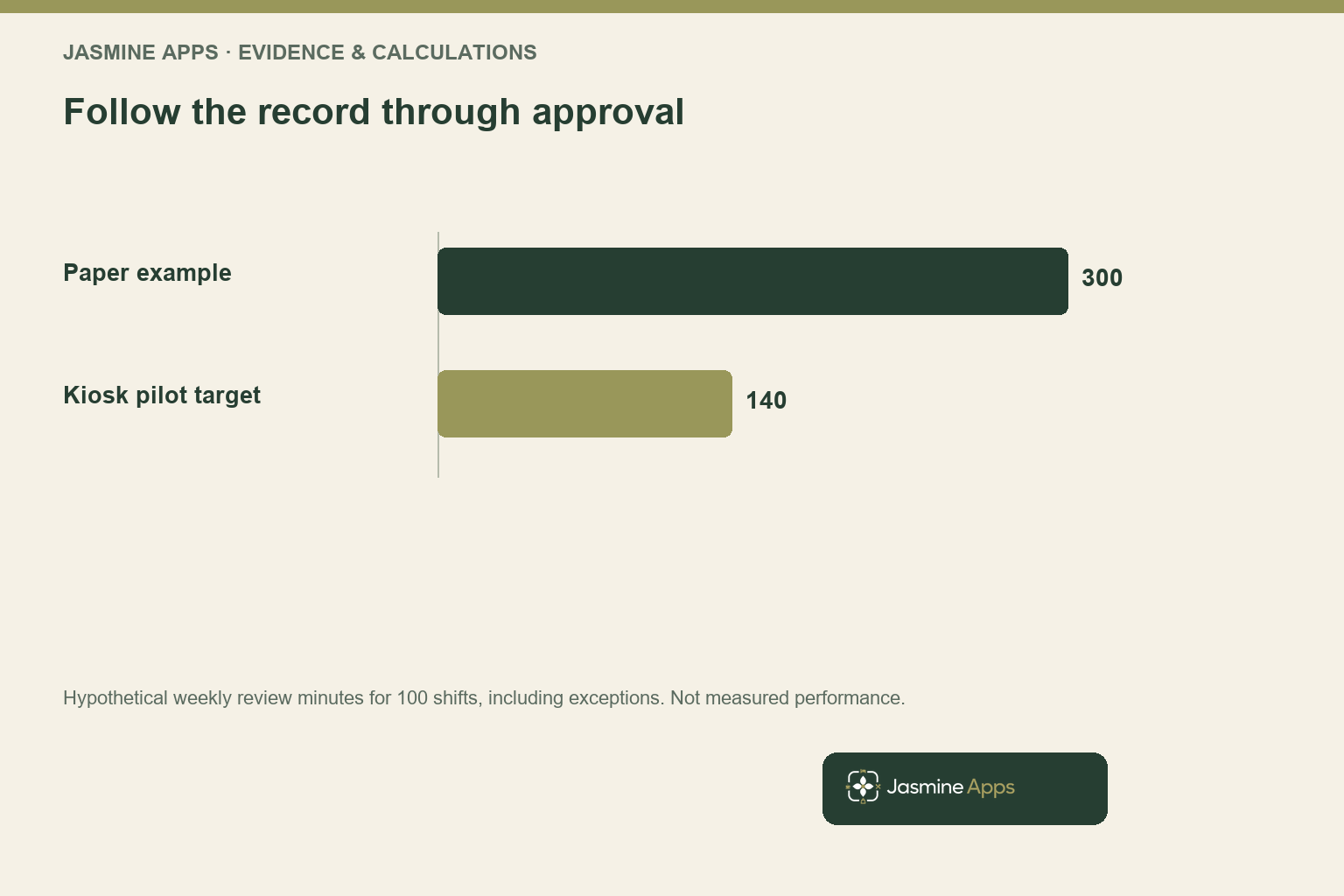
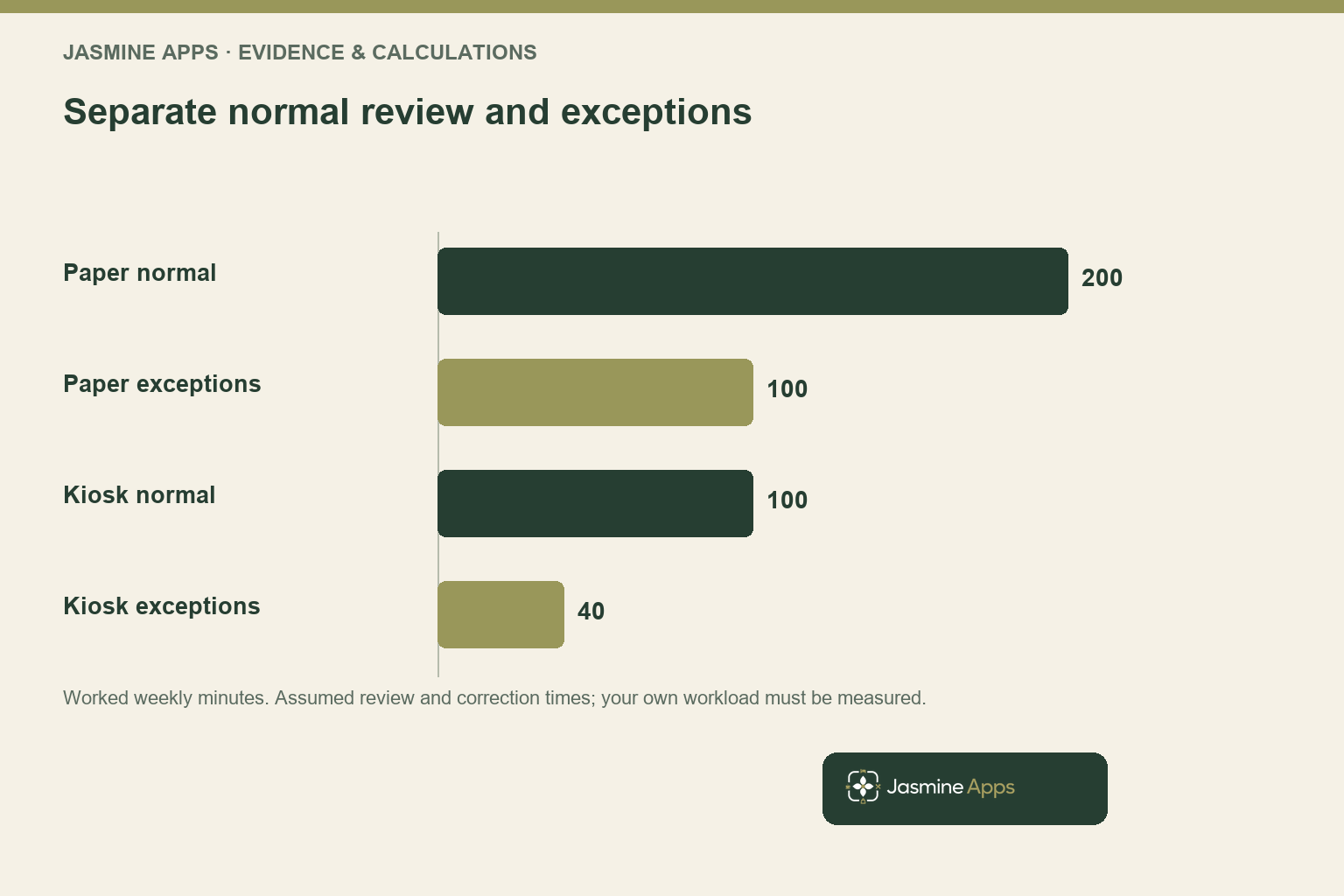
For a hypothetical weekly workload of 100 shifts, suppose reviewing the normal entries takes two minutes per shift and twenty exceptions take another five minutes each. Your total is 300 minutes, or five hours. The example shows why the exception route can matter as much as the original recording method.
Set an equally complete kiosk comparison. Measure normal review time, missing actions, correction work and any support needed at the device. If a faster arrival creates more forgotten departures, your first-stage result may look good while the approved-record process gets worse; keep the start and finish of the measurement unchanged.
Your hospitality payroll preparation guide covers the later handover. Use it to identify the record your supervisor actually needs to produce. A useful attendance change leaves that colleague with clearer information and a dependable decision route, while your employees know what to do at arrival, during breaks and when leaving.
Test PIN clock-in versus paper timesheets during breaks
A complete shift record includes the break actions your setup requires. Your employees need to understand whether they record the start and end of a break, where they do it and what to do if they forget. Your manager also needs a review process that fits the actual working pattern rather than silently treating every gap as correct.
Clock Jasmine Kiosk uses personal PINs for clock-in, clock-out and break actions. Demonstrate those actions with fictional records on the device you intend to install. Check the normal screen, the response after an action and the route back to the starting point, so staff can see whether the record has been captured.
For adult workers, GOV.UK’s rest-break overview describes the general twenty-minute uninterrupted break entitlement when working more than six hours, with relevant exceptions. Your attendance process should support the rules and working arrangements that apply to your team. Recording a break does not itself establish that the break was properly taken.
In the worked comparison, suppose normal kiosk review takes one minute across 100 shifts and ten exceptions need four minutes each. That gives 140 minutes, compared with the paper example’s 300. The 160-minute difference is a hypothetical target to investigate, not a performance promise or a reason to approve records without checking them.
Ask your supervisor to review a missed break action, a forgotten departure and an incorrect entry. You can then evaluate whether the complete correction is clear, who can make it and how the final record is approved. The most useful setup is the one your team can follow reliably during a real working day.
Make PIN clock-in versus paper timesheets usable at the entrance
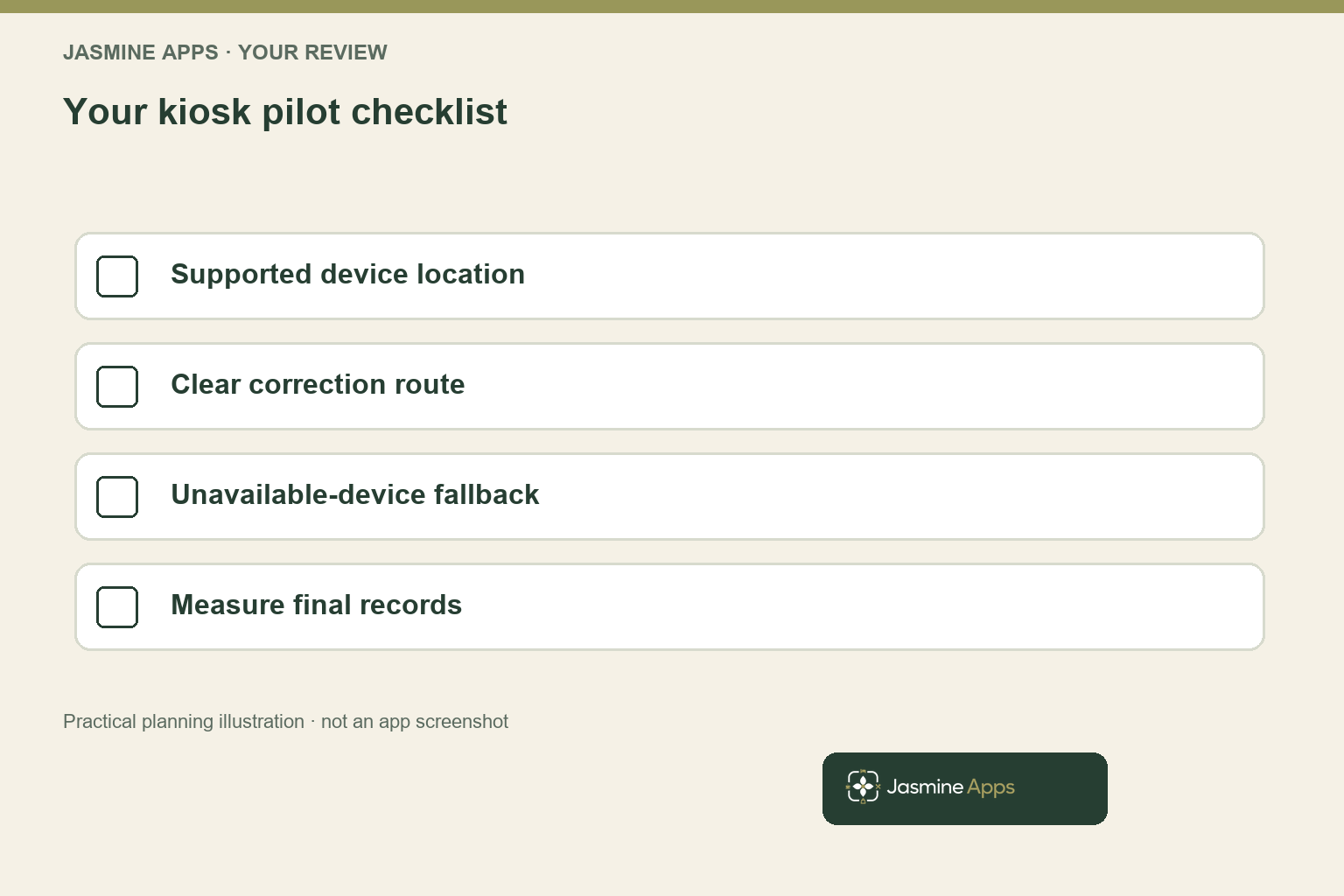
Your device location affects whether employees use it consistently. Put the kiosk on the normal arrival and departure route, with suitable power, connectivity and physical protection. Check visibility and access for the people who will use it, including colleagues arriving together before a busy service or leaving after close.
Keep PINs personal and follow your organisation’s access process. Staff should know how to report a forgotten PIN or a device problem without sharing another colleague’s code. Your demonstration can use fictional identities to explore those routes, while the manager confirms the permissions and responsibilities needed for a correction.
Device capacity is a separate question from timesheet review. Your staff clock-in queue guide explores arrival demand at a shared kiosk. Here, test whether the location and instructions help each person complete the right actions throughout the shift, including quieter departure periods when a supervisor may not be beside the tablet.
Provide a short fallback process for unavailable equipment. Explain how an employee reports the shift, how the manager records the exception and how the information is reviewed afterwards. Confirm the supported behaviour during connectivity problems in your proposed setup; avoid assuming that every action will automatically synchronise under every failure condition.
Jasmine Apps currently lists Kiosk at £5 per venue monthly as an extension to Clock Jasmine, which starts at £1 per employee monthly with a £25 minimum. Add the tablet, installation, setup and tax basis to your quote. You can then assess the complete attendance route against the supervisor work and record quality you intend to improve.
Choose the attendance route your team can sustain
Start with a representative team and a clear review period. Explain the actions, correction route and fallback before the pilot begins, then allow time for staff to learn the device. Record initial support separately from normal recurring work so you can see both adoption effort and the process your supervisor will manage later.
Keep a small measurement set: completed shift records, exceptions, review minutes and questions requiring help. Add the reason for each exception, using appropriate access and minimal personal detail. A weekly pattern of missed departures may call for better device placement or instructions rather than another feature or a stricter attendance message.
Compare the pilot with paper using the same approval standard. Your manager should not skip checks simply to make the digital method look faster. The useful outcome is a clearer, reviewable record with less avoidable reconciliation, while genuine exceptions still receive the attention needed to handle them correctly.
Value any time released carefully. In the hypothetical example, 160 minutes weekly amounts to ten hours and forty minutes over four weeks. If paid hours remain unchanged, that is supervisor capacity for other work; a cash saving requires an actual expense reduction. Include subscription and device costs separately when making the buying decision.
At the end of the pilot, ask staff and the supervisor what became easier and what remains unclear. Adjust the instructions, placement or review responsibilities before expanding. A sustainable attendance process should be understandable on an ordinary Tuesday and at the end of your busiest service, with a workable route from the first action to the final approved record.
Pro Tips
Use the same finish line. Compare both methods at the point where the shift record is ready for the next approved handover. Stopping the kiosk measurement at clock-in hides the review work your supervisor still needs to do.
Classify exceptions. Separate forgotten actions, device problems and genuine working-pattern changes. Each needs a different improvement, so the reason is more useful than a single error count.
Check the departure route. Watch where employees leave after closing and whether the device remains accessible. A convenient arrival point can still be easy to miss at the end of the shift.
Common Mistakes
Sharing personal PINs. You weaken the connection between the employee and the attendance action. Give staff a clear access-help route and keep codes personal.
Approving every digital entry automatically. You can carry mistakes into the next handover. Use the same review standard for uncertain records, regardless of how they were captured.
Ignoring the underlying plan and hardware. You underestimate the full cost by counting only the £5 extension. Include Clock, the supported device, installation and any relevant setup charges.
Frequently Asked Questions
Are digital timesheets always better than paper?
Your answer depends on the complete process and the people using it. Digital recording can make attendance actions more structured, but a poorly placed device or unclear correction route can create new work. Compare normal entries, missing actions, review time and the final approved record using the same standard. Your best route is the one staff can follow consistently and your supervisor can maintain without unnecessary reconciliation each week.
What does Clock Jasmine Kiosk record?
Your kiosk workflow uses personal PINs for clock-in, clock-out and break actions as an extension of Clock Jasmine. Demonstrate the exact screens and resulting attendance records with fictional identities before rollout. Check corrections, permissions and any unavailable-device scenario in your proposed setup. Your supervisor should understand how the captured actions become a reviewed record and which decisions still need their approval before the next handover to payroll preparation.
Can a PIN kiosk prove that a staff member took a proper break?
Your recorded action is useful information, but it does not by itself establish how the break was taken. Your manager needs working arrangements and reviews that fit the applicable rules and actual shift. Demonstrate missed or incorrect break entries and agree who handles them. Keep the recording process understandable for staff, with a clear way to raise a problem rather than silently treating every digital action as complete proof of compliance.
How do you compare paper and kiosk administration time?
You measure from attendance recording through the completed approval stage for the same type of shifts. Count normal review, exceptions, corrections and device support, including work another colleague performs. Separate one-off learning from recurring administration and keep your approval standard consistent. A reduction in minutes represents useful supervisor capacity; describe a cash saving only where you can identify an actual reduction in paid expenditure after introducing the new process.
How much does a Clock Jasmine Kiosk setup cost?
Jasmine Apps currently lists the Kiosk extension at £5 per venue monthly or £50 annually, in addition to Clock Jasmine. Clock’s monthly price is £1 per employee with a £25 minimum. Your full quotation should confirm the supported device, installation, setup, annual minimum treatment and taxes. Compare that complete scope with the attendance-review work you intend to improve, rather than treating the extension price as the whole deployment cost.
PIN clock-in versus paper timesheets: your next step
Your PIN clock-in versus paper timesheets decision should make the whole shift easier to review. Request a Clock Jasmine Kiosk demonstration covering arrival, breaks, departure and a correction. You can leave with a practical attendance route, a complete quotation and a pilot that measures the work your supervisor actually needs to finish.